
Gavrilo Princip Biography Quotes 3 Report mistakes
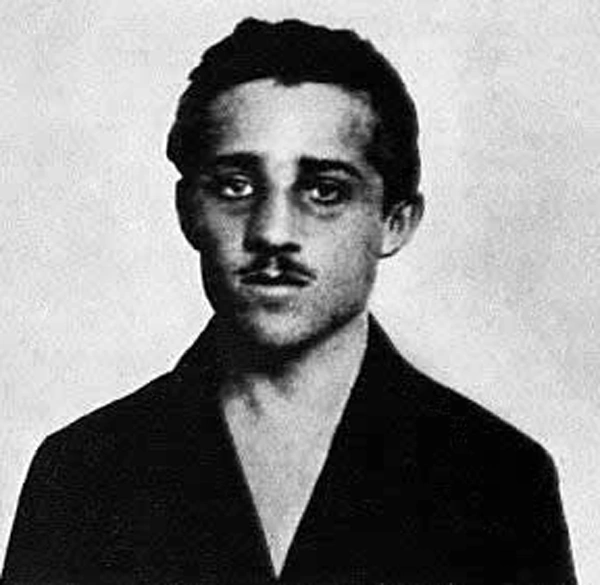
| 3 Quotes | |
| Occup. | Revolutionary |
| From | Hungary |
| Born | July 25, 1894 Obljaj, Bosnia and Herzegovina, Austria-Hungary |
| Died | April 28, 1918 Terezín, Bohemia, Austria-Hungary |
| Aged | 23 years |
| Cite | |
Citation Formats
APA Style (7th ed.)
Gavrilo princip biography, facts and quotes. (2026, February 11). FixQuotes. https://fixquotes.com/authors/gavrilo-princip/
Chicago Style
"Gavrilo Princip biography, facts and quotes." FixQuotes. February 11, 2026. https://fixquotes.com/authors/gavrilo-princip/.
MLA Style (9th ed.)
"Gavrilo Princip biography, facts and quotes." FixQuotes, 11 Feb. 2026, https://fixquotes.com/authors/gavrilo-princip/. Accessed 26 Mar. 2026.
Early Life and Background
Gavrilo Princip was born on July 25, 1894, in the village of Obljaj near Bosansko Grahovo, in Bosnia under Austro-Hungarian administration, to a poor Serb farming family. The region lived with layered loyalties and pressures - Ottoman memories, Habsburg bureaucracy, and South Slavic national awakenings - all sharpened by land poverty and political subordination. Princip grew up in a household where survival depended on hard rural labor, and where dignity was frequently negotiated in the face of officials, taxes, and the quiet humiliations of being governed from afar.His childhood coincided with the 1908 annexation of Bosnia and Herzegovina by Austria-Hungary, an event that transformed local resentment into organized nationalist agitation. For many young Bosnian Serbs, Croats, and Muslims, the empire represented both modern order and foreign domination; the contradiction was formative. Princip was slight in build and often ill, yet intensely inward and stubbornly purposeful, absorbing the talk of nationhood and injustice that traveled through schools, cafes, and clandestine circles more quickly than it could be policed.
Education and Formative Influences
As a teenager Princip left the countryside for schooling in Sarajevo and later drifted toward Belgrade, where Serbian nationalist youth networks, reading societies, and revolutionary romanticism gave language to his anger. He read widely for someone of his station - literature and political writings that framed sacrifice as historical necessity - and he encountered the culture of conspiratorial activism that flourished in the shadow of imperial surveillance. This was the era of assassinations and propaganda by deed across Europe, and Princip was drawn to the belief that a single decisive act could puncture an empire and redeem a people.Career, Major Works, and Turning Points
Princip is remembered not for a body of work but for one catalytic moment: the assassination of Archduke Franz Ferdinand and his wife Sophie in Sarajevo on June 28, 1914. Recruited into the Young Bosnia milieu and linked, through arms and logistics, to elements of the Serbian Black Hand network, he joined a small team positioned along the Archduke's route. After an earlier bomb attempt failed, a wrong turn brought the royal car within feet of Princip near the Latin Bridge; he fired, mortally wounding the couple. Arrested immediately, he became the centerpiece of the Sarajevo trial, where his youth spared him execution under Habsburg law but consigned him to harsh imprisonment. He died on April 28, 1918, in the fortress prison at Theresienstadt (Terezin), emaciated and ill with tuberculosis, as the war his act helped ignite consumed the old order.Philosophy, Style, and Themes
Princip's inner life fused peasant grievance with a bookish, absolutist moral imagination. He framed himself as a rural son speaking for the unheard, insisting, “I am the son of peasants and I know what is happening in the villages. That is why I wanted to take revenge, and I regret nothing”. The sentence is less a confession than a self-portrait: he cast violence as retributive justice for structural misery, and he guarded against doubt by converting suffering into mandate. His nationalism was not merely ethnic pride but a demand for political agency - a belief that liberation required personal negation, even martyrdom.Yet his testimony also reveals a striking dissociation at the moment of action, a psychological narrowing that often accompanies extremist resolve. “I aimed at the Archduke. I do not remember what I thought at that moment”. The claim suggests not cold calculation but a trance-like submission to a role already rehearsed in imagination and group expectation. Even his description of the shooting is stripped of triumph: “I only know that I fired twice, or perhaps several times, without knowing whether I had hit or missed”. That uncertainty exposes how the symbolic weight later attached to the event exceeded the lived experience of the shooter - a few seconds of chaos that history would convert into a lever.
Legacy and Influence
Princip's legacy is inseparable from the chain reaction that followed: Austria-Hungary's ultimatum to Serbia, the July Crisis, and the outbreak of World War I, which shattered empires and redrew Europe. He has been alternately enshrined as a freedom fighter in Yugoslav and some Serbian narratives, condemned as a terrorist in others, and interpreted by historians as a symptom of a broader era of nationalist volatility and imperial rigidity. Monuments, plaques, and renamed streets have come and gone with regimes, reflecting how his meaning is fought over rather than settled. In the end, Princip endures less as an individual biography than as a mirror in which societies argue about legitimacy, violence, and the terrible efficiency with which a young revolutionary can collide with an overstrained world.Our collection contains 3 quotes written by Gavrilo, under the main topics: Justice - War.
Other people related to Gavrilo: Ivo Andric (Writer)
Source / external links