
Georg C. Lichtenberg Biography Quotes 60 Report mistakes
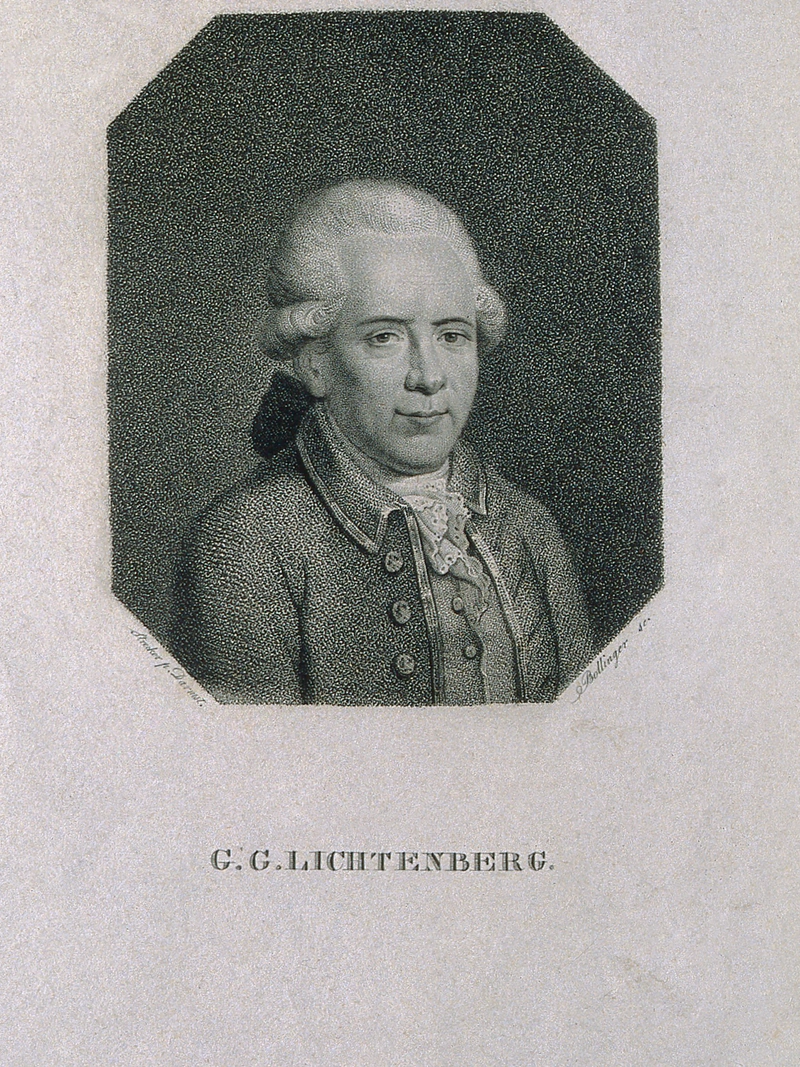
| 60 Quotes | |
| Born as | Georg Christoph Lichtenberg |
| Known as | Georg Christoph Lichtenberg; G. C. Lichtenberg |
| Occup. | Scientist |
| From | Germany |
| Born | July 1, 1742 Ober-Ramstadt, Hesse-Darmstadt |
| Died | February 24, 1799 Goettingen |
| Aged | 56 years |
| Cite | |
Citation Formats
APA Style (7th ed.)
Georg c. lichtenberg biography, facts and quotes. (2026, February 11). FixQuotes. https://fixquotes.com/authors/georg-c-lichtenberg/
Chicago Style
"Georg C. Lichtenberg biography, facts and quotes." FixQuotes. February 11, 2026. https://fixquotes.com/authors/georg-c-lichtenberg/.
MLA Style (9th ed.)
"Georg C. Lichtenberg biography, facts and quotes." FixQuotes, 11 Feb. 2026, https://fixquotes.com/authors/georg-c-lichtenberg/. Accessed 26 Mar. 2026.
Early Life and Background
Georg Christoph Lichtenberg was born on 1 July 1742 in Ober-Ramstadt, in the Landgraviate of Hesse-Darmstadt, a small German state whose learned culture depended on court patronage and church schooling. He was the seventeenth child of a Protestant pastor, Johann Conrad Lichtenberg, and his wife, Henriette Catharina Eckhard. The household was pious and bookish but financially strained; the father died when Georg was still a boy, leaving the family precarious and making scholarship not a luxury but a lifeline.Illness shaped his inner life early. A spinal deformity (likely kyphoscoliosis) left him short, in pain, and visibly different in a society that treated bodily irregularity as moral spectacle. Rather than retreat, he cultivated an alert, defensive wit and a keen eye for the social theater around him - the glances, the etiquette, the hypocrisies. That lifelong sensitivity to how people manage appearances would become as central to his thinking as any experiment.
Education and Formative Influences
After local schooling in Darmstadt, Lichtenberg studied at the University of Goettingen, the new Hanoverian university founded in 1737 and rapidly becoming a hub of Enlightenment science and letters. He trained in mathematics and physics, absorbing the Newtonian turn that made measurement, instruments, and probability the language of nature. Goettingen also immersed him in British intellectual culture; he learned English, read widely, and later served as a mediator of British science to German readers - a role strengthened by his two journeys to England (1770 and 1774-1775), where he witnessed experimental physics in public lecture halls and encountered a society that combined commerce, empiricism, and satire in ways that suited his temperament.Career, Major Works, and Turning Points
Lichtenberg spent his adult life at Goettingen, rising from a modest post to professor of experimental physics and a celebrated lecturer who treated demonstrations as moral and epistemic dramas. He published scientific writings on instrumentation and phenomena such as electricity, introduced students to careful measurement, and helped establish standards of experimental practice; his name remains attached to the branching electrical patterns called Lichtenberg figures, first produced when he investigated electrostatic discharges. Yet his most original literary work stayed private: the Sudelbuecher (waste books), notebooks he kept from the late 1760s until his death, filled with aphorisms, sketches, scientific observations, and self-interrogations. A major turning point was his encounter with English culture - Hogarth in particular - which sharpened his sense that satire could be an instrument of knowledge; his later commentaries on Hogarth and his own aphoristic style fused moral psychology with the habits of an experimentalist. He died in Goettingen on 24 February 1799, leaving behind both published science and a posthumous literary masterpiece.Philosophy, Style, and Themes
Lichtenberg belonged to the Enlightenment, but he was its uneasy conscience. He distrusted system-building and preferred the probe, the marginal note, the test case. His notebooks model a mind that refuses to let concepts harden into idols: doubt is necessary, but it must remain functional rather than theatrical. “Doubt must be no more than vigilance, otherwise it can become dangerous”. For him, skepticism was like a laboratory control - a disciplined check on error, not a pose of superiority. This is why his prose often moves by sudden turns: he sets a thought in motion, observes its consequences, then interrupts it before it becomes dogma.His satire is not cruelty but diagnosis, aimed as much at himself as at others. He treated moral life as a study in concealed motives, social masks, and the mind's self-protective fictions: “Every man has his moral backside which he refrains from showing unless he has to and keeps covered as long as possible with the trousers of decorum”. That frank image captures his psychological realism - the sense that virtue is often a choreography, and that embarrassment is a powerful governor of behavior. Yet he also saw history propelled by the small and the disregarded, by the unnoticed lever rather than the grand plan: “The human tendency to regard little things as important has produced very many great things”. The line is characteristic of his double vision: he mocks petty seriousness while admitting that civilization is built from it.
Legacy and Influence
Lichtenberg's scientific reputation rests on his teaching, his empirical ethos, and the electrical figures that carry his name, but his enduring cultural force comes from the Sudelbuecher, which made the aphorism a modern instrument - part observation, part experiment, part confession. He influenced later German prose and thought by demonstrating that intellectual honesty can be fragmentary without being shallow, and that clarity can be sharpened by humor rather than dulled by solemnity. In an age that prized systems, he left a model of the thinker as instrument-maker: calibrating language, testing motives, and refusing to confuse the elegance of an idea with the truth of the world.Our collection contains 60 quotes written by Georg, under the main topics: Witty One-Liners - Ethics & Morality - Truth - Wisdom - Justice.