
Georg Wilhelm Friedrich Hegel Biography Quotes 21 Report mistakes
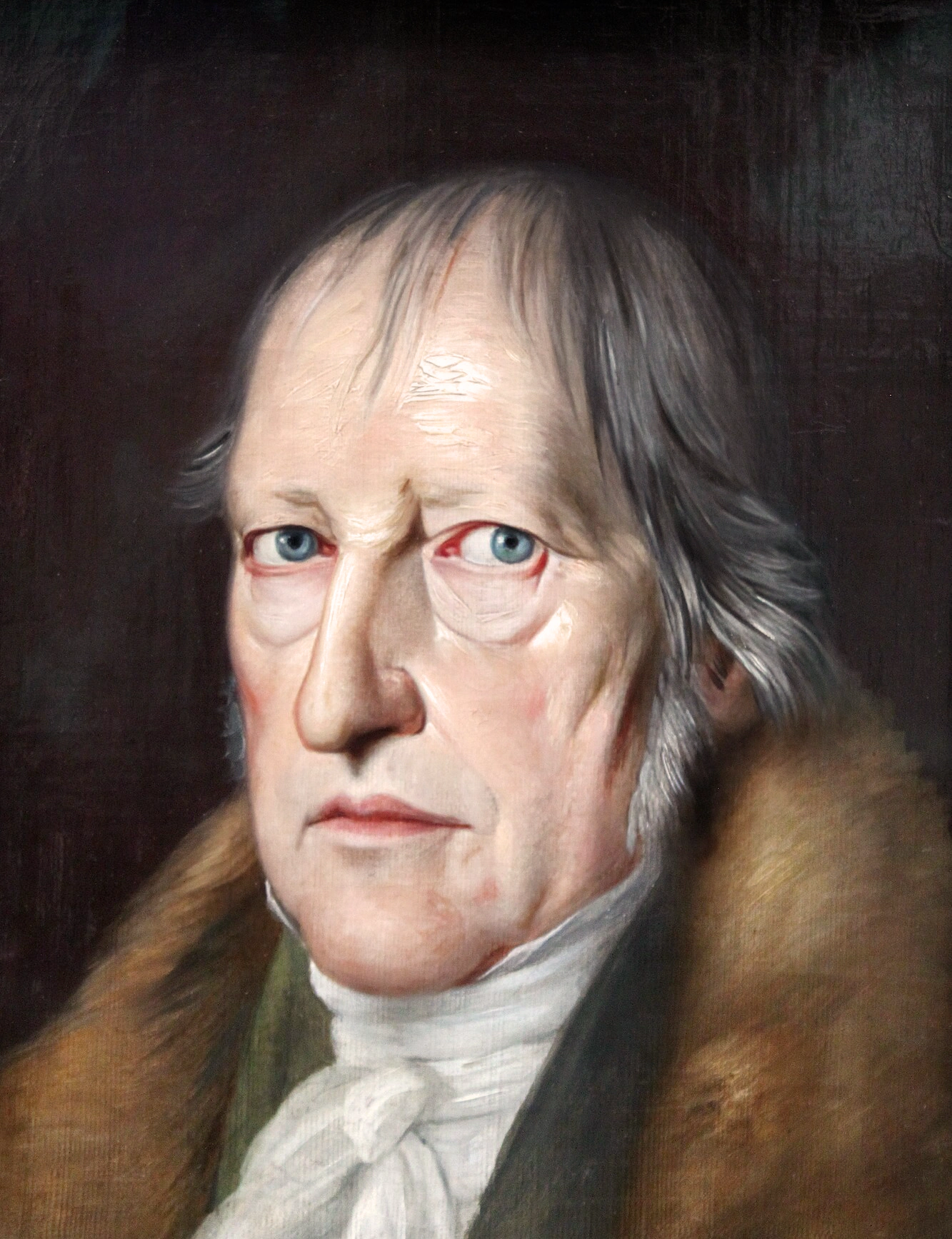
| 21 Quotes | |
| Occup. | Philosopher |
| From | Germany |
| Spouse | Marie Helena Susanna von Tucher (1811) |
| Born | August 27, 1770 |
| Died | November 14, 1831 |
| Aged | 61 years |
| Cite | |
Citation Formats
APA Style (7th ed.)
Georg wilhelm friedrich hegel biography, facts and quotes. (2026, February 11). FixQuotes. https://fixquotes.com/authors/georg-wilhelm-friedrich-hegel/
Chicago Style
"Georg Wilhelm Friedrich Hegel biography, facts and quotes." FixQuotes. February 11, 2026. https://fixquotes.com/authors/georg-wilhelm-friedrich-hegel/.
MLA Style (9th ed.)
"Georg Wilhelm Friedrich Hegel biography, facts and quotes." FixQuotes, 11 Feb. 2026, https://fixquotes.com/authors/georg-wilhelm-friedrich-hegel/. Accessed 6 Mar. 2026.
Early Life and Background
Georg Wilhelm Friedrich Hegel was born on August 27, 1770, in Stuttgart in the Duchy of Wurttemberg, a Protestant territory in the Holy Roman Empire marked by civil-service discipline and pietist moral seriousness. His father, Georg Ludwig Hegel, worked in the ducal financial administration; the household belonged to the educated middle strata that prized order, study, and advancement through state institutions. Hegel grew up amid the administrative rationality and religious earnestness that would later reappear, transfigured, in his defense of ethical life (Sittlichkeit) and his suspicion of merely private morality.Childhood losses and the texture of late Enlightenment Swabia shaped his inwardness. His mother, Maria Magdalena Louisa, died when he was a teenager, leaving a muted grief that contemporaries sensed as reserve rather than sentimentality. Stuttgart also gave him early access to Latin classics and the civic language of law and history - an apprenticeship in seeing human life as organized, public, and answerable to institutions, not just to personal conscience.
Education and Formative Influences
From 1788 Hegel studied at the Tubinger Stift, the Protestant seminary attached to the University of Tubingen, where he formed a fateful triangle of friendships with Friedrich Holderlin and Friedrich Wilhelm Joseph Schelling. The French Revolution erupted during their student years, and Hegel followed it with a mixture of excitement and anxiety, learning early that freedom could arrive as both liberation and terror. At Tubingen he absorbed Kant and the debates over reason, faith, and autonomy, while his private notebooks reveal a young thinker moving from theological concerns toward a philosophical account of community, history, and the conditions under which modernity could reconcile subjective freedom with shared life.Career, Major Works, and Turning Points
After working as a private tutor in Bern (1793-1796) and Frankfurt (1797-1800), Hegel entered the philosophical world at Jena, where he taught and co-edited the Critical Journal of Philosophy with Schelling; the Napoleonic era pressed history into his study as lived experience. His first major book, Phenomenology of Spirit (1807), appeared as Jena fell to Napoleon, and it announced his method of tracing consciousness through conflicts that generate richer forms of freedom. He then held posts as rector of a Nuremberg gymnasium (1808-1816), where he wrote the Science of Logic (1812-1816), and as professor at Heidelberg (1816-1818), publishing the Encyclopedia of the Philosophical Sciences (1817). In Berlin from 1818 he became the leading philosopher of the Prussian capital, issuing the Philosophy of Right (1821) and influential lectures on history, religion, aesthetics, and the history of philosophy; he died on November 14, 1831, during a cholera outbreak, at the height of institutional prestige and intellectual controversy.Philosophy, Style, and Themes
Hegel sought a philosophy adequate to modern life: not a morality of isolated individuals, but a rational account of how freedom becomes real in families, civil society, and the state. His dialectical style - often misread as a formula - is better understood as a disciplined attention to how a position, when taken seriously, generates tensions that demand conceptual revision. Hence his insistence that thought is not decoration laid atop facts but the medium in which facts become intelligible: “An idea is always a generalization, and generalization is a property of thinking. To generalize means to think”. The sentence also discloses his psychology as a worker of concepts, trusting patient elaboration over intuition, and wagering that clarity is earned by passing through difficulty rather than avoiding it.Yet the system is not cold. Hegel treated history as a moral arena in which deeds and institutions are tested for what they truly mean: “World history is a court of judgment”. This is both metaphysical and personal - a refusal to let private sincerity substitute for public consequence. His account of tragedy, likewise, reveals a mind fascinated by conflicts that cannot be solved by simple condemnation: “Genuine tragedies in the world are not conflicts between right and wrong. They are conflicts between two rights”. Behind his dense prose lies an ethic of seriousness: modernity must learn to recognize the rational content within opposing claims, then build institutions that can contain the collision without flattening it into mere opinion.
Legacy and Influence
Hegel's influence radiated through the nineteenth and twentieth centuries, splitting into rival heirs: Right Hegelians who read him as a theorist of the rational state, and Left Hegelians - including Feuerbach and Marx - who turned his historical logic against religion and existing authority. His imprint is deep in Marxism, historicism, hermeneutics, existentialism, critical theory, and even analytic debates about recognition and normativity; the vocabulary of alienation, recognition, ethical life, and the historical formation of selfhood bears his fingerprints. Admired and resisted in equal measure, Hegel endures because he made modern freedom answerable to time, conflict, and institutions, insisting that what we are cannot be separated from the histories that formed us and the social worlds we must continuously remake.Our collection contains 21 quotes written by Georg, under the main topics: Motivational - Ethics & Morality - Wisdom - Truth - Justice.
Other people related to Georg: Ferdinand Christian Baur (Theologian)
Frequently Asked Questions
- Hegel and marx: Marx was heavily influenced by Hegel's dialectical method, but he criticized Hegel's idealism and applied dialectics to materialism and class struggle.
- Hegel dialectic: Hegel's dialectic is a process of reasoning between contradictions (thesis and antithesis) that leads to their resolution and synthesis.
- Hegel theory of state: Hegel's theory of the state asserts that it is the embodiment of reason and the highest expression of human freedom, responsible for the formation of ethical life.
- Georg Wilhelm Friedrich Hegel philosophy of history: Hegel's philosophy of history posits that history moves in a linear, rational progression, driven by Spirit's self-development and realization of freedom.
- Hegel theory: Hegel's theory centers around the dialectical process, whereby reality develops through a series of contradictions and their resolutions, ultimately leading to the Absolute.
- Georg Wilhelm Friedrich Hegel contribution to philosophy: Hegel revolutionized philosophy with his dialectical approach, his development of the concept of spirit, and his views on history, state, and self-consciousness.
- Hegel Philosophy Summary: Hegel's philosophy is often called 'Absolute Idealism,' emphasizing the ideas of dialectics, absolute spirit, and the synthesis of contradictions.
- How old was Georg Wilhelm Friedrich Hegel? He became 61 years old
Georg Wilhelm Friedrich Hegel Famous Works
- 1835 Lectures on Aesthetics (Book)
- 1833 Lectures on the History of Philosophy (Book)
- 1820 Elements of the Philosophy of Right (Book)
- 1817 Encyclopedia of the Philosophical Sciences (Book)
- 1812 Science of Logic (Book)
- 1807 Phenomenology of Spirit (Book)
Source / external links