
George Boole Biography Quotes 5 Report mistakes
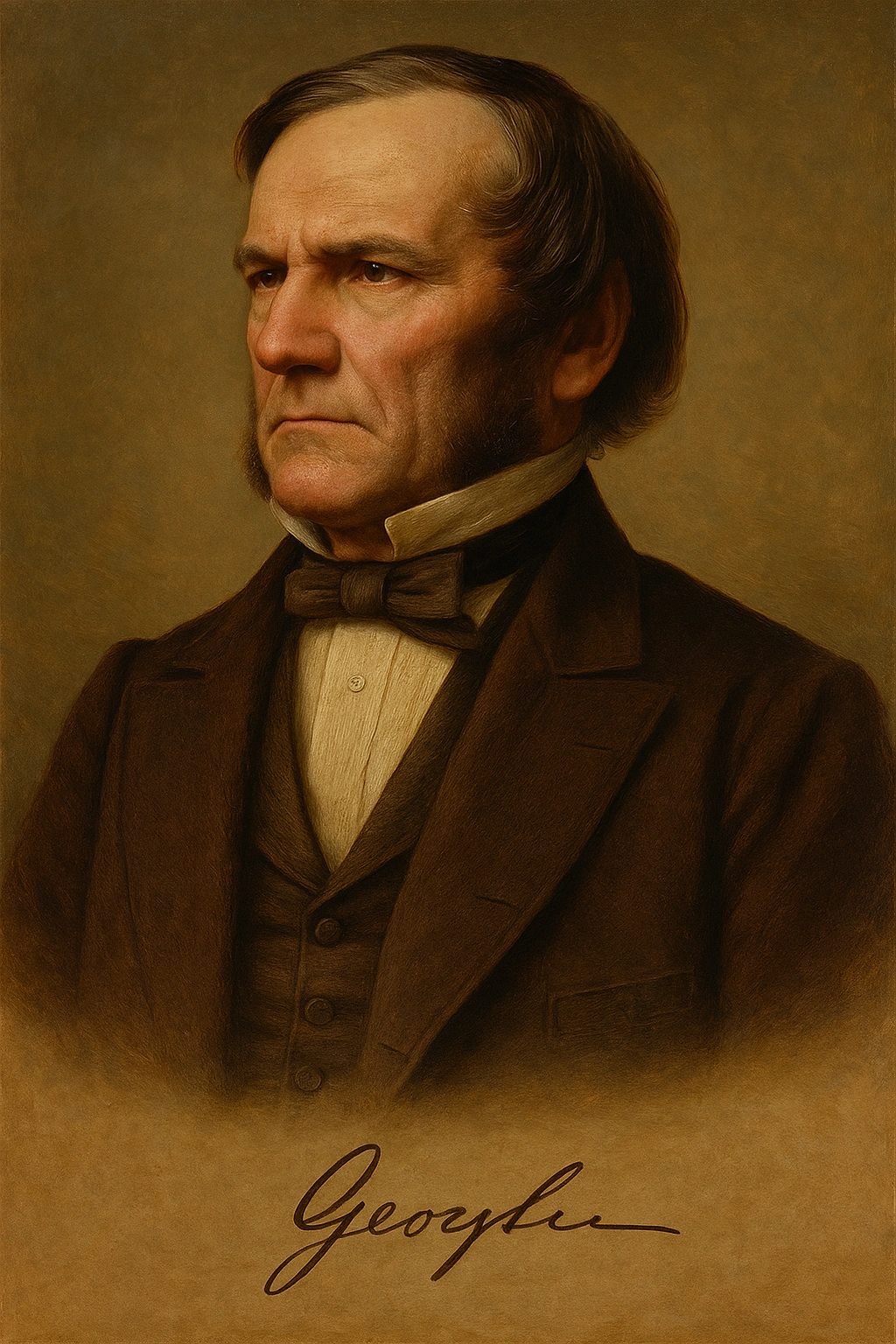
| 5 Quotes | |
| Occup. | Mathematician |
| From | Ireland |
| Born | November 2, 1815 Lincoln, England |
| Died | December 8, 1864 Ballintemple, Cork, Ireland |
| Cause | Pneumonia |
| Aged | 49 years |
| Cite | |
Citation Formats
APA Style (7th ed.)
George boole biography, facts and quotes. (2026, February 11). FixQuotes. https://fixquotes.com/authors/george-boole/
Chicago Style
"George Boole biography, facts and quotes." FixQuotes. February 11, 2026. https://fixquotes.com/authors/george-boole/.
MLA Style (9th ed.)
"George Boole biography, facts and quotes." FixQuotes, 11 Feb. 2026, https://fixquotes.com/authors/george-boole/. Accessed 12 Feb. 2026.
Early Life and Background
George Boole was born on 2 November 1815 in Lincoln, England, the eldest child of John Boole and Mary Ann Boole (nee Joyce). His father, a shoemaker by trade, had a lively interest in mathematics and scientific instruments, and he introduced his son to mathematics at an early age. The family did not have substantial means, and the young Boole combined schooling with significant self-directed study, supplemented by the intellectual curiosity he inherited from his father. From childhood he showed an aptitude for languages, learning Latin and Greek and later reading French and German mathematical texts, which broadened the range of ideas available to him beyond standard English textbooks.The household's circumstances required Boole to begin earning early. He worked as an assistant teacher in local schools around Lincoln before establishing his own schools in the 1830s. These responsibilities deepened his pedagogical skills and sharpened his appetite for systematic study. The combination of self-education, teaching, and persistent reading formed the practical foundation for his later breakthroughs.
Self-Taught Mathematician and Early Publications
Boole's mathematical trajectory crystallized when he encountered the community around the Cambridge Mathematical Journal, where Duncan F. Gregory encouraged promising contributors. Beginning in the early 1840s, Boole published a series of papers on differential operators, analysis, and the calculus of finite differences. Augustus De Morgan, one of the leading British mathematicians and logicians of the day, also corresponded with him, offering critique and support. These relationships provided intellectual companionship to a largely self-taught scholar who had not followed the usual university pathway.In 1844 Boole published a major paper, On a General Method in Analysis, in the Philosophical Transactions of the Royal Society. The work earned him a Royal Medal, a significant recognition that placed him among the foremost British mathematicians of his generation. It also established the operator methods and algebraic habits of thought that would carry over into his approach to logic.
Logic and the Laws of Thought
Boole turned to questions of logic with the conviction that reasoning itself could be expressed through algebraic symbolism. In 1847 he published The Mathematical Analysis of Logic, which advanced the revolutionary claim that logic could be treated as an algebra of classes. He developed a formal symbolism in which operations such as combination and exclusion could be represented algebraically and manipulated according to rules akin to those in algebra and analysis.His mature statement of the program appeared in 1854 as An Investigation of the Laws of Thought, on Which Are Founded the Mathematical Theories of Logic and Probabilities. There he unified his algebra of logic with a treatment of probability, laying out inequalities and methods for reasoning under uncertainty that would later be recognized as foundational. The algebraic logic he forged became the basis for what is now called Boolean algebra, in which expressions are interpreted with truth values and operations correspond to logical conjunction, disjunction, and negation. Although Boole's original formulations involved classes and elective symbols rather than the modern truth-functional apparatus, the line of descent is direct and decisive.
His work quickly attracted attention among philosophers and mathematicians of logic. Augustus De Morgan engaged critically with Boole's methods, and later figures such as William Stanley Jevons, Charles Sanders Peirce, and Ernst Schroder elaborated and generalized the ideas. The shift from syllogistic forms to algebraic logic marked a turning point in the history of logic and the eventual development of mathematical logic as a field.
Queen's College, Cork
In 1849, Boole was appointed the first professor of mathematics at the newly founded Queen's College, Cork (now University College Cork). The position brought him to Ireland, where he spent the rest of his life. The post demanded both teaching and administrative organization in a young institution, and he built a curriculum that reflected his dual interests in rigorous analysis and foundational questions. Despite his lack of a university degree, his published work and the respect of leading scholars had established his credentials.Boole continued to publish during his years in Cork, extending his reach beyond logic into mainstream analysis. He produced two lasting textbooks: A Treatise on Differential Equations (1859) and A Treatise on the Calculus of Finite Differences (1860). Both works distilled his earlier research into accessible form and became standard references for decades. Students and colleagues regarded him as meticulous and generous, and his careful lectures helped to consolidate mathematical teaching at the college.
Family and Personal Character
In 1855 Boole married Mary Everest, an intellectually gifted woman who had studied mathematics informally and maintained contact with leading figures such as Augustus De Morgan. She was the niece of Sir George Everest, the surveyor after whom the world's highest mountain is named. The match was both personal and intellectual: Mary Everest Boole later became a respected author on mathematical pedagogy, advocating intuitive and experiential methods for teaching children. Together they had five daughters: Mary Ellen, Margaret, Alicia, Lucy, and Ethel Lilian. Alicia Boole Stott became noted for her work on the geometry of higher-dimensional polytopes, and Ethel Lilian Voynich became a celebrated novelist. Lucy Everest Boole pursued chemistry, and the family as a whole remained engaged with scientific and literary pursuits.Boole's temperament combined modesty with an intense drive for clarity. Friends and correspondents, including De Morgan and Duncan F. Gregory, recognized in him both originality and independence. He wrote with an aim to uncover the structure beneath technique, often seeking unifying principles rather than isolated results. Those who knew him in Cork remembered his kindness and his concern for students as well as his commitment to the new college.
Final Illness and Death
In late 1864, after exposure to harsh weather en route to a lecture, Boole fell seriously ill. His condition worsened rapidly, and he died on 8 December 1864 in County Cork. Contemporary accounts described a lung-related illness consistent with pneumonia. He was buried in Cork, and the academic community mourned the loss of a scholar whose career had seemed to reach new heights with each successive publication.Legacy and Influence
The impact of Boole's ideas on modern science and technology is profound. Boolean algebra provided a conceptual bridge between logic and algebra that later enabled the symbolic design of circuits and computation. In the twentieth century, Claude Shannon showed that switching circuits could be analyzed and optimized using Boolean algebra, an insight that underpins digital electronics and computer engineering. From symbolic logic to programming languages and hardware design, the vocabulary and techniques of Boole's algebra now permeate the digital world.Within mathematics, his work on finite differences, differential equations, and probability left enduring tools. The inequalities and bounds he derived for probabilities of unions of events continue to be part of probabilistic reasoning, and his textbooks influenced generations of analysts. In logic, the tradition he helped found developed into a rich edifice, extending to model theory, proof theory, and the algebraic study of logical systems.
Equally lasting is the example of his life. Guided initially by the curiosity of his father, supported and challenged by figures such as Duncan F. Gregory and Augustus De Morgan, and sustained by a vibrant partnership with Mary Everest Boole, George Boole rose from modest circumstances to transform the language of reasoning. His years in Ireland as the first professor of mathematics at Queen's College, Cork anchored his contributions in an academic community that benefited from his energy and vision. The combination of rigorous analysis, symbolic invention, and educational commitment defines his place in the canon of nineteenth-century mathematics, and his name has become synonymous with the algebra of logic that structures modern computation.
Our collection contains 5 quotes written by George, under the main topics: Reason & Logic.
Frequently Asked Questions
- Where did George Boole live: Born in Lincoln, England; lived and worked in Cork, Ireland
- George Boole family: Married to Mary Everest; had five children
- George Boole education: Primarily self-taught; studied mathematics independently
- George Boole contributions to mathematics: Developed Boolean algebra and advances in symbolic logic
- How did George Boole die: Pneumonia, after walking in the rain and teaching in wet clothes
- What is George Boole famous for: Founding Boolean algebra and impacting digital circuit design
- George Boole contribution to computer: Foundation of digital logic through Boolean algebra
- George Boole invention: Boolean algebra
- How old was George Boole? He became 49 years old
George Boole Famous Works
- 1860 A Treatise on the Calculus of Finite Differences (Book)
- 1859 A Treatise on Differential Equations (Book)
- 1854 An Investigation of the Laws of Thought (Book)
- 1847 The Mathematical Analysis of Logic (Book)
Source / external links