
George Foreman Biography Quotes 20 Report mistakes
| 20 Quotes | |
| Born as | George Edward Foreman |
| Occup. | Athlete |
| From | USA |
| Born | January 10, 1949 Marshall, Texas |
| Age | 77 years |
| Cite | |
Citation Formats
APA Style (7th ed.)
George foreman biography, facts and quotes. (2026, February 11). FixQuotes. https://fixquotes.com/authors/george-foreman/
Chicago Style
"George Foreman biography, facts and quotes." FixQuotes. February 11, 2026. https://fixquotes.com/authors/george-foreman/.
MLA Style (9th ed.)
"George Foreman biography, facts and quotes." FixQuotes, 11 Feb. 2026, https://fixquotes.com/authors/george-foreman/. Accessed 25 Mar. 2026.
Early Life and Background
George Edward Foreman was born on January 10, 1949, in Marshall, Texas, and grew up in Houston's Fifth Ward, a segregated, hard-scrabble world where pride and scarcity lived side by side. He was raised by his mother, Nancy Reaves, and a stepfather he long believed was his biological father; the later discovery that J.D. Foreman was his biological father added a private undertow to a boy already learning to measure himself against instability. Foreman often framed his origins without romance: “When I was a kid in Houston, we were so poor we couldn't afford the last 2 letters, so we called ourselves po'”.In his teens he drifted into petty crime and street fights, huge for his age, quick to anger, and hungry for respect he did not yet know how to earn. The civil rights era promised change, but neighborhoods like his still ran on informal power, and a reputation could be a kind of currency. Foreman later described that early toughness as both armor and trap - it made him formidable, yet it also kept him from imagining a life built on discipline rather than impulse.
Education and Formative Influences
Foreman left school early and entered the Job Corps, first in Texas and then in California, where counselors steered him toward boxing as a structure for his force. Under trainer Doc Broadus and later the influential Dick Sadler, he learned that the ring rewarded obedience to craft, not just intimidation; footwork, timing, and conditioning became a substitute education. The program also gave him his first sustained experience of adult mentorship, and it reshaped his self-concept from feared teenager to coached athlete with a future he could plan.Career, Major Works, and Turning Points
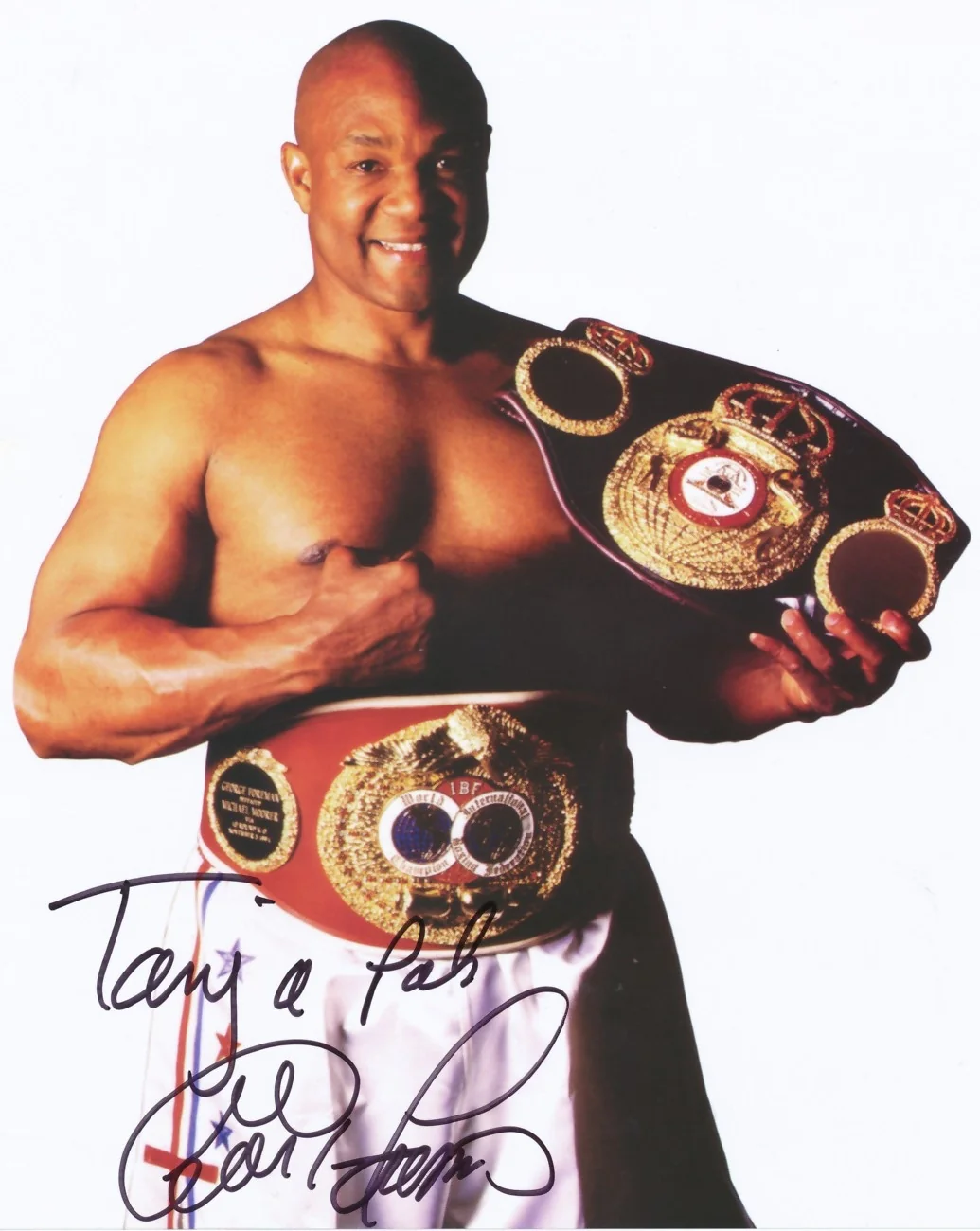
A rapid ascent followed: Foreman won the heavyweight gold medal at the 1968 Mexico City Olympics, turning raw power into national spectacle. As a professional he stormed through contenders and in 1973 dismantled Joe Frazier in Kingston, Jamaica, scoring six knockdowns in two rounds to seize the world heavyweight title. His aura of inevitability met its great rupture in 1974 in Kinshasa, Zaire, where Muhammad Ali's "rope-a-dope" and psychological pressure culminated in Foreman's knockout loss in the eighth round - a public defeat that became an inner crisis. After regaining momentum he suffered a second defining loss to Jimmy Young in 1977, after which he experienced a religious conversion, retired, and became an ordained minister. A decade later he returned improbably as a heavier, genial contender, and in 1994 - at age 45 - he knocked out Michael Moorer to reclaim the heavyweight championship, the oldest man ever to do so. In the 1990s he became a mass-market entrepreneur, best known for the George Foreman Grill, translating sporting trust into a durable consumer brand.Philosophy, Style, and Themes
Foreman's boxing style was built on geometry and menace: he cut the ring, leaned his weight into short, clubbing punches, and used forearms and shoulders to steer opponents into impact zones. Early Foreman fought as if certainty itself were a weapon, a mindset he later summarized with disarming simplicity: “I'm a winner each and every time I go into the ring”. Yet the Ali fight exposed how pride can calcify into predictability; the tactical lesson was obvious, but the deeper lesson was psychological - that a man can be strongest exactly where he is least flexible.The second Foreman - preacher, comeback artist, pitchman - was less about domination than about attention management: staying calm, ignoring ridicule, and letting time work for him. He articulated that skill as emotional technique rather than mysticism: “That's my gift. I let that negativity roll off me like water off a duck's back. If it's not positive, I didn't hear it. If you can overcome that, fights are easy”. Even his business ethic carried the same moral: identity is a promise that must be kept. “Put your name on something, it better be the best... you only get one shot”. Across eras, the theme is reinvention without denial - he did not erase the violent young man so much as discipline him into usefulness.
Legacy and Influence
Foreman endures as one of the heavyweight division's rare figures who belongs to multiple cultural moments: the brutal clarity of 1970s championship boxing, the faith-and-family turn of late-1970s American life, the improbable second acts of the 1990s, and the rise of athlete-as-brand. His comeback recalibrated what aging could mean in elite sport, while his entrepreneurial success became a template for credibility-driven endorsements that outlast highlight reels. In biography and memory, he remains a study in how power can mature into steadiness - and how a public career can become, over time, an argument for self-command.Our collection contains 20 quotes written by George, under the main topics: Witty One-Liners - Motivational - Victory - Sports - Resilience.
Other people related to George: Michael Moorer (Athlete), Jim Lampley (Celebrity), Larry Merchant (Writer)
Source / external links