
George III Biography Quotes 6 Report mistakes
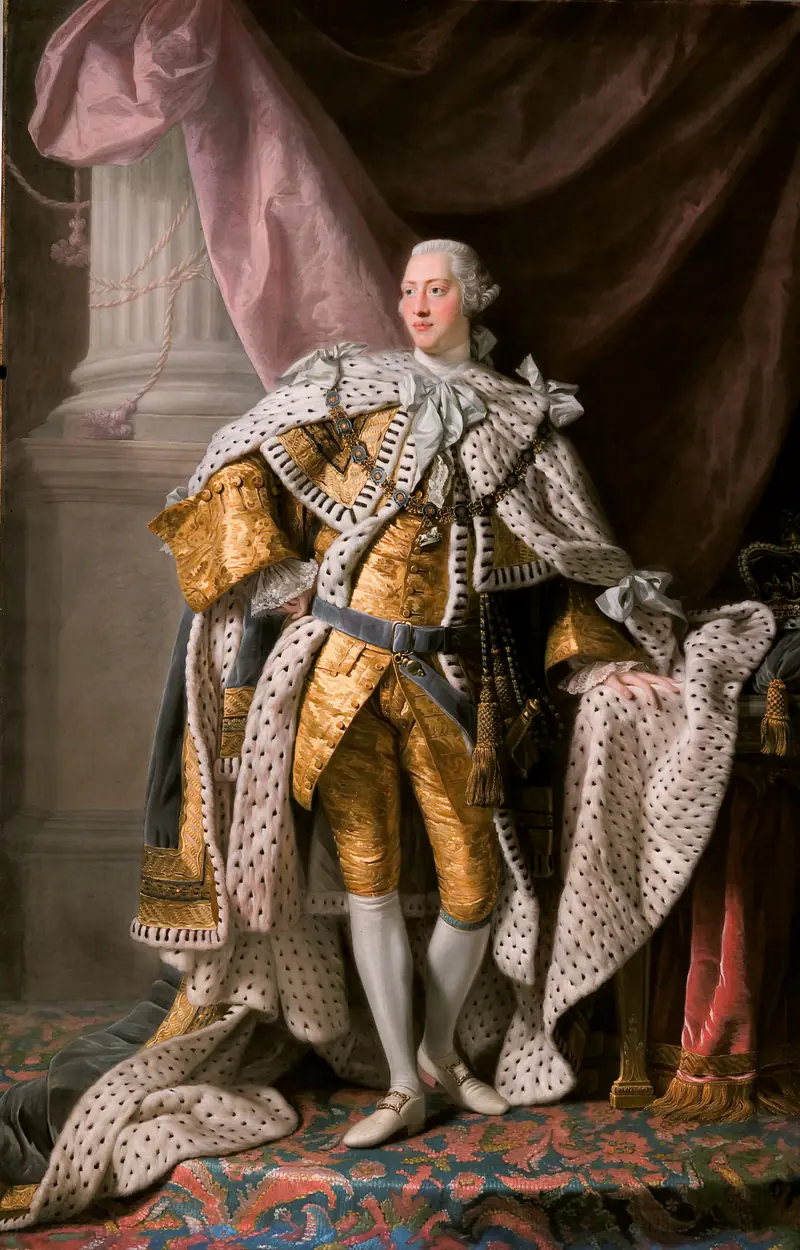
Attr: Allan Ramsay
| 6 Quotes | |
| Known as | King George III |
| Occup. | Royalty |
| From | England |
| Born | June 4, 1738 London, England |
| Died | January 29, 1820 |
| Aged | 81 years |
George III was born on 4 June 1738 in London, the grandson of King George II and the eldest son of Frederick, Prince of Wales, and Princess Augusta of Saxe-Gotha. His father died in 1751, making the young George Prince of Wales and heir apparent. Raised in Britain and speaking English as his native tongue, he was the first of the Hanoverian line to be thoroughly British in upbringing. His education was supervised by tutors chosen by his mother and by John Stuart, 3rd Earl of Bute, whose influence shaped the prince's earnest, conscientious character and his interest in science and agriculture. George III succeeded his grandfather on 25 October 1760, determined to be an active monarch who would preserve the prerogatives of the Crown while working with Parliament.
Marriage and Family
On 8 September 1761 he married Charlotte of Mecklenburg-Strelitz. The union was affectionate and stable, and together they had a very large family. Among their children were George, Prince of Wales (later George IV), Frederick, Duke of York, William (later William IV), Edward, Duke of Kent and father of the future Queen Victoria, and Ernest Augustus (later King of Hanover). Their daughters included the much-loved Princess Amelia, whose death in 1810 deeply affected the king. George III led a notably domestic life for a monarch, earning the nickname Farmer George for his plain habits and interest in estate management at Kew and Windsor.
Governance and Politics
Early in his reign George III relied on Lord Bute but soon cycled through ministries as he sought to balance royal authority with the claims of powerful factions. William Pitt the Elder (later Earl of Chatham) and George Grenville guided policy in the aftermath of the Seven Years' War, culminating in the Treaty of Paris in 1763. The Stamp Act of 1765 and its repeal under the Marquess of Rockingham exposed strains within imperial governance and Parliament. Charles Townshend's duties and the coercive measures that followed colonial resistance drove events toward conflict in North America. The king's relationship with his ministers remained central: the long administration of Lord North intertwined his government with the crisis that became the American Revolutionary War. After the defeat at Yorktown in 1781 and the fall of North's ministry, governments led by Rockingham and then the Earl of Shelburne negotiated peace, recognized in the Treaty of Paris of 1783.
Later that year, George III helped end the Fox, North Coalition, preferring the youthful William Pitt the Younger, whom he supported from late 1783. Over time the king's own vision of monarchy adjusted to political realities: while he remained engaged, the authority of cabinet government and party leaders became more entrenched. He clashed at times with Charles James Fox and Edmund Burke on constitutional issues and reform, but he learned to work with a succession of prime ministers, including Henry Addington, Lord Grenville, the Duke of Portland, Spencer Perceval, and Lord Liverpool.
Empire, War, and the American Revolution
The king's reign began as Britain emerged victorious from the global Seven Years' War, inheriting vast new territories and burdensome debts. Seeking revenue and authority in the colonies prompted measures that colonists resisted, culminating in the outbreak of war in 1775. George III believed firmly in parliamentary sovereignty and the unity of the empire, positions shared by many in Britain. Military events in America swung back and forth under commanders such as General William Howe and Lord Cornwallis; after Saratoga in 1777 and especially after the French alliance with the Americans, British prospects dimmed. Cornwallis's surrender at Yorktown in 1781 ended hopes for military victory. Though the king initially wished to continue the war, political reality compelled peace. He accepted American independence, and relations in later years normalized, with figures such as George Washington and John Adams engaging diplomatically with Britain.
Later Wars and the Napoleonic Era
The French Revolution and the rise of Napoleon pulled Britain into prolonged conflict. Under Pitt the Younger, and later under Addington, Grenville, Perceval, and Liverpool, Britain mobilized finance, navy, and alliances. The Royal Navy, led by admirals like Horatio Nelson, destroyed French and allied fleets, notably at Trafalgar in 1805. On land, the Duke of Wellington led the army to a decisive victory at Waterloo in 1815, during the Regency administered by the Prince of Wales. George III did not personally direct strategy in these years, especially as his health declined, but his reign encompassed Britain's endurance and ultimate success in the struggle against Napoleon. The Acts of Union of 1801, supported by the king, created the United Kingdom of Great Britain and Ireland. A proposed companion policy, Catholic emancipation, brought a rupture with Pitt; George III opposed it on conscientious grounds, prompting Pitt's resignation in 1801 and a reconfiguration of ministries.
Culture, Science, and Patronage
George III was a serious patron of learning and the arts. He supported the founding of the Royal Academy of Arts in 1768, promoting the work of painters such as Joshua Reynolds and Thomas Gainsborough. He assembled an extensive scholarly library, later known as the King's Library, which became a foundation of the national collections. His interest in astronomy and instrumentation led him to support William Herschel and Caroline Herschel after William's discovery of Uranus in 1781; the king provided stipends and encouragement for their work. He took a close interest in botany and agriculture at Kew, where he and Queen Charlotte worked with advisers such as Sir Joseph Banks to develop the gardens as a center of scientific exchange. The king's practical bent extended to improvements at Windsor and to the purchase of Buckingham House for Queen Charlotte, laying groundwork for the modern royal residence.
Personal Character and Public Image
George III cultivated a reputation for moral rectitude and simplicity, contrasting with the more flamboyant image later associated with his son George IV. He moved among his subjects with an informality that endeared him to many. Assaults on his person, including the failed attack by Margaret Nicholson in 1786 and the shooting by James Hadfield in 1800, displayed his composure and charity, as he favored leniency for assailants judged insane. His sobriquet Farmer George reflected both admiration and satire, acknowledging his interest in improvement and his steady, domestic style.
Health, Regency, and Final Years
From 1788 onward George III suffered severe bouts of illness that affected his mind and capacity to rule. Contemporary observers and later scholars have debated causes, including porphyria and psychiatric explanations; the precise diagnosis remains uncertain. He recovered from early episodes, allowing him to resume duties and to play a meaningful role in politics through the 1790s. However, after the death of his beloved daughter Princess Amelia in 1810, his condition worsened. In 1811 Parliament enacted a formal Regency under the Prince of Wales, who governed as Prince Regent and later succeeded as George IV. The king spent his final years at Windsor, increasingly blind and deaf, withdrawn from public life. Queen Charlotte died in 1818, and George III himself died on 29 January 1820, closing a reign of nearly sixty years.
Legacy
George III's life bridged the transformation of Britain from a European power with a transatlantic empire into a global industrial and naval power set against revolutionary France. He presided over the loss of the American colonies yet saw the consolidation of British strength in India and the emergence of a more disciplined fiscal-military state. At home, his reign advanced the constitutional balance between Crown and Parliament, as ministers from Rockingham and North to Pitt the Younger, Grenville, Perceval, and Liverpool navigated party alignments and executive authority. In culture and science he left enduring marks through patronage of the Royal Academy, the enrichment of national libraries, and support for astronomers and botanists. As a husband and father, he anchored the Hanoverian dynasty, with sons George IV and William IV succeeding in turn and his granddaughter Victoria poised to define a new age. His image has shifted over time, from caricatured tyrant in revolutionary propaganda to a conscientious, sometimes tragic sovereign whose virtues and limitations were inseparable from the turbulent era he inhabited.
Our collection contains 6 quotes who is written by George, under the main topics: Witty One-Liners - Ethics & Morality - Writing - War - Betrayal.
Other people realated to George: John Adams (President), Alan Bennett (Dramatist), Charles Churchill (Poet), John Wilkes (Journalist), Junius (Writer), Beilby Porteus (Clergyman), Horace Walpole (Author), Arthur Young (Writer), Fanny Burney (Novelist), Benjamin West (Artist)
Source / external links