
George Orwell Biography Quotes 89 Report mistakes
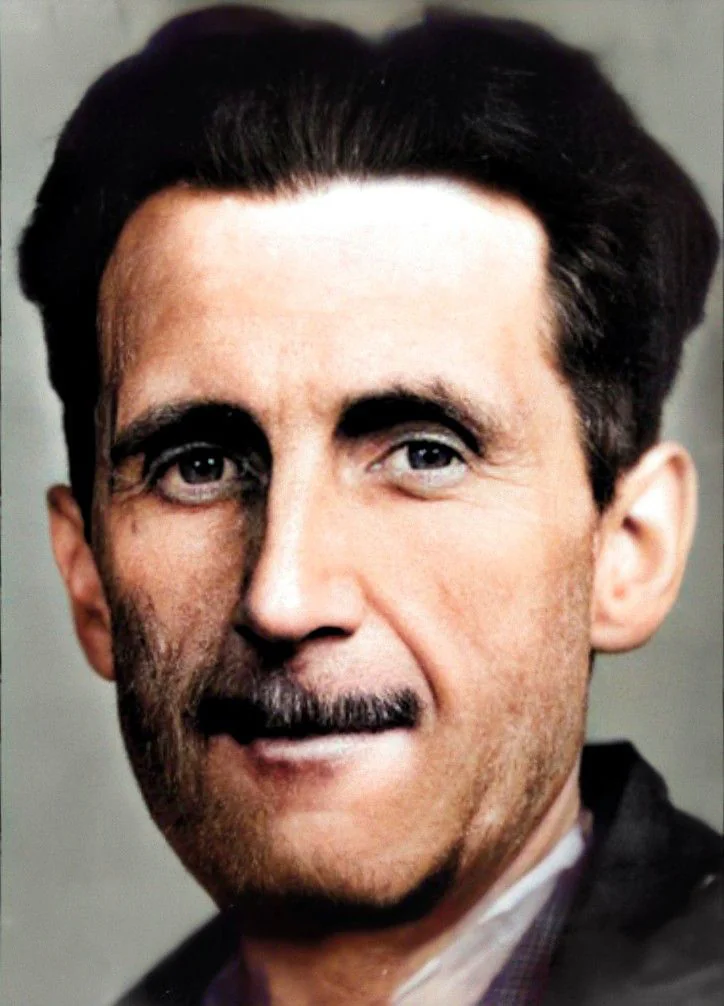
| 89 Quotes | |
| Born as | Eric Arthur Blair |
| Occup. | Author |
| From | United Kingdom |
| Spouse | Eileen O'Shaughnessy |
| Born | June 25, 1903 Motihari, Bengal, British India |
| Died | January 21, 1950 London, England |
| Cause | Tuberculosis |
| Aged | 46 years |
| Cite | |
Citation Formats
APA Style (7th ed.)
George orwell biography, facts and quotes. (2026, February 1). FixQuotes. https://fixquotes.com/authors/george-orwell/
Chicago Style
"George Orwell biography, facts and quotes." FixQuotes. February 1, 2026. https://fixquotes.com/authors/george-orwell/.
MLA Style (9th ed.)
"George Orwell biography, facts and quotes." FixQuotes, 1 Feb. 2026, https://fixquotes.com/authors/george-orwell/. Accessed 24 Mar. 2026.
Early Life and Background
George Orwell was born Eric Arthur Blair on June 25, 1903, in Motihari, Bengal Presidency, British India, into the administrative afterworld of empire. His father, Richard Walmesley Blair, worked in the Opium Department of the Indian Civil Service; his mother, Ida Mabel Limouzin, came from a family with French connections and a precarious gentility. The Blairs returned to England in 1904, settling in Henley-on-Thames, a respectable town whose calm surface made class feel like weather - ever-present, rarely discussed, and impossible to escape.That early mixture of imperial reach and domestic constraint became Orwell's lifelong pressure point: he belonged to the ruling apparatus but not securely to its wealth. He grew up observing how status is performed, how virtue is claimed, and how humiliation can be administered in polite settings. Tuberculosis, which would shadow his adult life and help set the tempo of his work, amplified his sense of time as something spent rather than owned, lending urgency to his moral attention and sharpening his suspicion of complacency.
Education and Formative Influences
Orwell was educated at St Cyprian's, Eastbourne, and then at Eton College (1917-1921), where he read widely, wrote, and absorbed the codes of an elite he both understood and resisted. He declined university and entered the Indian Imperial Police in Burma (1922-1927), an experience that hardened into a private argument with himself: how a system can recruit ordinary people to do what they would otherwise condemn. The resignation that followed was not a clean conversion but a break with a future that promised comfort at the price of moral anesthesia, pushing him toward the deliberate risk of writing and political witness.Career, Major Works, and Turning Points
Back in Europe, he immersed himself in poverty and casual labor, turning experience into "Down and Out in Paris and London" (1933) under the pen name George Orwell, a name chosen to sound plain, English, and unadorned. "Burmese Days" (1934) converted his colonial memories into a bleak anatomy of complicity. Commissioned to study industrial hardship, he traveled among the unemployed in northern England, producing "The Road to Wigan Pier" (1937), then went to Spain to fight for the Republic, where he was wounded and witnessed the internecine purges that shaped "Homage to Catalonia" (1938). During World War II he wrote essays and worked for the BBC, then distilled his anti-totalitarian imagination into "Animal Farm" (1945) and "Nineteen Eighty-Four" (1949), composed while his health collapsed on Jura and in hospital; he died in London on January 21, 1950.Philosophy, Style, and Themes
Orwell's governing obsession was the corrosion of truth under pressure - from governments, parties, mobs, and the self. His prose is famous for its apparent simplicity, but that plainness is an ethic: to say exactly what happened, to name the interest behind a slogan, to resist the narcotic of euphemism. He distrusted doctrinal purity because he had seen how ideals become instruments, and he refused the comforting lie that clean hands are available in dirty times. “To survive it is often necessary to fight and to fight you have to dirty yourself”. The sentence is less a permission slip than a confession of the psychic cost he believed honest politics must pay.From that realism came his defense of intellectual independence as a civic duty rather than a literary pose. “Freedom is the right to tell people what they do not want to hear”. The line exposes his psychology: a man willing to be disliked if it preserved his inner alignment with observable fact. In "Nineteen Eighty-Four" he dramatized how power seeks not only obedience but the remodeling of memory and logic, offering a nightmare in which contradictory slogans become internalized: “War is peace. Freedom is slavery. Ignorance is strength”. For Orwell, language was the battleground where conscience either survives or is quietly rewritten, and the private mind - its capacity to remember, judge, and say "no" - was the last human territory.
Legacy and Influence
Orwell's work outlived the specific quarrels of his decade because it maps recurring mechanisms: propaganda that makes cruelty sound normal, surveillance that turns intimacy into risk, and political faith that punishes doubt. "Orwellian", "Big Brother", "thoughtcrime", and "Newspeak" became global shorthand, often simplified, yet still pointing readers back to his central demand that citizens defend factual reality and moral clarity. He remains a reference point for journalists, dissidents, and democratic socialists, not as a saint but as a writer who treated self-deception as a political problem and made the struggle for truth feel personal, immediate, and nonnegotiable.Our collection contains 89 quotes written by George, under the main topics: Witty One-Liners - Ethics & Morality - Funny - Truth - Wisdom.
Other people related to George: Aldous Huxley (Novelist), Cyril Connolly (Journalist), John Pilger (Journalist), Thomas Pynchon (Writer), Yevgeny Zamyatin (Novelist), Mark Crispin Miller (Journalist), Lorin Maazel (Musician)
George Orwell Famous Works
- 1949 1984 (Novel)
- 1945 Animal Farm (Novella)
- 1939 Coming Up for Air (Novel)
- 1938 Homage to Catalonia (Memoir)
- 1937 The Road to Wigan Pier (Non-fiction)
- 1936 Keep the Aspidistra Flying (Novel)
- 1934 Burmese Days (Novel)
- 1933 Down and Out in Paris and London (Novel)
Source / external links