
George W. Bush Biography Quotes 89 Report mistakes
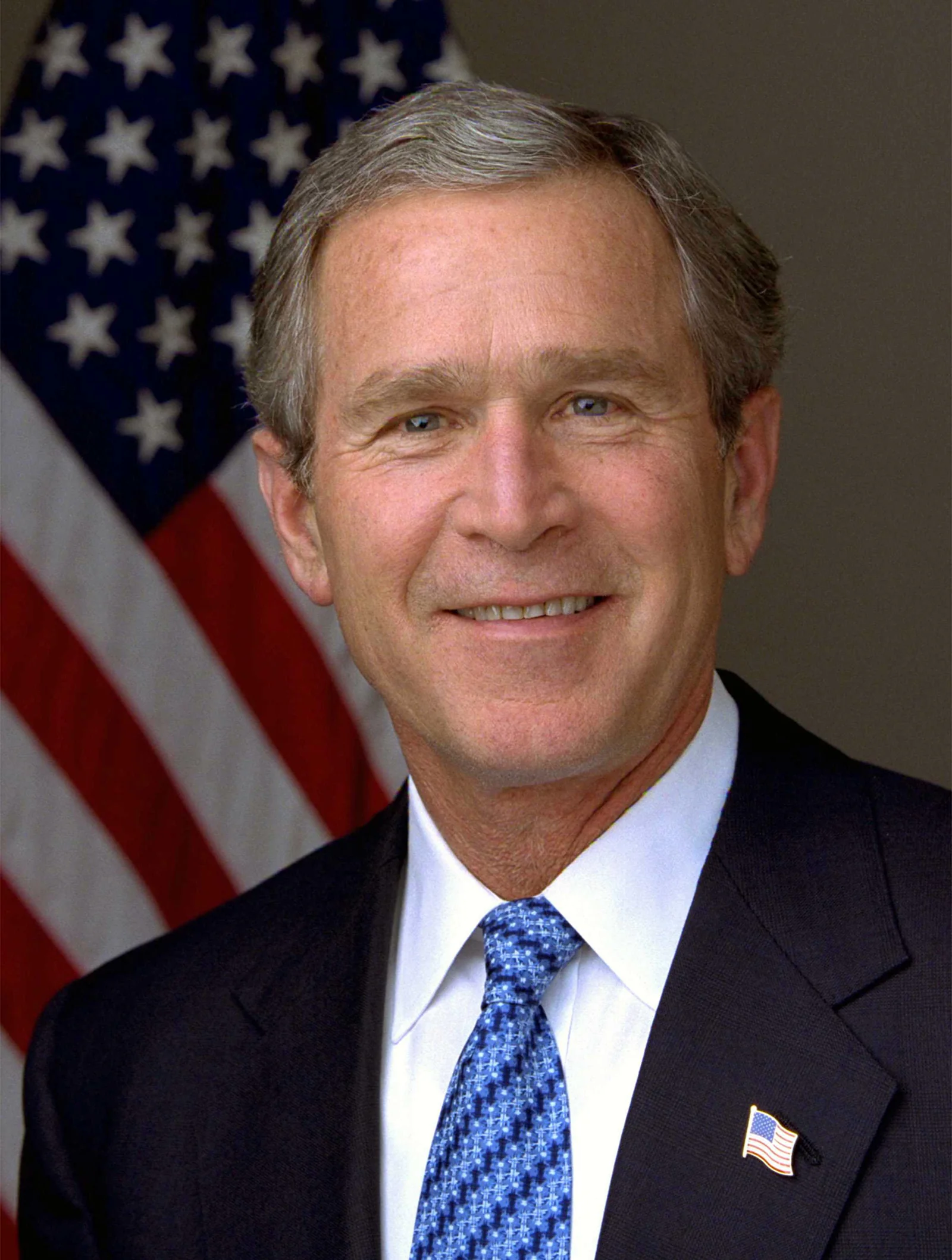
| 89 Quotes | |
| Born as | George Walker Bush |
| Occup. | President |
| From | USA |
| Born | July 6, 1946 New Haven, Connecticut |
| Age | 79 years |
| Cite | |
Citation Formats
APA Style (7th ed.)
George w. bush biography, facts and quotes. (2026, February 3). FixQuotes. https://fixquotes.com/authors/george-w-bush/
Chicago Style
"George W. Bush biography, facts and quotes." FixQuotes. February 3, 2026. https://fixquotes.com/authors/george-w-bush/.
MLA Style (9th ed.)
"George W. Bush biography, facts and quotes." FixQuotes, 3 Feb. 2026, https://fixquotes.com/authors/george-w-bush/. Accessed 12 Feb. 2026.
Early Life and Background
George Walker Bush was born July 6, 1946, in New Haven, Connecticut, the first child of George H. W. Bush and Barbara Pierce Bush. Raised largely in West Texas and Houston, he absorbed a frontier ethos shaped by oil-town risk, competitive sports, and a patrician family story that mixed Yankee duty with Sun Belt ambition. The death of his younger sister Robin in 1953 from leukemia marked the household with private grief and a sharpened religio-moral seriousness that would later echo in his language about purpose and providence.As a young man Bush developed a reputation for conviviality and occasional recklessness, a tension that became central to his self-conception: the affable son of privilege who needed to prove grit. His early adulthood unfolded against the churn of Vietnam, civil rights realignment, and a Republican Party moving from Eastern establishment to a Southern and Western base - a political migration his family both benefited from and helped accelerate.
Education and Formative Influences
Bush attended Phillips Academy Andover, graduated from Yale University in 1968, and earned an MBA from Harvard Business School in 1975. Between Yale and Harvard he served as a pilot in the Texas Air National Guard, an experience later scrutinized during his presidential campaigns. His formation drew from three streams: inherited political apprenticeship (watching his father's rise), corporate-capitalist problem solving (oil ventures and deal-making), and a strain of evangelical-inflected moral clarity that deepened after he quit drinking in 1986, encouraged by his wife, Laura Welch Bush, whom he married in 1977.Career, Major Works, and Turning Points
Bush's early business career included failed and modestly successful oil ventures (Arbusto Energy, later Bush Exploration), culminating in a partnership role with the Texas Rangers baseball franchise, where stadium politics and public relations honed his retail charm. After advising his father's 1988 presidential campaign, he won the Texas governorship in 1994, emphasizing education standards, welfare reform, and a bipartisan style alongside strong support for capital punishment. He ran for president in 2000 on "compassionate conservatism", won after the disputed Florida recount and Bush v. Gore, and governed amid two epochal shocks: the September 11, 2001 attacks and the 2003 invasion of Iraq. His tenure included the Afghanistan war, the Iraq war, the USA PATRIOT Act, the creation of the Department of Homeland Security, Medicare Part D, No Child Left Behind, and the 2008 financial crisis response (including TARP), ending with low approval yet enduring party influence.Philosophy, Style, and Themes
Bush's governing psychology fused genial accessibility with a stark, binary moral frame. His public voice favored plainspoken certainty - sometimes lapsing into malapropism - but beneath it lay a disciplined message about resolve, loyalty, and national purpose. After 9/11 he cast the struggle in civilizational terms, insisting, "Every nation in every region now has a decision to make. Either you are with us, or you are with the terrorists". The line was more than rhetoric: it revealed an inner need to impose order on chaos, to force clarity where intelligence, diplomacy, and history offered ambiguity. That same impulse animated his doctrine of preemption, framed as an answer to catastrophic risk rather than traditional deterrence.Yet Bush also carried an awareness of democratic constraint and of how power is judged over time. "A dictatorship would be a heck of a lot easier, there's no question about it". The remark, half-joke and half-confession, exposed the friction between his preference for decisive action and the procedural drag of Congress, courts, allies, and public opinion. He spoke similarly about posterity, conceding that "The true history of my administration will be written 50 years from now, and you and I will not be around to see it". That belief functioned as self-protection - a way to endure immediate backlash - and as a faith claim that intentions, not only outcomes, would someday be weighed.
Legacy and Influence
Bush left office in 2009 with his presidency defined by the post-9/11 security state and the Iraq War's long shadow, but also by durable domestic architecture such as expanded prescription drug coverage and an education accountability regime that both parties later revised rather than erased. In retirement he cultivated a quieter, more introspective public identity through painting and veterans' advocacy, while his decisions continue to shape debates over executive power, surveillance, torture and detention, alliance management, and the costs of nation-building. For Republicans he remains a hinge figure: the last pre-Trump party leader rooted in evangelical moral language and post-Cold War interventionism, and a cautionary case study in how certainty, when paired with imperfect information, can remake the world for decades.Our collection contains 89 quotes written by George, under the main topics: Witty One-Liners - Ethics & Morality - Justice - Dark Humor - Sarcastic.
Other people related to George: Dan Rather (Journalist), Colin Powell (Statesman), Dick Cheney (Vice President), Mel Martinez (Politician), Donald Rumsfeld (Politician), Kenneth Lay (Businessman), Steve Forbes (Businessman), Marion Berry (Politician), Aleksander Kwasniewski (Politician), Dick Durbin (Politician)
Frequently Asked Questions
- George Bush death: George H. W. Bush passed away on November 30, 2018. George W. Bush is still alive.
- george h. w. bush presidential term: 1989 to 1993.
- George W Bush net worth: Estimated to be around $40 million.
- When did George W Bush die: He has not died as of the latest update.
- George W Bush age: He was born on July 6, 1946, so he is 77 years old as of 2023.
- George W Bush today: He is retired from politics and occasionally engages in public speaking and charitable activities.
- George W Bush father: George H. W. Bush.
- Is George W Bush still alive: Yes, as of the latest update.
- How old is George W. Bush? He is 79 years old
George W. Bush Famous Works
- 2021 Out of Many, One: Portraits of America's Immigrants (Book)
- 2014 41: A Portrait of My Father (Book)
- 2010 Decision Points (Book)
- 1999 A Charge to Keep (Book)