
George Will Biography Quotes 26 Report mistakes
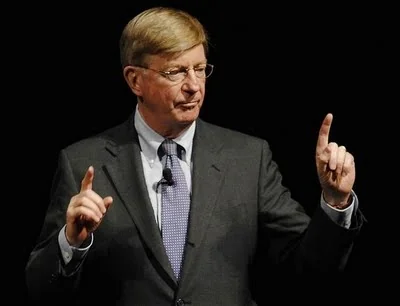
| 26 Quotes | |
| Born as | George Frederick Will |
| Occup. | Journalist |
| From | USA |
| Spouse | Marianne Lorensen |
| Born | May 4, 1941 Champaign, Illinois, U.S. |
| Age | 84 years |
| Cite | |
Citation Formats
APA Style (7th ed.)
George will biography, facts and quotes. (2026, February 11). FixQuotes. https://fixquotes.com/authors/george-will/
Chicago Style
"George Will biography, facts and quotes." FixQuotes. February 11, 2026. https://fixquotes.com/authors/george-will/.
MLA Style (9th ed.)
"George Will biography, facts and quotes." FixQuotes, 11 Feb. 2026, https://fixquotes.com/authors/george-will/. Accessed 5 Mar. 2026.
Early Life and Background
George Frederick Will was born on May 4, 1941, in Champaign, Illinois, into a Midwestern world of post-Depression frugality and wartime mobilization that soon gave way to the confidence of American ascendancy. The terrain of his youth was not glamorous - college-town streets, newspapers on porches, radio voices narrating national life - but it trained an instinct that became his signature: politics as civic weather, always present, always shaping what people believe is normal.He matured as the United States moved from the moral clarity of World War II memory into the ambiguities of Cold War power, civil rights conflict, Vietnam, and the cultural revolutions of the 1960s. Will would spend his career anatomizing those shifts with the temperament of a classicist and the impatience of a columnist: skeptical of romantic politics, alert to institutional incentives, and drawn to the ways mass democracy can turn governance into performance.
Education and Formative Influences
Will studied at Trinity College in Hartford, then earned graduate degrees at Oxford University and Princeton University, receiving a PhD in political science. Oxford sharpened his sense of political tradition and the uses of history; Princeton professionalized his interest in American institutions, especially the Framers and the constitutional architecture that constrains passions by forcing them through procedures. His intellectual formation blended Burkean caution, Madisonian realism about factions, and an academic habit of defining terms before judging outcomes - a discipline that later made his journalism sound simultaneously literary and prosecutorial.Career, Major Works, and Turning Points
After early work in political journalism and commentary, Will became nationally prominent as a syndicated columnist for The Washington Post Writers Group, building a wide readership with a style that treated daily politics as raw material for arguments about character, incentives, and the long run. He also became a familiar television presence, including years as a panelist on ABC's This Week, where his compact aphorisms and historical asides offered a counterpoint to campaign-season urgency. Across decades he wrote books that consolidated his themes - on statecraft, conservatism, baseball and culture, and constitutional argument - and his reputation evolved from movement conservative voice to a more explicitly institutional critic, especially as populism and personality-driven politics tested the Republican Party he had often defended.Philosophy, Style, and Themes
Will's inner life, as it appears on the page, is the psychology of a man who distrusts emotional overclaim and prefers the chastening company of facts, history, and rules. His conservatism is less a romance of the past than a theory of human limitation: people are predictably self-justifying, so systems must anticipate vanity, impatience, and appetite. That is why he returns to the Constitution not as scripture but as machinery - a design for slowing down certainty. The same temperament surfaces in his dry, paradox-friendly humor and his preference for the telling detail over the grand moral scream.He is also a critic of performance - in sports, in politics, and in media - and he uses those arenas to measure standards. “Sports serve society by providing vivid examples of excellence”. Yet he can turn acerbic when spectacle replaces seriousness: “Football combines the two worst things about America: it is violence punctuated by committee meetings”. His political writing similarly reads audiences as a force shaping politicians, not just a target of persuasion: “A politician's words reveal less about what he thinks about his subject than what he thinks about his audience”. Underneath these lines is a consistent theme - that modern life rewards pose, so citizens must relearn discernment, and that institutions, when healthy, make it harder for pose to harden into policy.
Legacy and Influence
Will endures as one of the late 20th century's most recognizable American columnists - a writer who brought political theory, history, and a baseball fan's devotion to craft into the daily news cycle. His influence is visible in the way subsequent conservative and centrist commentators adopted his model: argument anchored in institutions, disdain for cant, and sentences built to survive past the headline. For admirers, he preserved a tradition of intellectually ambitious journalism; for critics, he exemplified elite confidence in proceduralism. Either way, his work helped define how a generation argued about American government - not as a set of personalities, but as a system whose incentives and limits shape the nation's character.Our collection contains 26 quotes written by George, under the main topics: Witty One-Liners - Truth - Art - Justice - Sarcastic.
Other people related to George: Kathleen Parker (Journalist)
George Will Famous Works
- 2019 The Conservative Sensibility (Book)
- 2014 A Nice Little Place on the North Side: Wrigley Field at One Hundred (Book)
- 2008 One Man's America: The Pleasures and Provocations of Our Singular Nation (Book)
- 1994 The Leveling Wind: Politics, the Culture and Other News 1990-1994 (Book)
- 1992 Restoration: Congress, Term Limits and The Recovery of Deliberative Democracy (Book)
- 1990 Men At Work: The Craft of Baseball (Book)
- 1987 The New Season: A Spectator's Guide to the 1988 Election (Book)
- 1983 Statecraft as Soulcraft: What Government Does (Book)
Source / external links