
Georges Carpentier Biography Quotes 2 Report mistakes
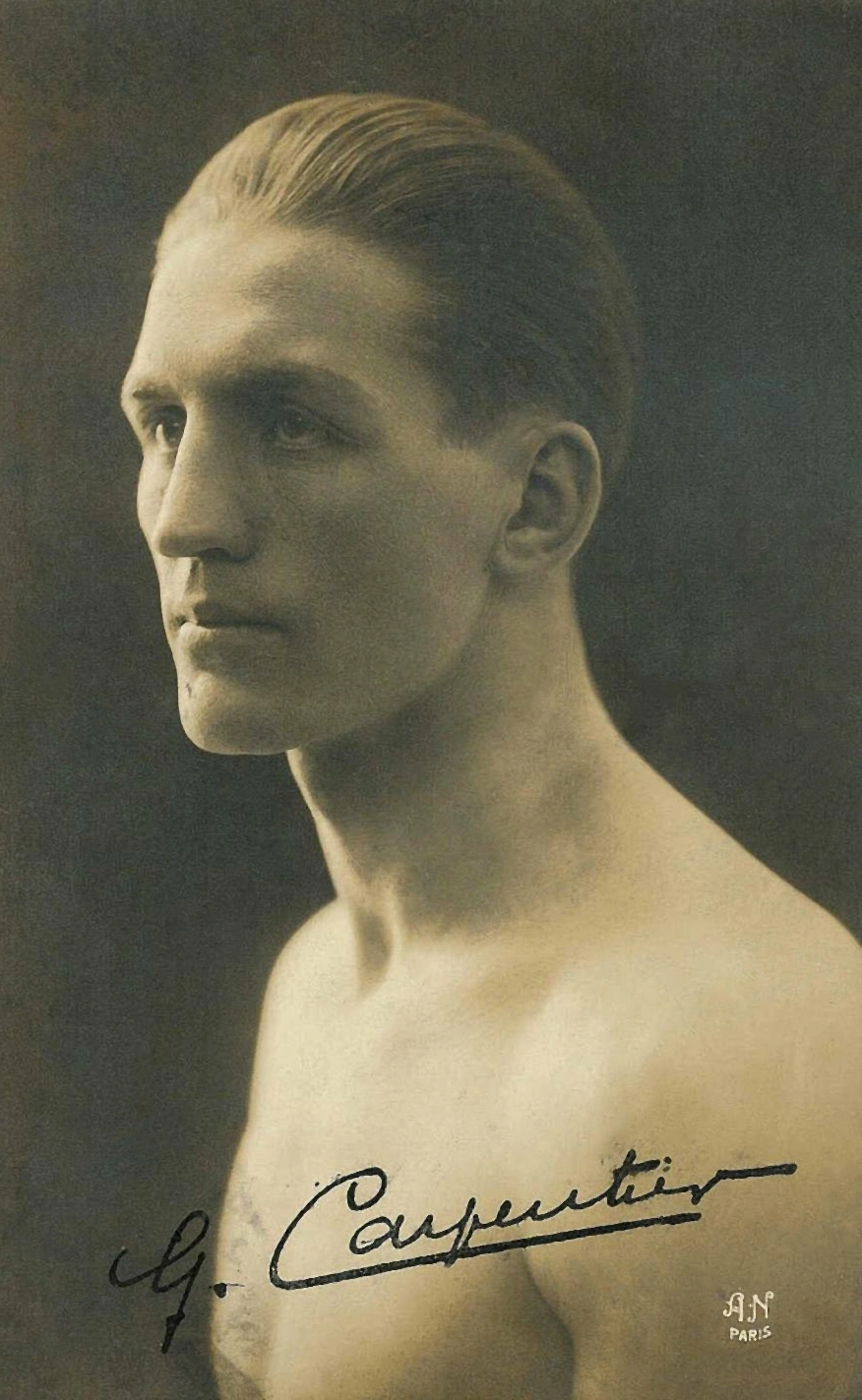
| 2 Quotes | |
| Occup. | Athlete |
| From | France |
| Born | January 12, 1894 Lievin, Lens, Pas-de-Calais, France |
| Died | October 28, 1975 Paris, France |
| Aged | 81 years |
| Cite | |
Citation Formats
APA Style (7th ed.)
Georges carpentier biography, facts and quotes. (2026, February 11). FixQuotes. https://fixquotes.com/authors/georges-carpentier/
Chicago Style
"Georges Carpentier biography, facts and quotes." FixQuotes. February 11, 2026. https://fixquotes.com/authors/georges-carpentier/.
MLA Style (9th ed.)
"Georges Carpentier biography, facts and quotes." FixQuotes, 11 Feb. 2026, https://fixquotes.com/authors/georges-carpentier/. Accessed 12 Feb. 2026.
Early Life and Background
Georges Carpentier was born on January 12, 1894, in Lievin, Pas-de-Calais, in northern France, a coal-basin landscape where labor, injury, and early responsibility were part of ordinary life. His father worked in the mines, and the Carpentier household sat close to the rhythms of working-class discipline - a background that later made his polish in the ring feel almost improbable to French admirers, who saw in him both the son of the pits and a self-made celebrity of the Belle Epoque.As a boy he boxed in local gyms and fairground bouts, where craft mattered as much as courage: timing, footwork, and the ability to stay calm under rough conditions. Even before national fame, he was marked by speed and a capacity to learn quickly, qualities that helped him rise through weight classes in a period when fighters often fought frequently and publicly, building reputations as much through resilience as through carefully managed careers.
Education and Formative Influences
Carpentier had no prolonged formal education compared with the Parisian elite who later embraced him; his education was apprenticeship - to trainers, sparring partners, and the public economics of prizefighting. French boxing in the early 1900s borrowed from British models but sought its own style, and Carpentier absorbed that hybrid: the emphasis on scientific technique alongside the appetite for spectacle. He was also shaped by a growing mass press that turned athletes into symbols, teaching him to speak, dress, and perform like a modern star while retaining the directness of his origins.Career, Major Works, and Turning Points
Turning professional as a teenager, Carpentier became one of France's first truly international boxing idols, winning the European welterweight title in 1911 and then collecting championships across divisions as his body and confidence matured. He defeated the British champion "Bombardier" Billy Wells to win the European heavyweight title in 1913, a victory that helped make him a continental hero. World War I interrupted and transformed everything: he served in the French military and became celebrated not just as a fighter but as a decorated airman - "the Orchid Man" in wartime mythmaking, an image of gallantry that France badly wanted. After the war he returned to boxing as a global attraction, culminating in his 1921 bout against Jack Dempsey for the world heavyweight championship in Jersey City - an event that became one of the era's defining sporting spectacles. Carpentier lost by knockout, but the fight cemented his status as boxing's first modern crossover celebrity, after which he increasingly moved toward public appearances and entertainment, including acting, while his ring career waned.Philosophy, Style, and Themes
Carpentier's boxing was often described as elegant, even aristocratic, but it was built on discipline and calculation rather than softness. His style relied on fast entries, sharp counters, and an instinct for positioning that let him fight larger men without staying in their line of fire. He treated boxing as a complete craft, and his outlook can be captured by his insistence that "Attack is only one half of the art of boxing". In practice, that meant offense designed to create exits, combinations that ended with balance, and a respect for defense as psychological control - the ability to deny an opponent the feeling that brute force could solve the problem.The other theme running through Carpentier's inner life was reinvention under pressure. He lived through the collapse of the Belle Epoque, the trauma of trench warfare, and the commercialization of sport into big-business theater. His public image - soldier, gentleman, French icon - could have become a cage, yet he showed a readiness to adapt, sometimes at the cost of criticism from purists. The mindset behind that adaptability is close to the aphorism "Life is very interesting if you make mistakes". Read psychologically, it suggests a man who accepted risk as the price of growth: the willingness to fight Dempsey at a disadvantage, to step onto new stages after the ring, and to treat failure not as humiliation but as information.
Legacy and Influence
Carpentier died on October 28, 1975, but he remained a template for the European sports star as national emblem and international performer. He helped professionalize French boxing's aspirations, proving a fighter from northern industrial France could headline global events and carry cultural meaning beyond results. His blend of technical speed, defensive intelligence, and media savvy anticipated the modern athlete-celebrity, while his wartime service bound his athletic narrative to the history of France itself, making him not merely a champion of titles but a champion of an era's anxieties, hopes, and changing ideas of masculinity.Our collection contains 2 quotes written by Georges, under the main topics: Sports - Learning from Mistakes.
Other people related to Georges: Gene Tunney (Athlete)
Source / external links