
Georgia O'Keeffe Biography Quotes 27 Report mistakes
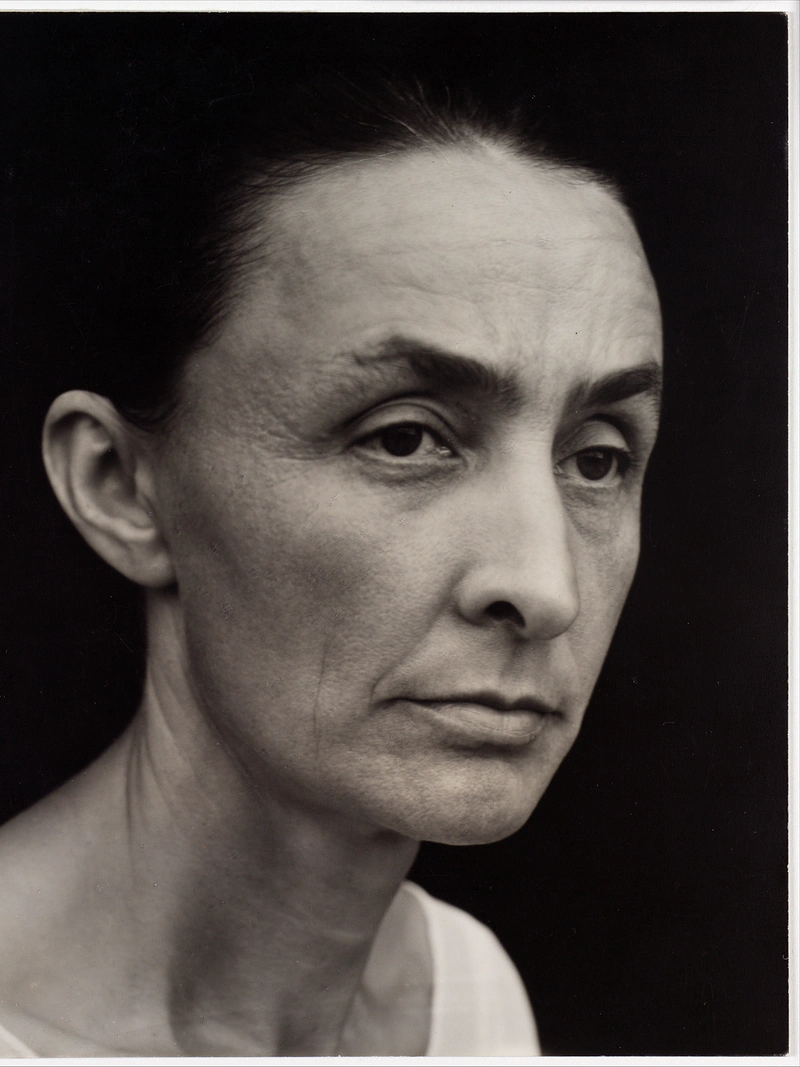
Attr: Alfred Stieglitz, CC0
| 27 Quotes | |
| Born as | Georgia Totto O'Keeffe |
| Occup. | Artist |
| From | USA |
| Born | November 15, 1887 Sun Prairie, Wisconsin, United States |
| Died | March 6, 1986 Santa Fe, New Mexico, United States |
| Aged | 98 years |
| Cite | |
Citation Formats
APA Style (7th ed.)
Georgia o'keeffe biography, facts and quotes. (2026, February 11). FixQuotes. https://fixquotes.com/authors/georgia-okeeffe/
Chicago Style
"Georgia O'Keeffe biography, facts and quotes." FixQuotes. February 11, 2026. https://fixquotes.com/authors/georgia-okeeffe/.
MLA Style (9th ed.)
"Georgia O'Keeffe biography, facts and quotes." FixQuotes, 11 Feb. 2026, https://fixquotes.com/authors/georgia-okeeffe/. Accessed 12 Feb. 2026.
Early Life and Background
Georgia Totto O'Keeffe was born on November 15, 1887, on a dairy farm near Sun Prairie, Wisconsin, the second of seven children in an Irish-Hungarian Catholic household. Rural labor, wide sky, and seasonal change formed her earliest visual grammar: barns, fields, and the close study of living forms. From childhood she showed a stubborn independence, announcing early that she intended to be an artist - an ambition still unusual for a Midwestern farm girl at the turn of the century.As the United States industrialized and cities expanded, O'Keeffe carried an opposite kind of attentiveness: an ability to isolate a single contour, a bone, a petal, and treat it as a complete world. Family moves and financial pressures later pushed her toward practical work, but the sense of space she learned in the open country - and the discipline of farm life - would remain in her painting as clarity, economy, and resolve.
Education and Formative Influences
She studied art in Chicago at the School of the Art Institute (1905-1906) and in New York at the Art Students League (1907-1908), where she trained in academic drawing and won a prize for still life, then left when illness and money forced her back. A decisive turn came in 1912-1916, while teaching in Texas (Amarillo, then Canyon): encountering Arthur Wesley Dow's ideas about composition, design, and personal expression, she began radical charcoal abstractions that rejected salon realism. In 1916 she mailed drawings to a friend, who showed them to photographer and impresario Alfred Stieglitz in New York; he exhibited them at his gallery 291 without her permission, setting in motion a partnership that would define - and complicate - her rise.Career, Major Works, and Turning Points
O'Keeffe moved to New York in 1918 to work under Stieglitz's patronage; their relationship became romantic, and they married in 1924. In the 1920s she produced the magnified flower paintings that made her famous (including works such as Black Iris and Jimson Weed) alongside sharp-edged New York images like Radiator Building - Night, New York, translating modern architecture into felt experience. Summers at Lake George brought quieter motifs, but the real rupture came in 1929 when she first traveled to New Mexico: the desert, bones, adobe walls, and distant mesas offered both subject and sanctuary. After a period of exhaustion and hospitalization in 1933, she rebuilt her life around the Southwest, buying Ghost Ranch in 1940 and a house in Abiquiu in 1945. Stieglitz died in 1946; by 1949 she moved permanently to New Mexico, and in 1977 she received the Presidential Medal of Freedom, becoming a living emblem of American modernism.Philosophy, Style, and Themes
Her art was never a matter of transcription but of equivalence - translating sensation into form. "I had to create an equivalent for what I felt about what I was looking at - not copy it". That insistence helps explain both the intimacy of her flowers and the austerity of her bones: each motif becomes a vessel for concentrated attention, purified of anecdote. Her famous enlargements were also a strategy of confrontation with the hurried modern gaze - "I decided that if I could paint that flower in a huge scale, you could not ignore its beauty". In an era of speed, advertising, and metropolitan spectacle, she treated seeing as an ethical act, demanding time from the viewer.Psychologically, O'Keeffe balanced vulnerability with an iron will, building a private sovereignty inside public scrutiny. Stieglitz's photographs and the critical habit of reading her work through sexuality often tried to fix her into a single story; her response was to keep moving, geographically and artistically, toward environments that matched her inner scale. Fear did not vanish, but it became fuel: "I've been absolutely terrified every moment of my life - and I've never let it keep me from doing a single thing I wanted to do". The clean lines, cropped perspectives, and severe compositions that look effortless are, in this light, acts of self-command - a way to make a life as coherent as a painting.
Legacy and Influence
O'Keeffe died on March 6, 1986, in Santa Fe, New Mexico, after shaping nearly a century of American art. She expanded modernism's vocabulary by proving that abstraction and direct observation could be the same impulse, and she offered a model of artistic autonomy for women whose ambition was routinely treated as novelty. Her New York paintings remain among the most persuasive visual poems of the modern city, while her New Mexico works helped define the Southwest in the national imagination without reducing it to mere regional color. Through the Georgia O'Keeffe Museum in Santa Fe (opened 1997), major retrospectives, and the continuing afterlife of her images in photography, design, and popular culture, she endures as an artist who made attention itself - disciplined, fearless, and exacting - her most original subject.Our collection contains 27 quotes written by Georgia, under the main topics: Motivational - Art - Friendship - Mortality - Nature.
Other people related to Georgia: Yousuf Karsh (Photographer), Paul Strand (Photographer), Bob Balaban (Actor)