
Gerald R. Ford Biography Quotes 31 Report mistakes
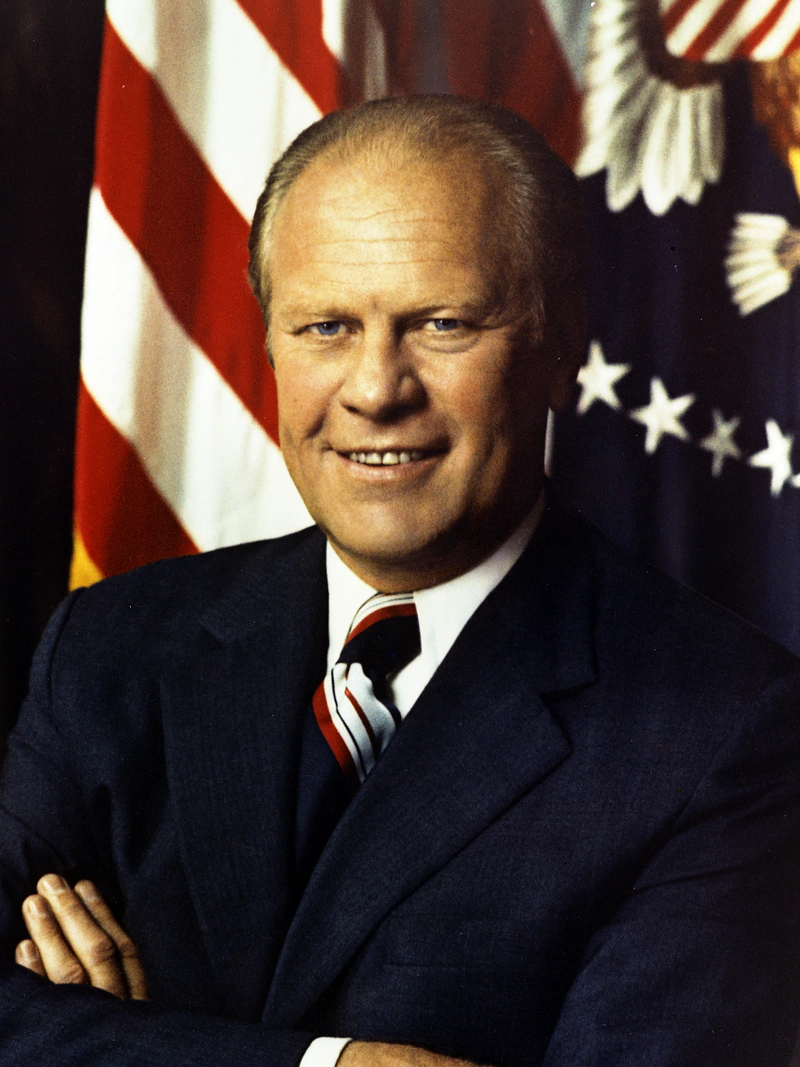
| 31 Quotes | |
| Born as | Leslie Lynch King Jr. |
| Occup. | President |
| From | USA |
| Born | July 14, 1913 Omaha, Nebraska, USA |
| Died | December 26, 2006 Rancho Mirage, California, USA |
| Aged | 93 years |
| Cite | |
Citation Formats
APA Style (7th ed.)
Gerald r. ford biography, facts and quotes. (2026, February 11). FixQuotes. https://fixquotes.com/authors/gerald-r-ford/
Chicago Style
"Gerald R. Ford biography, facts and quotes." FixQuotes. February 11, 2026. https://fixquotes.com/authors/gerald-r-ford/.
MLA Style (9th ed.)
"Gerald R. Ford biography, facts and quotes." FixQuotes, 11 Feb. 2026, https://fixquotes.com/authors/gerald-r-ford/. Accessed 5 Mar. 2026.
Early Life and Background
Gerald Rudolph Ford Jr. was born Leslie Lynch King Jr. on July 14, 1913, in Omaha, Nebraska, into a household marked by volatility. His father, Leslie Lynch King Sr., was violent toward his mother, Dorothy Ayer Gardner King; she fled with her infant son to Grand Rapids, Michigan. The break was decisive and protective, and it set a pattern that would recur in Ford's public life: a preference for stability over drama, and for institutional order over personal myth.In 1916 Dorothy married Gerald R. Ford Sr., a Grand Rapids businessman, who raised the boy as his own. Though he was known as Gerald Ford from childhood, he did not legally change his name until 1935. The quiet fact of being remade - a Midwestern upbringing grafted onto a birth name he eventually set aside - gave him an unusual interior discipline: he learned early that identity could be chosen, and that private wounds did not have to become public theater. That self-containment, often mistaken for blandness, was a hard-won temperament.
Education and Formative Influences
Ford attended South High School in Grand Rapids, excelled in football, and worked at various jobs that reinforced his ethic of reliability. He studied economics at the University of Michigan, where he became a standout center on the football team and, years later, would be offered professional contracts he declined in favor of law. After Yale Law School, he returned to Michigan, joined a law firm, and during World War II served in the U.S. Navy on the light aircraft carrier USS Monterey in the Pacific, experiencing the war not as grand strategy but as routine risk, responsibility, and chain-of-command life - the kind of environment that fitted his character and later shaped his instinct for procedural legitimacy.Career, Major Works, and Turning Points
Elected to the U.S. House of Representatives in 1948 from Michigan's 5th district, Ford served a quarter-century and became House Republican leader, respected for decency, mastery of process, and a reputation for personal fairness even when ideological agreement was absent. The defining hinge of his life came from the collapse of trust in Watergate: in 1973 Richard Nixon nominated him as vice president under the 25th Amendment after Spiro Agnew resigned; in August 1974, Nixon resigned and Ford became the only person to assume the presidency without having been elected either president or vice president. His single most consequential act - the pardon of Nixon - was intended to close a national wound but instead deepened suspicion, costing him political capital he never fully regained. He governed amid inflation, recession, and the aftershocks of Vietnam, contending with a heavily Democratic Congress, and lost narrowly in 1976 to Jimmy Carter after a campaign in which his plain-spoken steadiness competed with the electorate's appetite for renewal.Philosophy, Style, and Themes
Ford's worldview was conservative but not performative: a belief in limits, in rules, and in incremental repair rather than sweeping reinvention. He saw government as necessary but dangerous when unmoored from restraint, distilling that tension in the warning, “A government big enough to give you everything you want is a government big enough to take from you everything you have”. Yet his conservatism was coupled to a civic humility that treated democratic legitimacy as more important than personal brilliance; he spoke most earnestly about the impersonal bedrock of the system: “Our great Republic is a government of laws and not of men. Here, the people rule”. The psychology beneath those lines is revealing: a man who had rebuilt his own life by choosing steadiness, and who entered the Oval Office through constitutional procedure, clung to legality as a moral language.His public style - genial, sometimes awkward, often self-deprecating - functioned as a kind of emotional governance. By refusing the romance of charisma, he tried to lower the national temperature after the fever of scandal. The best Ford quips were not mere jokes but signals of a temperament that distrusted ego and deflated pretension: “I know I am getting better at golf because I am hitting fewer spectators”. Behind the humor sat a deeper theme: moral progress as something earned through hardship rather than proclaimed in comfort, a conviction he articulated plainly when he observed, “History and experience tell us that moral progress comes not in comfortable and complacent times, but out of trial and confusion”. For Ford, trial was not an excuse to abandon norms; it was the moment norms mattered most.
Legacy and Influence
Ford died on December 26, 2006, leaving a legacy defined less by policy triumph than by a specific kind of presidential character - restorative, procedural, and personally decent in an era that doubted decency could survive power. The Nixon pardon remains his most contested decision, but it also frames his enduring influence: the claim that a leader may accept political loss to spare the country prolonged institutional trauma. In a time when presidents are often judged by spectacle, Ford's reputation has slowly strengthened as historians and citizens revisit what it meant to be a caretaker of constitutional legitimacy - a man shaped by early disruption who chose, again and again, to make stability an ethical act.Our collection contains 31 quotes written by Gerald, under the main topics: Witty One-Liners - Ethics & Morality - Justice - Friendship - Freedom.
Other people related to Gerald: Vernon A. Walters (Soldier), John Sherman Cooper (Politician), Betty Ford (First Lady), David R. Gergen (American), James R. Thompson (Politician), George Aiken (Politician), Mitch McConnell (Politician), Earl Butz (Public Servant)
Gerald R. Ford Famous Works
- 1979 A Time to Heal: The Autobiography of Gerald R. Ford (Autobiography)
Source / external links