
Gertrude Stein Biography Quotes 81 Report mistakes
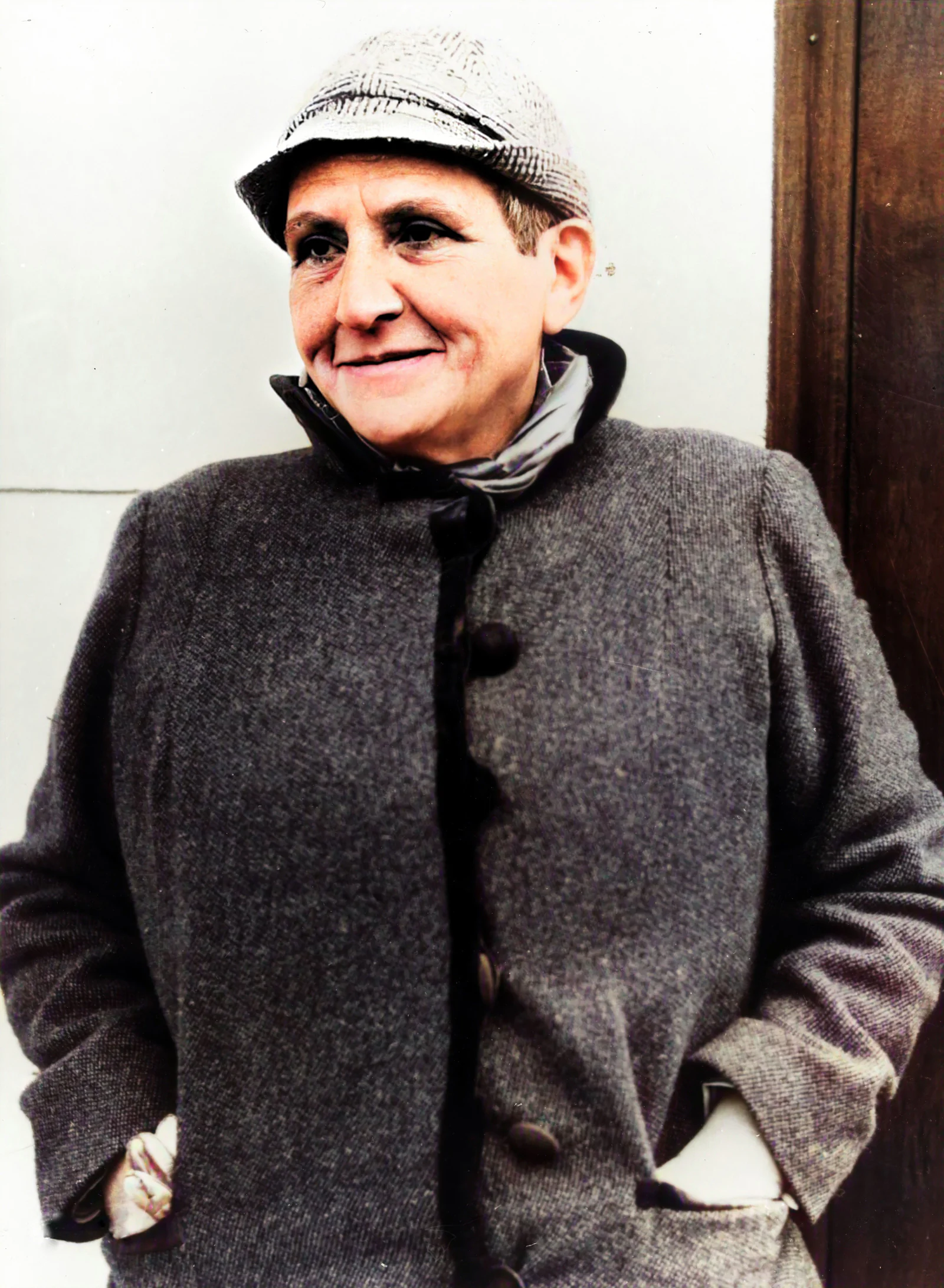
| 81 Quotes | |
| Occup. | Author |
| From | USA |
| Spouse | Alice B. Toklas |
| Born | February 3, 1874 Allegheny, Pennsylvania, USA |
| Died | July 29, 1946 Neuilly-sur-Seine, France |
| Cause | Stomach cancer |
| Aged | 72 years |
| Cite | |
Citation Formats
APA Style (7th ed.)
Gertrude stein biography, facts and quotes. (2026, February 11). FixQuotes. https://fixquotes.com/authors/gertrude-stein/
Chicago Style
"Gertrude Stein biography, facts and quotes." FixQuotes. February 11, 2026. https://fixquotes.com/authors/gertrude-stein/.
MLA Style (9th ed.)
"Gertrude Stein biography, facts and quotes." FixQuotes, 11 Feb. 2026, https://fixquotes.com/authors/gertrude-stein/. Accessed 5 Mar. 2026.
Early Life and Background
Gertrude Stein was born on February 3, 1874, in Allegheny, Pennsylvania, into a prosperous German-Jewish family whose mobility shaped her sense of identity as something made, not inherited. Her parents, Daniel and Amelia Stein, moved the household repeatedly in her early years, including time in Vienna and Paris, before settling in Oakland, California. The cosmopolitan childhood left her with a lasting double vision: American practicality and European density of history, a tension that later became both subject and method.Her mother died in 1888 and her father in 1891, leaving Gertrude and her siblings effectively orphaned as adolescents, supported by family resources but forced into self-definition early. She lived closely with her brother Leo, whose taste and ambition would help draw her into art and expatriate life, while her bond with Alice B. Toklas - met later in Paris - became the central domestic and creative partnership of her adult life. The losses and the privilege combined into a distinctive temperament: skeptical of sentiment, hungry for immediacy, and convinced that attention itself could be a form of power.
Education and Formative Influences
Stein entered Radcliffe College in 1893 and studied psychology under William James, absorbing his ideas about consciousness, habit, and the stream of experience; these would later reappear as literary procedure rather than philosophical argument. She also worked with Hugo Munsterberg and pursued medical studies at Johns Hopkins beginning in 1897, leaving without a degree in 1901. The laboratory, the clinic, and Jamesian introspection trained her to treat language like an instrument for registering mind in motion - less a vehicle for story than a field where perception could be tested, repeated, and revised.Career, Major Works, and Turning Points
In 1903 Stein moved to Paris with Leo and established the famous salon at 27 rue de Fleurus, where she and Toklas (from 1907) hosted painters and writers and helped midwife modernism: Picasso, Matisse, Braque, Apollinaire, and later Hemingway and Fitzgerald. Stein collected early Cubist work with startling prescience and wrote in parallel, seeking a prose equivalent to visual fragmentation and reassembly. Her early major book, Three Lives (1909), blended realism with rhythmic insistence; Tender Buttons (1914) pushed further into radical linguistic object-making. After World War I she became a public voice for an expatriate generation, coining "the Lost Generation" and publishing The Autobiography of Alice B. Toklas (1933), a strategic masterpiece of self-mythologizing that made her famous in the United States. She lectured across America in 1934-35, then returned to France, surviving World War II in Vichy-controlled territory with Toklas, protected in part by local connections and the ambiguous politics of the time. She died on July 29, 1946, in Neuilly-sur-Seine, leaving behind a body of work that still divides readers into initiates and skeptics.Philosophy, Style, and Themes
Stein treated identity as geography and habit, not confession. She could declare, with a calm that masks a lifelong displacement, “America is my country and Paris is my hometown”. The sentence is less a travel slogan than a psychological map: the nation as origin, the city as chosen mind. That choice - to live where art felt new, to make a home inside a movement - underwrote her belief that history is not merely inherited but practiced, constructed by repetition and attention.Her style made that belief audible. Instead of plot-driven causality, she pursued the texture of the present tense, working with recurrence, slight variation, and a stubborn refusal to translate sensation into conventional explanation. The famously circular “Rose is a rose is a rose is a rose”. is not emptiness but an argument about naming: that language both fixes an object and releases an aura of associations that cannot be reduced to a single definition. Stein also insisted that time is the medium of meaning, writing, “History takes time. History makes memory”. For her, the sentence is a machine for manufacturing memory in real time; repetition is not redundancy but a way of seeing again, until seeing becomes knowledge. Her brusque judgments of peers and her impatience with literary pieties were part of the same discipline: to protect the experiment from being softened into mere charm.
Legacy and Influence
Stein endures as a foundational architect of literary modernism and an exemplar of how a writer can turn private method into public culture. She helped legitimate avant-garde painting through collecting and conversation, shaped the mythology of expatriate Paris, and widened what English prose could do - influencing later innovators from the Language poets to postmodern stylists and performance writers who treat voice as structure. At the same time, her reputation remains morally and politically complicated by her wartime circumstances and by the power dynamics embedded in her salon-making and self-presentation. Yet the core achievement persists: she made form a way of thinking, and made thinking, in its stubborn repetitions, sound like a life being lived.Our collection contains 81 quotes written by Gertrude, under the main topics: Witty One-Liners - Wisdom - Truth - Art - Music.
Other people related to Gertrude: Virgil Thomson (Composer), Richard Foreman (Playwright), Carl Van Vechten (Writer), Paul Bowles (Composer), Malcolm Cowley (Critic), Janet Malcolm (Writer)
Frequently Asked Questions
- How did Gertrude Stein die: Stomach cancer
- Gertrude Stein writing style: Experimental, repetitive, nontraditional narrative and syntax
- What was Gertrude Stein most famous for: Innovative modernist literature and famous salons in Paris
- Gertrude Stein Truism: 'Rose is a rose is a rose is a rose'
- Gertrude Stein works: 'Three Lives', 'Tender Buttons', 'The Making of Americans', 'The Autobiography of Alice B. Toklas'
- Gertrude Stein poems: 'A Carafe, That Is a Blind Glass', 'Sacred Emily', 'Stanzas in Meditation'
- Gertrude Stein famous works: 'Three Lives', 'Tender Buttons', 'The Autobiography of Alice B. Toklas'
- How old was Gertrude Stein? She became 72 years old
Gertrude Stein Famous Works
- 1937 Everybody's Autobiography (Autobiography)
- 1933 The Autobiography of Alice B. Toklas (Autobiography)
- 1914 Tender Buttons (Poetry)
- 1909 Three Lives: Stories of the Good Anna, Melanctha, and the Gentle Lena (Novel)
Source / external links