
Gloria Steinem Biography Quotes 46 Report mistakes
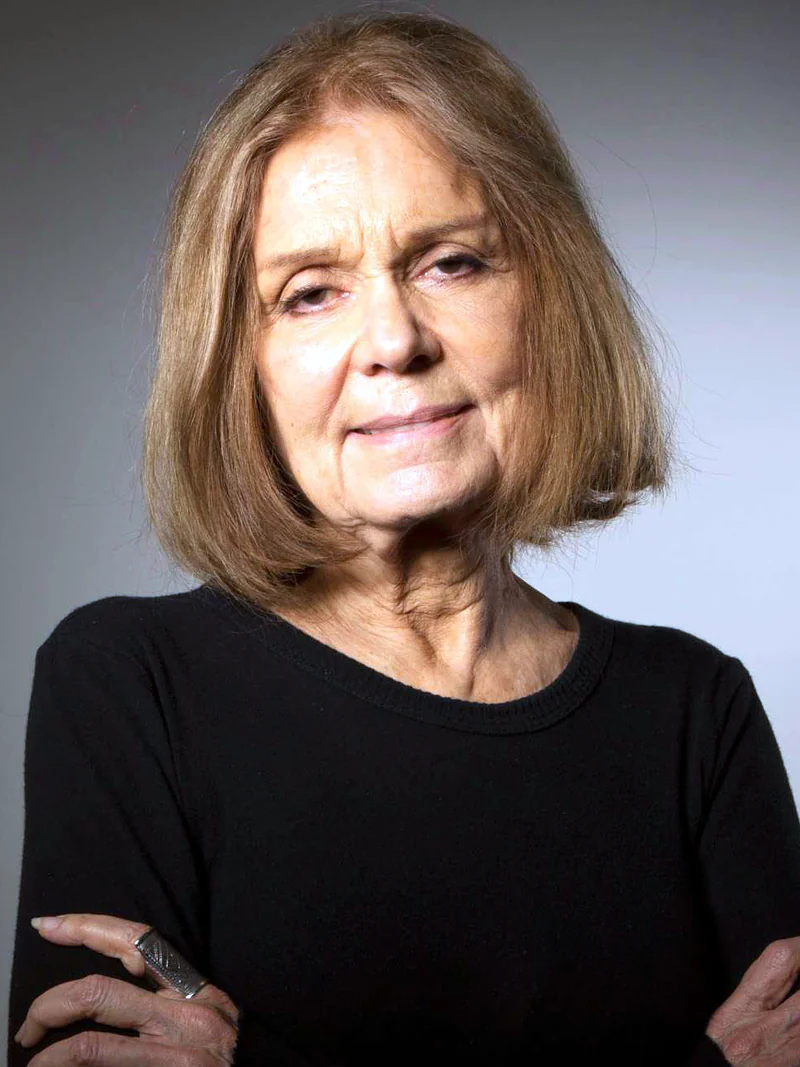
Attr: people.com
| 46 Quotes | |
| Born as | Gloria Marie Steinem |
| Occup. | Activist |
| From | USA |
| Born | March 25, 1934 Toledo, Ohio, USA |
| Age | 92 years |
| Cite | |
Citation Formats
APA Style (7th ed.)
Gloria steinem biography, facts and quotes. (2026, February 2). FixQuotes. https://fixquotes.com/authors/gloria-steinem/
Chicago Style
"Gloria Steinem biography, facts and quotes." FixQuotes. February 2, 2026. https://fixquotes.com/authors/gloria-steinem/.
MLA Style (9th ed.)
"Gloria Steinem biography, facts and quotes." FixQuotes, 2 Feb. 2026, https://fixquotes.com/authors/gloria-steinem/. Accessed 26 Mar. 2026.
Early Life and Background
Gloria Marie Steinem was born on March 25, 1934, in Toledo, Ohio, into a peripatetic, financially precarious household shaped by the Depression's long aftershocks. Her father, Leo Steinem, was a traveling antiques dealer whose work kept the family on the road, and the constant motion produced in her an early aptitude for observation, listening, and quick intimacy with strangers - skills that later served both her reporting and her organizing.Her mother, Ruth (Nuneviller) Steinem, struggled with severe mental illness; after her parents separated, Gloria spent much of her adolescence in Toledo as a caregiver, absorbing the quiet arithmetic of women's unpaid labor and the social penalties attached to vulnerability. That domestic reality - the way private pain became public limitation - seeded her lifelong insistence that what looked like personal failure was often structural constraint, and that dignity could not depend on a woman's attachment to a man or the stability of a marriage.
Education and Formative Influences
Steinem attended Waite High School in Toledo and graduated in 1952 before enrolling at Smith College, where she studied government and graduated Phi Beta Kappa in 1956. A fellowship then took her to India in the late 1950s, where she encountered Gandhian traditions of nonviolent protest and the organizing strategies of women in grassroots movements; the experience sharpened her sense that political change is built through patient networks as much as through formal institutions, and that gender inequality travels easily across borders even when it takes different local forms.Career, Major Works, and Turning Points
Moving to New York, Steinem worked as a journalist in the early 1960s, gaining national attention with "A Bunny's Tale" (1963), an undercover report on working conditions at Playboy Clubs that translated private exploitation into public fact. As the modern women's movement accelerated, she became a central strategist and public voice: co-founding New York magazine (1968) and, in 1972, helping launch Ms. magazine, which blended investigative reporting with movement priorities and made feminist analysis mainstream reading. She co-founded the National Women's Political Caucus in 1971, campaigned for the Equal Rights Amendment, and spent decades on the road building coalitions across race, class, and region, even as celebrity threatened to turn her into a symbol rather than an organizer. Later milestones included co-founding the Women's Media Center (2005) and publishing memoir and essays such as My Life on the Road (2015), reinforcing her role as both chronicler and builder of second-wave and post-second-wave feminism.Philosophy, Style, and Themes
Steinem's core premise is that liberation is not a gift bestowed by enlightened authorities but an active practice that changes the person doing it. “Power can be taken, but not given. The process of the taking is empowerment in itself”. The line captures her psychology: a wary impatience with permission and a trust in incremental courage, forged in a youth where stability was scarce and self-reliance was not a slogan but a necessity. Even her journalistic voice - lucid, anecdotal, strategically unemotional - functions as a bridge between individual testimony and systemic critique, converting shame into data and isolation into solidarity.Her feminism also resists the glamour of idealization, especially when women are turned into icons in order to keep them harmless. “A pedestal is as much a prison as any small, confined space”. That insight explains her refusal to play the flawless spokeswoman and her emphasis on movement over messiah: she repeatedly redirected attention to local organizers, electoral infrastructure, and the long, unphotogenic work of changing norms. Yet she pairs realism with imaginative reach, treating hope as a discipline rather than a mood: “Without leaps of imagination, or dreaming, we lose the excitement of possibilities. Dreaming, after all, is a form of planning”. In her hands, dreaming becomes strategy - a way to envision childcare, wages, bodily autonomy, and political representation as interconnected rather than competing claims.
Legacy and Influence
Steinem endures as a defining architect of American feminism, not merely for her visibility but for the institutions she helped build and the rhetorical tools she popularized: consciousness-raising as analysis, personal narrative as evidence, and coalition politics as the only route to durable reform. Ms. reoriented what counted as news, while her organizing helped normalize women's candidacies and feminist public language across generations. Critiqued at times for the limitations of her era's mainstream feminism, she nonetheless evolved in public, lending her platform to intersectional and younger movements while modeling how an activist can remain strategically relevant without surrendering moral clarity.Our collection contains 46 quotes written by Gloria, under the main topics: Witty One-Liners - Motivational - Ethics & Morality - Justice - Writing.
Other people related to Gloria: Annie Gottlieb (Writer), Liz Carpenter (Writer), Carolyn Gold Heilbrun (Author), Letty Cottin Pogrebin (Writer)