
Golda Meir Biography Quotes 33 Report mistakes
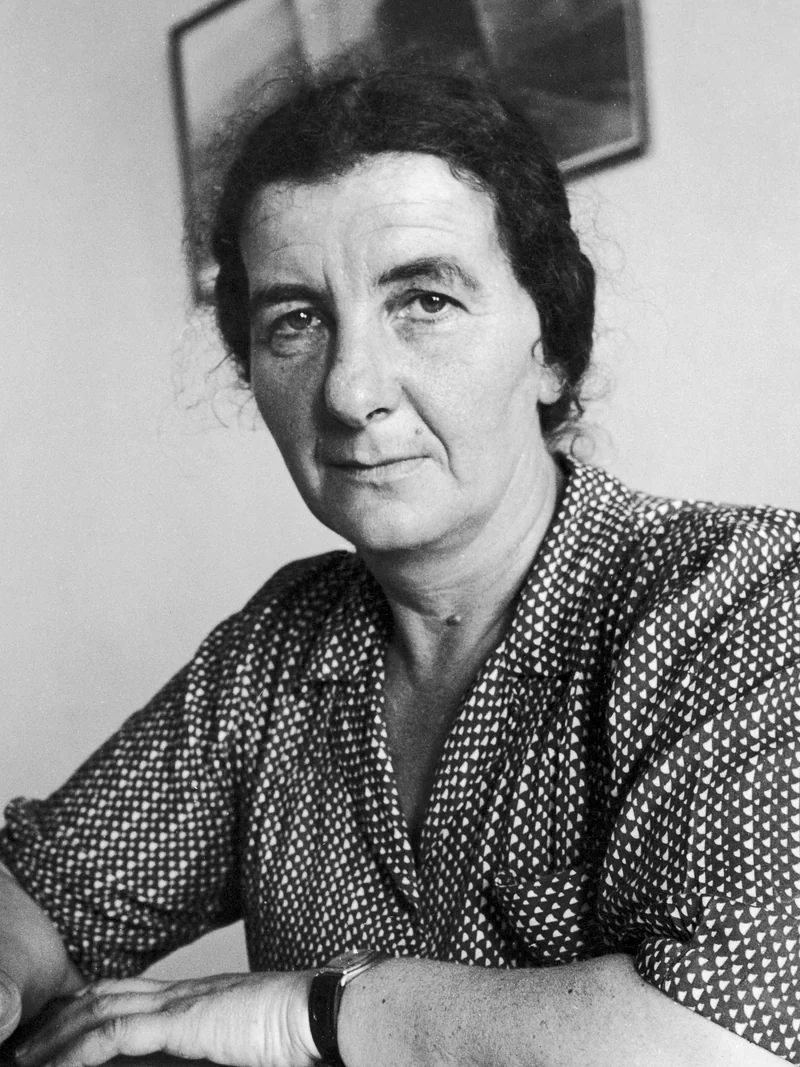
Attr: biography.com
| 33 Quotes | |
| Born as | Golda Mabovitch |
| Known as | Golda Meyerson |
| Occup. | Leader |
| From | Israel |
| Born | May 3, 1898 Kiev, Russian Empire |
| Died | December 8, 1978 Jerusalem, Israel |
| Cause | lymphoma |
| Aged | 80 years |
| Cite | |
Citation Formats
APA Style (7th ed.)
Golda meir biography, facts and quotes. (2026, February 11). FixQuotes. https://fixquotes.com/authors/golda-meir/
Chicago Style
"Golda Meir biography, facts and quotes." FixQuotes. February 11, 2026. https://fixquotes.com/authors/golda-meir/.
MLA Style (9th ed.)
"Golda Meir biography, facts and quotes." FixQuotes, 11 Feb. 2026, https://fixquotes.com/authors/golda-meir/. Accessed 5 Mar. 2026.
Early Life and Background
Golda Meir was born Golda Mabovitch on May 3, 1898, in Kyiv, then in the Russian Empire, into a Jewish world shaped by poverty, legal restriction, and periodic violence. Her earliest memories, later retold with blunt clarity, included the fear of pogroms and the intimate logistics of survival - a family sealing a doorway, listening for footsteps, counting what could be carried if they had to run. Those formative anxieties did not make her cautious; they made her certain that Jewish safety required political agency, not prayer alone.In 1906 her family emigrated to the United States and settled in Milwaukee, Wisconsin, part of a great Eastern European Jewish migration that mixed old-country trauma with American civic possibility. In a new language and landscape, Meir learned to treat public life as something ordinary people could enter and alter. She worked, organized, and argued early - a temperament that fused moral urgency with impatience for excuses, and that would later harden into a reputation for severity that often masked a private tenderness.
Education and Formative Influences
In Milwaukee she attended North Division High School and trained briefly as a teacher at Milwaukee State Normal School, but her most consequential education came from politics: Zionist circles, labor organizing, and the idea that nation-building could be done with hands as well as speeches. After a period in Denver, Colorado, living with her sister Sheyna and encountering debate-rich immigrant and socialist milieus, she committed to Labor Zionism and to a life that would be measured not by comfort but by usefulness.Career, Major Works, and Turning Points
In 1921 she and her husband, Morris Meyerson (Meirson), moved to British Mandate Palestine and joined Kibbutz Merhavia, entering the austere pioneer culture that prized collective discipline and distrusted bourgeois sentiment. Her gifts for negotiation soon pulled her from the fields into the institutions of the Yishuv: the Histadrut labor federation, fundraising and diplomacy abroad, and wartime coordination under the shadow of British limits and Arab-Jewish conflict. In 1948, days before Israel declared independence, she traveled to Amman to meet King Abdullah I in a last, failed attempt to avert wider war; she then became one of the signatories of Israel's Declaration of Independence. As Israel's first ambassador to the Soviet Union, later as minister of labor (1949-1956) and foreign minister (1956-1966), she helped steer mass immigration, housing, and Israel's diplomatic posture during the Suez era and Cold War realignments. In 1969 she became prime minister, leading a country marked by attrition on its borders and by deepening occupation after 1967; the Yom Kippur War of October 1973 - surprise attack, initial losses, and eventual military recovery at enormous human cost - became the central ordeal of her premiership and precipitated her resignation in 1974 amid public anger and commission findings about preparedness.Philosophy, Style, and Themes
Meir's inner life was a study in controlled feeling: she distrusted performative emotion yet governed through a moral vocabulary that made politics personal. “It's no accident many accuse me of conducting public affairs with my heart instead of my head. Well, what if I do? Those who don't know how to weep with their whole heart don't know how to laugh either”. The line is not sentimental rhetoric so much as self-diagnosis - a declaration that empathy, not detachment, justified the burdens she imposed on herself and others, and that grief was inseparable from responsibility in a society built around bereavement.Her style combined prairie plainspokenness learned in America with the hard realism of a small state in a hostile region. She could be wry about geopolitics - “Let me tell you something that we Israelis have against Moses. He took us 40 years through the desert in order to bring us to the one spot in the Middle East that has no oil!” - using humor as a pressure valve for scarcity and strategic disadvantage. Underneath the joke sat a durable creed of psychological endurance: “Pessimism is a luxury that a Jew can never allow himself”. That ethic of refusing despair helped her steady colleagues and publics, but it also narrowed her tolerance for dissent and contributed to a leadership posture that could confuse fortitude with inflexibility, especially on questions of Palestinians and the costs of ruling over another people.
Legacy and Influence
Meir died on December 8, 1978, in Jerusalem, after years of illness, leaving behind one of the most contested legacies among Israel's founders: a symbol of state-building grit, a pioneering woman who reached the summit of power without adopting softness as camouflage, and a leader indelibly associated with the trauma of 1973. To admirers she embodied the immigrant-made-good who converted insecurity into nationhood; to critics she personified a generation whose moral certainty could not fully adapt to new realities of occupation, diplomacy, and internal social fracture. Yet her influence endures in the language of Israeli politics - the expectation that leaders must radiate stamina under threat - and in the global memory of a prime minister who treated survival not as a slogan but as a daily administrative task.Our collection contains 33 quotes written by Golda, under the main topics: Witty One-Liners - Wisdom - Art - Sarcastic - Leadership.
Other people related to Golda: Oriana Fallaci (Journalist), Menachem Begin (Statesman), Valerie Harper (Actress), King Hussein (Royalty), Levi Eshkol (Statesman)