
Guy Laliberte Biography Quotes 19 Report mistakes
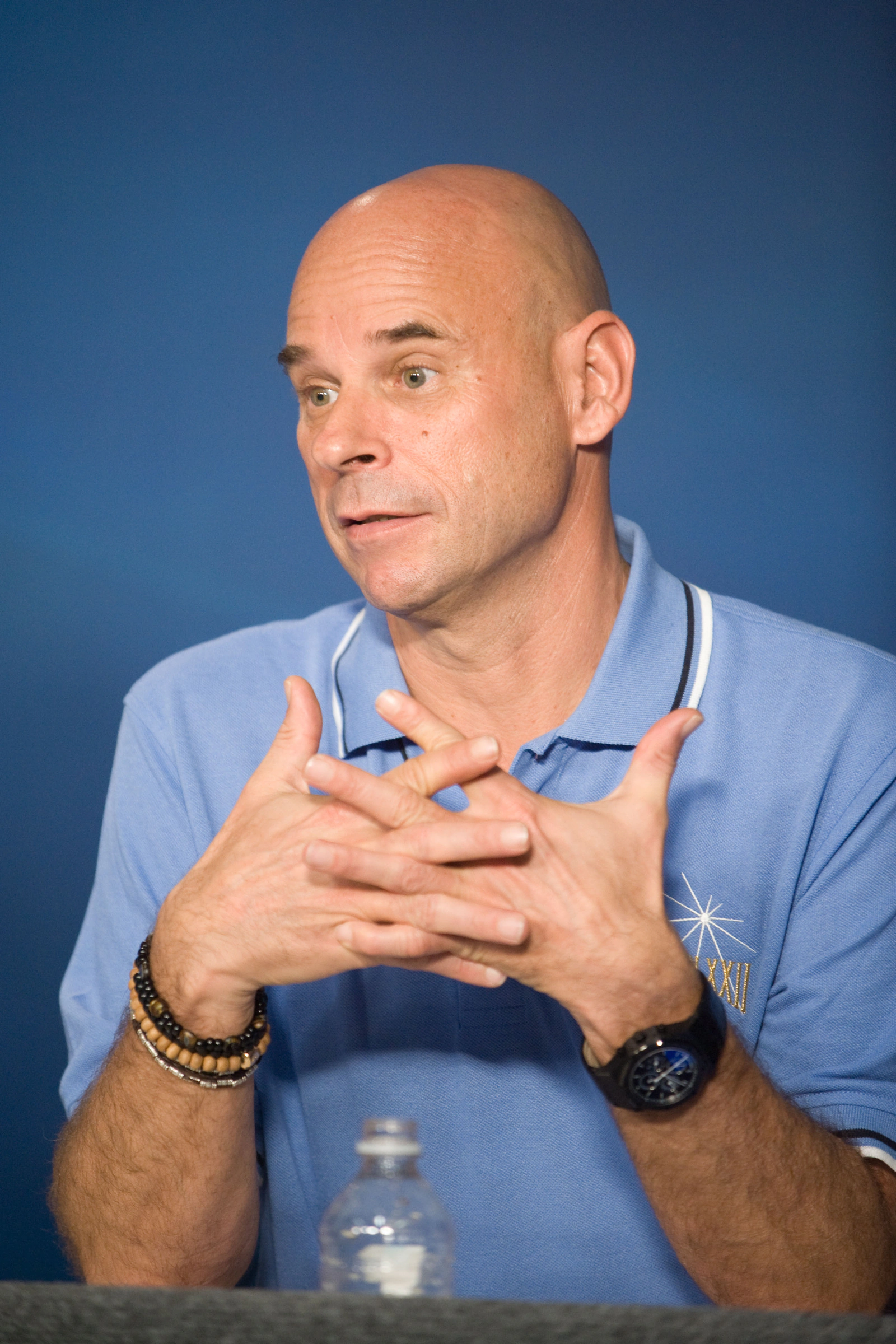
Attr: James Blair - NASA Human Spaceflight
| 19 Quotes | |
| Occup. | Businessman |
| From | Canada |
| Born | September 2, 1959 Quebec City, Quebec, Canada |
| Age | 66 years |
| Cite | |
Citation Formats
APA Style (7th ed.)
Guy laliberte biography, facts and quotes. (2026, February 11). FixQuotes. https://fixquotes.com/authors/guy-laliberte/
Chicago Style
"Guy Laliberte biography, facts and quotes." FixQuotes. February 11, 2026. https://fixquotes.com/authors/guy-laliberte/.
MLA Style (9th ed.)
"Guy Laliberte biography, facts and quotes." FixQuotes, 11 Feb. 2026, https://fixquotes.com/authors/guy-laliberte/. Accessed 27 Mar. 2026.
Early Life and Background
Guy Laliberte was born on September 2, 1959, in Quebec City, Quebec, into a French-Canadian milieu where Catholic tradition and the Quiet Revolution's aftershocks coexisted with a new confidence in Quebec identity. The 1960s and 1970s brought both cultural nationalism and economic uncertainty, and Laliberte grew up watching performers, buskers, and touring acts as part of everyday street life, not distant celebrity. That proximity to vernacular entertainment helped form his later instinct that art could be portable, popular, and technically ambitious at the same time.As a teenager he gravitated toward music and performance rather than a fixed trade, learning that attention is earned in real time and lost just as quickly. The discipline of street performing - reading crowds, pacing a routine, surviving bad weather and indifference - gave him a practical psychology of audiences: people do not buy "culture" in the abstract, they buy a moment in which they feel transformed. Long before he had investors or venues, he was testing the emotional mechanics of wonder on sidewalks and small stages.
Education and Formative Influences
Laliberte did not emerge from a conventional business-school pipeline; his core education was apprenticeship in the informal economy of performance, punctuated by travel and collaborative troupes in Quebec's festival circuit. In the early 1980s he joined and helped organize street-performer collectives, absorbing lessons from European circus traditions, commedia-style physicality, and the rising North American appetite for large-scale festivals. Just as important were managerial skills learned the hard way - negotiating permits, paying collaborators, and understanding that risk, if structured, could be a creative asset rather than a threat.Career, Major Works, and Turning Points
In 1984, amid Quebec's celebrations and a government willing to fund cultural exports, Laliberte co-founded Cirque du Soleil with fellow performers including Gilles Ste-Croix in Baie-Saint-Paul. The company evolved from touring shows in Quebec to an international phenomenon after a pivotal U.S. booking at the 1987 Los Angeles Arts Festival, proving the model could travel. Through the 1990s and 2000s Cirque expanded with resident productions such as Mystere (Las Vegas, 1993), O (1998), and Ka (2004), turning the casino city into a laboratory for theatrical spectacle and new stage technology. Laliberte became the company's public face and strategic driver, then gradually stepped back from day-to-day control; in 2015 he sold a majority stake to TPG Capital and partners, a major turning point that marked Cirque's transition from founder-led venture to institution. His later public profile also included high-visibility philanthropy and a 2009 private spaceflight to the International Space Station that he used to spotlight access to clean water.Philosophy, Style, and Themes
Laliberte's inner life reads like a tug-of-war between the vagabond's hunger for motion and the impresario's need for structure. His origin story is not boardroom ambition but escape velocity: “Originally the dream was about traveling and developing a job that would permit me to travel. And I decided to go into street performing because it was a traveling job; it would let me go around the world”. That line is less nostalgia than diagnosis - movement as identity, and performance as the passport. Even when Cirque became an industrial-scale enterprise, the emotional premise stayed intimate: “Inside every adult there's still a child that lingers. We're happiness merchants - giving people the opportunity to dream like children”. The "merchant" language reveals his candor about commerce, but it also shows how he framed profit as a byproduct of protecting wonder.His style was to modernize without desecrating the core ritual of the circus. He insisted the breakthrough was not invention from scratch but disciplined recombination, a pragmatic creativity captured in “We didn't reinvent the circus. We repackaged it in a much more modern way”. Psychologically, this is the mind of a builder rather than a mystic - someone who trusts editing, design, and systems, and who seeks a universal aesthetic that can cross language barriers through music, movement, and image. The recurring theme across Cirque's brand is controlled risk: precarious physical feats presented inside a meticulously engineered environment, mirroring the founder's own preference for daring that is rehearsed, insured, and repeatable.
Legacy and Influence
Laliberte helped redefine what a circus could be in the late-20th-century entertainment economy, proving that a non-animal, story-driven, high-design format could command premium prices and global tours. Cirque du Soleil influenced live production across Las Vegas, theme parks, pop concert staging, and contemporary circus schools, and it normalized the idea that acrobatics can sit alongside couture, original scores, and theatrical dramaturgy. His broader legacy lies in exporting a distinctively Quebecois creative confidence onto the world stage - and in modeling an artist-founder pathway where imagination is not the opposite of business, but its engine.Our collection contains 19 quotes written by Guy, under the main topics: Motivational - Art - Deep - Failure - Success.
Frequently Asked Questions
- Guy Laliberté poker losses: Reportedly tens of millions online; estimates around $26–$30M
- Guy Laliberté family: Father of five; past partner Claudia Barilla
- Guy Laliberté space: Visited the ISS in 2009 as a space tourist (Soyuz TMA-16)
- Guy Laliberte poker: High-stakes recreational player; created WSOP’s $1M Big One for One Drop
- Guy Laliberté DJ: Yes, he DJs under his own name (e.g., Ibiza, Burning Man)
- Guy Laliberté wife: Not publicly married; longtime ex-partner Claudia Barilla
- Guy Laliberté net worth: About $1.2 billion (est.)
- How old is Guy Laliberte? He is 66 years old
Guy Laliberte Famous Works
- 2013 Michael Jackson: One (Play)
- 2006 Love (Play)
- 2005 Corteo (Play)
- 2004 Kà (Play)
- 2003 Zumanity (Play)
- 1998 La Nouba (Play)
- 1998 O (Play)
- 1996 Quidam (Play)
- 1994 Alegría (Play)
- 1993 Mystère (Play)
- 1992 Saltimbanco (Play)
- 1990 Nouvelle Expérience (Play)
Source / external links