
H. C. Andersen Biography Quotes 10 Report mistakes
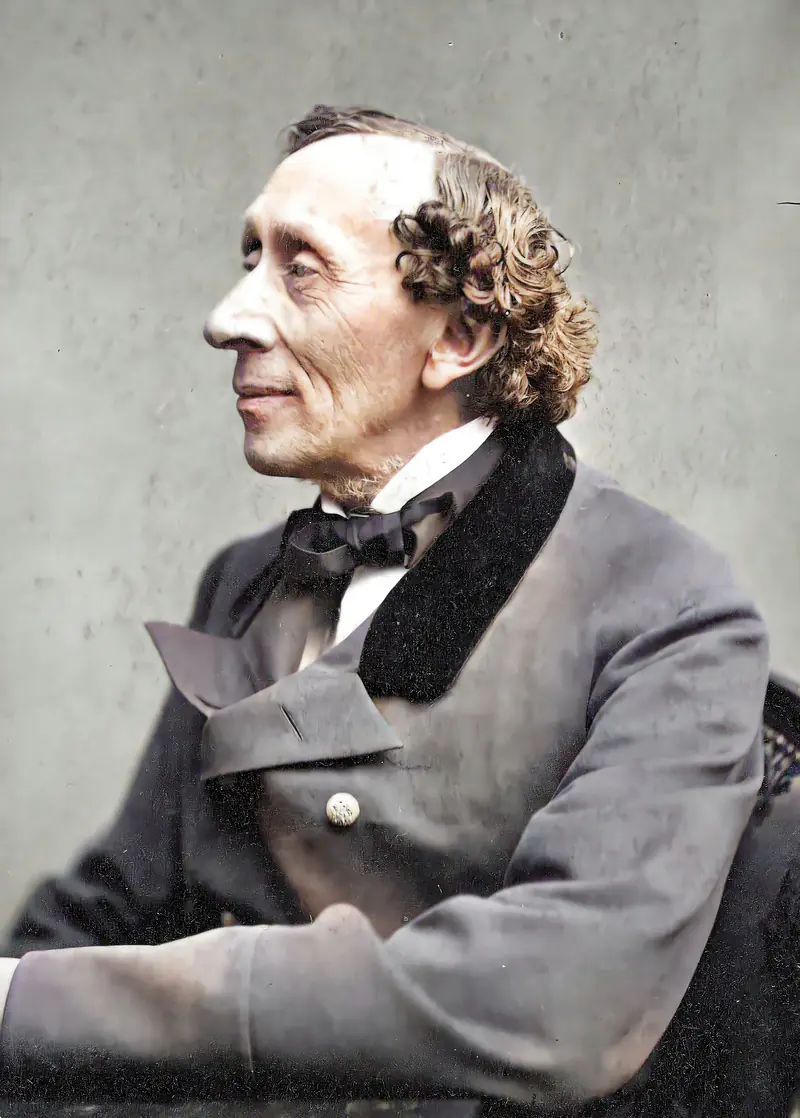
Attr: Thora Hallager
| 10 Quotes | |
| Born as | Hans Christian Andersen |
| Occup. | Writer |
| From | Denmark |
| Born | April 2, 1805 Odense, Denmark |
| Died | August 4, 1875 Copenhagen, Denmark |
| Cause | Heart failure |
| Aged | 70 years |
Hans Christian Andersen was born on 2 April 1805 in Odense on the island of Funen, in a Denmark still feeling the shockwaves of the Napoleonic era and national decline. His father, Hans Andersen, was a poor shoemaker with literary dreams; his mother, Anne Marie Andersdatter, worked as a washerwoman and carried the hard realism of poverty. The household sat near the margins of respectability, close to the citys underclass, yet the boy absorbed ballads, folk belief, and the theatricality of street life as if they were lessons in narrative structure.
His fathers death in 1816 and his mothers precarious survival sharpened the childs sense that life could turn on accident, humiliation, or a single benefactor. Andersen grew up tall, sensitive, and socially awkward, often convinced he was destined for something beyond his station. The tension between that private certainty and the public experience of being laughed at - for his voice, his body, his ambition - became an enduring engine in his work: a craving to be seen without being shamed.
Education and Formative Influences
In 1819 Andersen left Odense for Copenhagen, a fifteen-year-old with little schooling, a bundle of hopes, and the citys stage in his imagination. He sought work at the Royal Danish Theatre, failed repeatedly, and hovered on the edge of ridicule and destitution until patrons intervened, most decisively Jonas Collin, a director at the theatre who secured him support and schooling. The education was double-edged: at Slagelse Latin School and later Elsinore, under the severe Simon Meisling, Andersen was corrected, scolded, and socially isolated, yet he also received the classical grounding and discipline that made him more than a gifted autodidact. In the literary Copenhagen of Oehlenschlager, Heiberg, and later the wider European Romantic movement, he learned to fuse folk material with self-scrutiny and to treat the everyday as symbolic.
Career, Major Works, and Turning Points
After early attempts in poetry and drama, Andersen began to find a public voice in the 1830s: the novel The Improvisatore (1835) drew on his Italian travels, while the first installments of his fairy tales appeared the same year in Eventyr, fortalte for Born (Fairy Tales, Told for Children). Over the next four decades he produced a body of tales that moved far beyond nursery entertainment: "The Little Mermaid" (1837), "The Emperors New Clothes" (1837), "The Steadfast Tin Soldier" (1838), "The Ugly Duckling" (1843), "The Snow Queen" (1844-45), "The Red Shoes" (1845), and "The Little Match Girl" (1845). His international fame grew through translations and relentless travel - Germany, France, Italy, England, and beyond - bringing him into contact with figures such as Charles Dickens, whose friendship cooled after Andersens prolonged, awkward stay at his home. Diaries and letters reveal alternating exhilaration and panic: he was celebrated as a national poet and yet remained inwardly the anxious outsider, continually measuring his worth against salons, critics, and the fragile approval of the cultivated classes.
Philosophy, Style, and Themes
Andersens inner life ran on a paradox: a near-religious faith in wonder paired with an acute sensitivity to exclusion. His tales repeatedly stage the desire to belong - to a family, a body, a language, a social rank - and then test it through transformation, sacrifice, or exposure. He treated existence as enchanted but not comforting, insisting that the miraculous is not a reward for virtue but a condition of perception. "Life itself is the most wonderful fairy tale". For Andersen this was not a slogan of optimism so much as a defense against despair: if life is a tale, then pain can be shaped, and humiliation can be transmuted into meaning.
His style - plainspoken, rhythmic, intimate with the listener - disguises a modern psychological sharpness. Tears, silences, and small objects do the emotional work, and he is unafraid of endings that sting. "Where words fail, tears can speak". That line fits the way his protagonists often lose the very tools of self-advocacy: the mermaid gives up her voice, the match girl dies unseen, the ugly duckling cannot argue himself into dignity. Yet Andersen also insists on a minimum human entitlement to beauty and air, a sensual ethics for the poor and shamed. "Just living is not enough. One must have sunshine, freedom, and a little flower". The flower is never mere decoration - it is proof that the soul has claims the world does not automatically grant.
Legacy and Influence
When Andersen died on 4 August 1875 in Copenhagen, he had already helped redefine what a fairy tale could be: not a fixed folk artifact but a literary form capable of satire, metaphysical longing, and social critique in the same breath. His narratives seeded modern childrens literature while also feeding adult art - from theatre and ballet to illustration, film, and psychological realism - and his images (the naked emperor, the self-sacrificing mermaid, the despised duckling) became global shorthand for vanity, yearning, and late-blooming identity. In Denmark he remains a national writer; internationally he is a durable translator of inner weather into story, a craftsman who made vulnerability speak with authority and made wonder feel like a hard-won mode of survival.
Our collection contains 10 quotes who is written by C. Andersen, under the main topics: Music - Meaning of Life - Art - Life - Self-Discipline.
Frequently Asked Questions
- Hans Christian Andersen wife: Hans Christian Andersen never married and had no wife.
- Hans Christian Andersen movie: Notable films include the musical “Hans Christian Andersen” (1952) and many animated adaptations inspired by his tales, such as versions of The Little Mermaid and The Snow Queen.
- Eventyr H.C. Andersen: “Eventyr” means “fairy tales” in Danish, and it commonly refers to Andersen’s collections of fairy tales published across the 1830s–1870s.
- Hans Christian Andersen famous stories: His best-known stories include The Little Mermaid, The Ugly Duckling, The Snow Queen, The Emperor’s New Clothes, The Princess and the Pea, Thumbelina, and The Steadfast Tin Soldier.
- Hans Christian Andersen fairy tales list: Popular Andersen fairy tales include The Little Mermaid, The Ugly Duckling, The Snow Queen, The Emperor’s New Clothes, Thumbelina, The Princess and the Pea, The Red Shoes, The Steadfast Tin Soldier, and The Nightingale.
- How old was H. C. Andersen? He became 70 years old
H. C. Andersen Famous Works
- 1845 The Red Shoes (Fairy Tale)
- 1844 The Snow Queen (Fairy Tale)
- 1843 The Ugly Duckling (Fairy Tale)
- 1837 The Emperor's New Clothes (Fairy Tale)
- 1837 The Little Mermaid (Fairy Tale)
Source / external links