
H. R. Giger Biography Quotes 8 Report mistakes
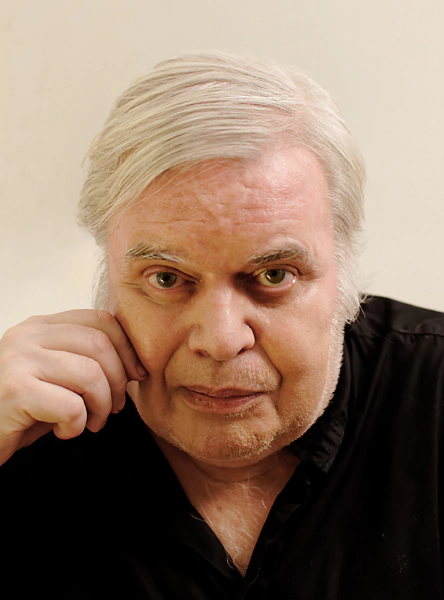
Attr: Matthias Belz, CC BY-SA 3.0
| 8 Quotes | |
| Born as | Hans Rudolf Giger |
| Occup. | Artist |
| From | Switzerland |
| Spouses | Li Tobler (1966–1975) Mia Bonzanigo (1979-1981) Carmen Maria Scheifele (2006-2014) |
| Born | February 5, 1940 Chur, Switzerland |
| Died | May 12, 2014 Zurich, Switzerland |
| Cause | Cardiac arrest |
| Aged | 74 years |
| Cite | |
Citation Formats
APA Style (7th ed.)
H. r. giger biography, facts and quotes. (2026, February 11). FixQuotes. https://fixquotes.com/authors/h-r-giger/
Chicago Style
"H. R. Giger biography, facts and quotes." FixQuotes. February 11, 2026. https://fixquotes.com/authors/h-r-giger/.
MLA Style (9th ed.)
"H. R. Giger biography, facts and quotes." FixQuotes, 11 Feb. 2026, https://fixquotes.com/authors/h-r-giger/. Accessed 11 Feb. 2026.
Early Life and Background
Hans Rudolf Giger was born on February 5, 1940, in Chur, in the Swiss canton of Graubunden, a region of narrow valleys and medieval stonework that could feel both protective and claustrophobic during the austerity of World War II-era Europe. Switzerland remained neutral, but the war and its aftershocks shaped the psychic weather of the continent: rationing, surveillance-minded order, and the constant awareness of mechanized death just beyond the borders. Giger grew up sensitive to atmosphere - to rooms, corridors, basements, and the hush of institutions - and his later art would often resemble architecture turned into nervous tissue.Family accounts and early interviews point to an imaginative child attracted to the morbid and the sacred in equal measure, collecting images that many adults would dismiss as unhealthy: skulls, mummies, medical illustrations, and the theatrical dread of Gothic spaces. Chur offered both Catholic iconography and alpine darkness; Giger learned early that fear and beauty are not opposites but adjacent rooms. That adjacency became his lifelong subject: the moment where the familiar world develops seams, and something biological begins to press through.
Education and Formative Influences
In the early 1960s Giger moved toward Zurich, studying architecture and industrial design (notably at the School of Applied Arts), training his eye on structure, proportion, and materials - the grammar that would later allow him to build convincing nightmares. He absorbed Surrealism (especially Salvador Dali), Symbolism, and the darker strain of fantastic art, while the era around him - the Cold War, the space race, psychedelia, and the sexual revolution - made it plausible that the future could be both liberating and inhuman. Airbrush technique, then associated with commercial precision, became his instrument for rendering skin like metal and metal like skin, a visual alchemy that mirrored the period's anxiety about machines entering the body and the body becoming a machine.Career, Major Works, and Turning Points
Giger emerged publicly in the late 1960s with posters and portfolios that fused eroticism, anatomy, and industrial form, and he gained wider recognition through books such as the "Necronomicon" series, which consolidated his "biomechanical" universe into a coherent mythos. A major turning point came when filmmaker Ridley Scott and the "Alien" (1979) production sought a creature and world that could feel truly other; Scott drew on Giger's imagery, leading to Giger's design of the alien and related elements, and ultimately an Academy Award for Visual Effects for the film's team. That success made him a reference point for modern screen horror and science fiction, but it also risked reducing him to a single monster; he spent subsequent decades insisting, through exhibitions, furniture, sculpture, and immersive spaces like the HR Giger Museum in Gruyeres (opened 1998), that his real subject was an entire cosmology, not a mascot.Philosophy, Style, and Themes
Giger's inner life reads as a sustained negotiation between compulsion and craft. His work is often described as prophetic, yet he framed it as an act of synthesis rather than clairvoyance: "Some people would say my paintings show a future world and maybe they do, but I paint from reality. I put several things and ideas together, and perhaps, when I have finished, it could show the future". Psychologically, that is the stance of an artist who distrusts grand claims but recognizes that honest attention to the present - to medical imagery, sexual politics, industrial technology, and the aesthetics of power - can produce visions that later look like destiny. The airbrush smoothness is not decoration; it is a refusal of comforting brushwork, a way of making the unreal feel clinically plausible.His themes orbit the porous boundary between creation and violation: birth as intrusion, sex as circuitry, motherhood as machinery, and sanctuaries that resemble laboratories. Critics called the results nihilistic, but Giger pushed back against that reading: "Some people say my work is often depressing and pessimistic, with the emphasis on death, blood, overcrowding, strange beings and so on, but I don't really think it is". That denial is revealing - less a dismissal of darkness than an insistence that darkness is only half the picture, that dread is an honest register of modern life rather than a pose. He even urged viewers to search for redemption in the imagery's cold glamour: "There is hope and a kind of beauty in there somewhere, if you look for it". In that sentence lies the core of his psychology: the need to control fear by aestheticizing it, to make the monstrous not harmless, but intelligible.
Legacy and Influence
Giger died on May 12, 2014, in Zurich after injuries from a fall, leaving behind a visual language so distinctive it became a cultural adjective: "Gigeresque". His influence runs through creature design, album art, industrial and gothic fashion, contemporary tattooing, video games, and the broader vocabulary of body horror - from artists inspired by his biomechanical erotics to filmmakers and designers who learned from his ability to make fantasy feel engineered. Yet his enduring importance is not only stylistic; it is historical. In an age increasingly defined by biotechnology, surveillance, and intimate technology, Giger's art remains a disciplined meditation on what it costs to fuse the organic with the manufactured - and on why, despite the terror, human beings keep building the future anyway.Our collection contains 8 quotes written by R. Giger, under the main topics: Witty One-Liners - Art - Learning - Hope - Knowledge.
Source / external links