
Hannah Arendt Biography Quotes 40 Report mistakes
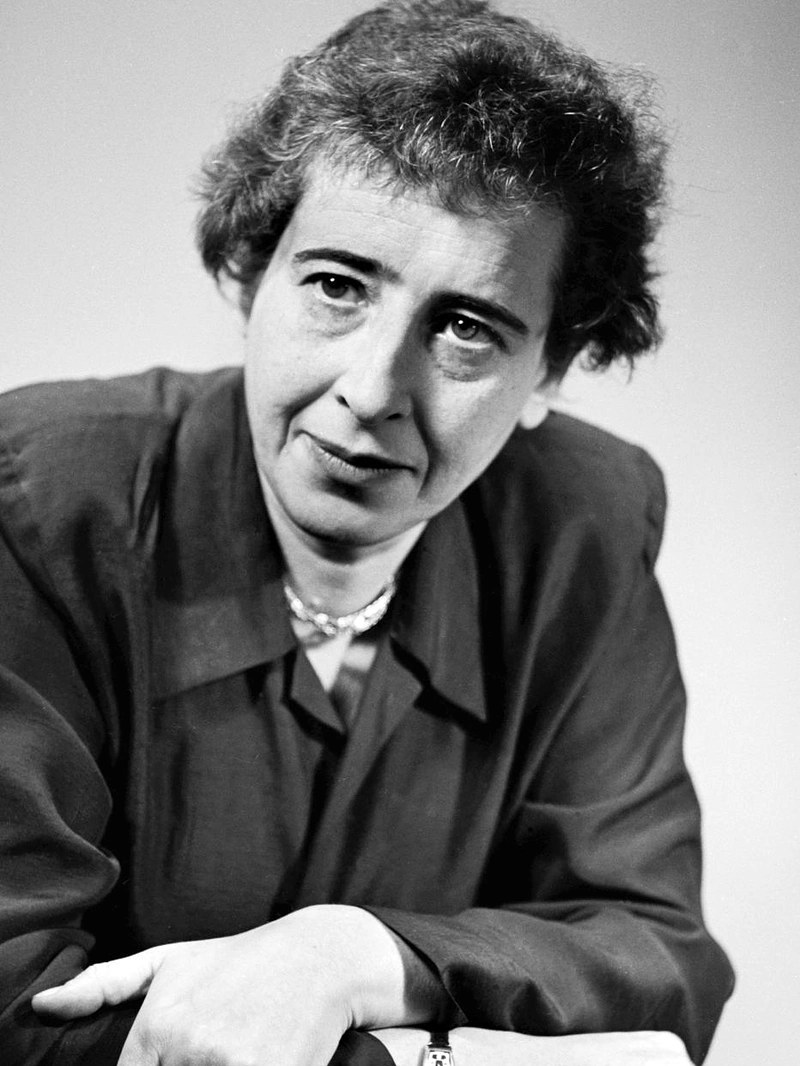
Attr: Commonweal Magazine
| 40 Quotes | |
| Occup. | Historian |
| From | Germany |
| Born | October 14, 1906 Linden (Hanover), German Empire |
| Died | December 4, 1975 New York City, United States |
| Cause | Heart attack |
| Aged | 69 years |
| Cite | |
Citation Formats
APA Style (7th ed.)
Hannah arendt biography, facts and quotes. (2026, February 11). FixQuotes. https://fixquotes.com/authors/hannah-arendt/
Chicago Style
"Hannah Arendt biography, facts and quotes." FixQuotes. February 11, 2026. https://fixquotes.com/authors/hannah-arendt/.
MLA Style (9th ed.)
"Hannah Arendt biography, facts and quotes." FixQuotes, 11 Feb. 2026, https://fixquotes.com/authors/hannah-arendt/. Accessed 26 Mar. 2026.
Early Life and Background
Hannah Arendt was born on October 14, 1906, in Linden, then a separate town near Hanover, into a secular Jewish family shaped by German culture and the aftershocks of empire. Her parents, Paul and Martha Arendt, soon returned east to Konigsberg in East Prussia, the city of Kant, whose civic pride in reason and law contrasted with the rising street-level poison of modern antisemitism. Paul Arendt died in 1913 after years of illness, leaving Martha to raise Hannah with a fierce independence that would become both armor and method: Arendt learned early that stability could vanish without warning, and that public life could not be trusted to protect the vulnerable.The First World War and the turbulent Weimar years formed her political weather. Konigsberg offered libraries and debate, but also the early signals of a Germany splintering into ideological camps. Arendt developed the temperament of an outsider who refused the consolations of belonging. Long before exile made her a refugee, she cultivated a habit of mental emigration - the ability to live in argument rather than tribe, and to treat the public realm as something constructed, fragile, and therefore ethically demanding.
Education and Formative Influences
Arendt studied philosophy and theology at the University of Marburg under Martin Heidegger, then moved to Freiburg to hear Edmund Husserl and to Heidelberg to complete her doctorate with Karl Jaspers in 1929, writing on St. Augustine's concept of love. Heidegger awakened her sense of thinking as an event; Jaspers modeled intellectual conscience and political responsibility. The combination left her suspicious of systems and devoted to judgment: thinking had to face the world without dissolving it into abstractions. Her early scholarly focus on love, natality, and the human capacity to begin again quietly prefigured the political vocabulary she later forged under far harsher conditions.Career, Major Works, and Turning Points
After Hitler's rise in 1933, Arendt was briefly arrested in Berlin for gathering evidence of Nazi antisemitic propaganda, then fled to Paris, where she worked with Jewish refugee organizations and married Heinrich Blucher in 1940. Interned at Gurs after the fall of France, she escaped and reached New York in 1941, rebuilding a life in English while reporting and editing for Jewish publications. Her breakthrough came with The Origins of Totalitarianism (1951), a vast diagnosis of imperialism, antisemitism, and the new machinery of terror; she followed with The Human Condition (1958), On Revolution (1963), and the contentious Eichmann in Jerusalem (1963), whose phrase "the banality of evil" made her both famous and fiercely disputed. Later works such as On Violence (1970) and The Life of the Mind (left incomplete at her death on December 4, 1975, in New York) deepened her inquiry into the links between thinking, willing, judging, and political freedom.Philosophy, Style, and Themes
Arendt wrote as a historian of ideas and institutions, but also as a diagnostician of moral weather - the subtle shifts by which ordinary life becomes compatible with atrocity. She distrusted the language of inevitability and the seductions of collective alibis, insisting that politics begins where individuals appear to one another as distinct "whos" and not as mere functions. Her prose is argumentative, classical in its taste for exempla, yet driven by the urgency of a refugee who had watched legality dissolve. She treated totalitarianism not as an exaggeration of tyranny but as a novel form of domination that aimed to make human spontaneity itself superfluous.Her most unsettling psychological claim is that evil can be shallow, produced by vacancy rather than demonic will: “The sad truth is that most evil is done by people who never make up their minds to be good or evil”. That line is less an excuse than a warning about thoughtlessness - the failure to conduct an inner dialogue capable of saying no. She also rejected the moral anesthesia of universal blame: "Where all are guilty, no one is; confessions of collective guilt are the best possible safeguard against the discovery of culprits, and the very magnitude of the crime the best excuse for doing nothing" [QuoteID=845
Our collection contains 40 quotes written by Hannah, under the main topics: Witty One-Liners - Ethics & Morality - Truth - Wisdom - Art.
Other people related to Hannah: Alfred Kazin (Critic), Mark Crispin Miller (Journalist)