
Hanoi Hannah Biography Quotes 20 Report mistakes
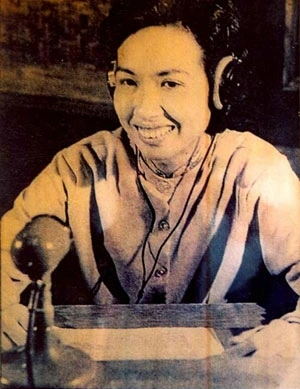
| 20 Quotes | |
| Born as | Trịnh Thị Ngọ |
| Occup. | Celebrity |
| From | Vietnam |
| Born | 1931 Hanoi, Vietnam |
| Cite | |
Citation Formats
APA Style (7th ed.)
Hanoi hannah biography, facts and quotes. (2026, February 11). FixQuotes. https://fixquotes.com/authors/hanoi-hannah/
Chicago Style
"Hanoi Hannah biography, facts and quotes." FixQuotes. February 11, 2026. https://fixquotes.com/authors/hanoi-hannah/.
MLA Style (9th ed.)
"Hanoi Hannah biography, facts and quotes." FixQuotes, 11 Feb. 2026, https://fixquotes.com/authors/hanoi-hannah/. Accessed 5 Mar. 2026.
Early Life and Background
Trinh Thi Ngo (often rendered Trinh Thi Ngo), later known to American listeners as "Hanoi Hannah", was born around 1931 in Vietnam, in a society being pulled between colonial rule, war, and the rising promise of independence. Her childhood unfolded against the long arc of French Indochina, when radio, print, and rumor carried politics into homes that had little formal power. Those early years, when the public sphere was dangerous and information was a contested weapon, quietly trained a generation to hear the stakes inside every phrase.In the North, revolutionary legitimacy was built not only on battlefield endurance but on narrative discipline - who could explain suffering, assign purpose, and claim the future. Ngo grew up in that moral weather. Later portrayals often reduce her to a single voice aimed at Americans, but the deeper story begins with a young woman absorbing how national survival could depend on language: the careful use of tone, the calibrated appeal to emotion, and the authority conferred by speaking as if history itself were listening.
Education and Formative Influences
She learned English well enough to work in broadcasting and translation, a rare and valuable skill in a country where international contact was limited and politically charged. Her formative influences were practical rather than literary: newsroom routines, the discipline of state media, and the constant necessity of matching words to policy. In North Vietnam, especially during the U.S. war years, radio was not entertainment but an instrument of statecraft, and a broadcaster was expected to be both technician and cadre - someone whose voice could carry certainty during uncertainty.Career, Major Works, and Turning Points
Ngo became a prominent English-language announcer for Radio Hanoi (Voice of Vietnam) during the Vietnam War, the figure Americans nicknamed "Hanoi Hannah" for her English broadcasts aimed at U.S. troops and the U.S. public. She read news, casualty lists, and political messaging designed to exploit homesickness, doubt, and the widening split between official U.S. rhetoric and soldiers' lived experience. Her signature opening framed the performance of authority: “This is the voice of Vietnam Broadcasting from Hanoi, capitol of the Democratic republic of Vietnam”. The turning point was not celebrity in the conventional sense, but recognition that her voice had become a battlefield asset - a recurring presence in the auditory life of men stationed far from home, and a symbol, to supporters and detractors alike, of psychological warfare conducted through cadence and facts.Philosophy, Style, and Themes
Her broadcasts blended propaganda with journalism-like detail: references to troop movements, protests in the United States, and the names of captured or killed servicemen. The technique was intimacy-by-precision, a style meant to produce the unsettling feeling that the enemy knew you personally. She did not present herself as a screaming ideologue; she cultivated the steadiness of a newscaster, making persuasion feel like information. In later reflections, she described her mission with a civic pragmatism that also reveals her self-concept - not as performer but as participant in national defense: “I had to do something for the country”. That sentence captures an inner life shaped by duty, where personal ambition dissolves into collective necessity.The themes running through her work were legitimacy, moral comparison, and the attempt to convert American democratic ideals into an argument against American policy. She framed war as a crisis of comprehension and consent, insisting that confusion itself was an indictment: “Nothing is more confused than to be ordered into a war to die or to be maimed for life without the faintest idea of what's going on”. Psychologically, this is not merely taunting; it is an effort to offer soldiers an interpretive ladder out of fear, toward anger at distant decision-makers. She also positioned her broadcast as aligned with domestic U.S. dissent, treating antiwar speech as usable evidence: “And we broadcast tapes sent to us from Americans against the war. These were most effective I believe”. Her method depended on borrowing American voices to weaken the boundary between home and front, making the conflict feel less like a foreign contest than a contested national story.
Legacy and Influence
"Hanoi Hannah" endures as an emblem of wartime radio: the voice as weapon, the microphone as a strategic tool, and the uneasy overlap between information and coercion. In American memory she is often filed under "propaganda", but her significance is broader - she demonstrates how modern conflict recruits broadcasters into roles that are part journalist, part actor, part state agent. In Vietnamese history she represents the media cadre who fought without a rifle, turning language into leverage during a long, grinding war whose meaning was argued as fiercely as it was fought.Our collection contains 20 quotes written by Hanoi, under the main topics: Funny - Writing - Freedom - Work Ethic - Military & Soldier.
Source / external links