
Harry S. Truman Biography Quotes 59 Report mistakes
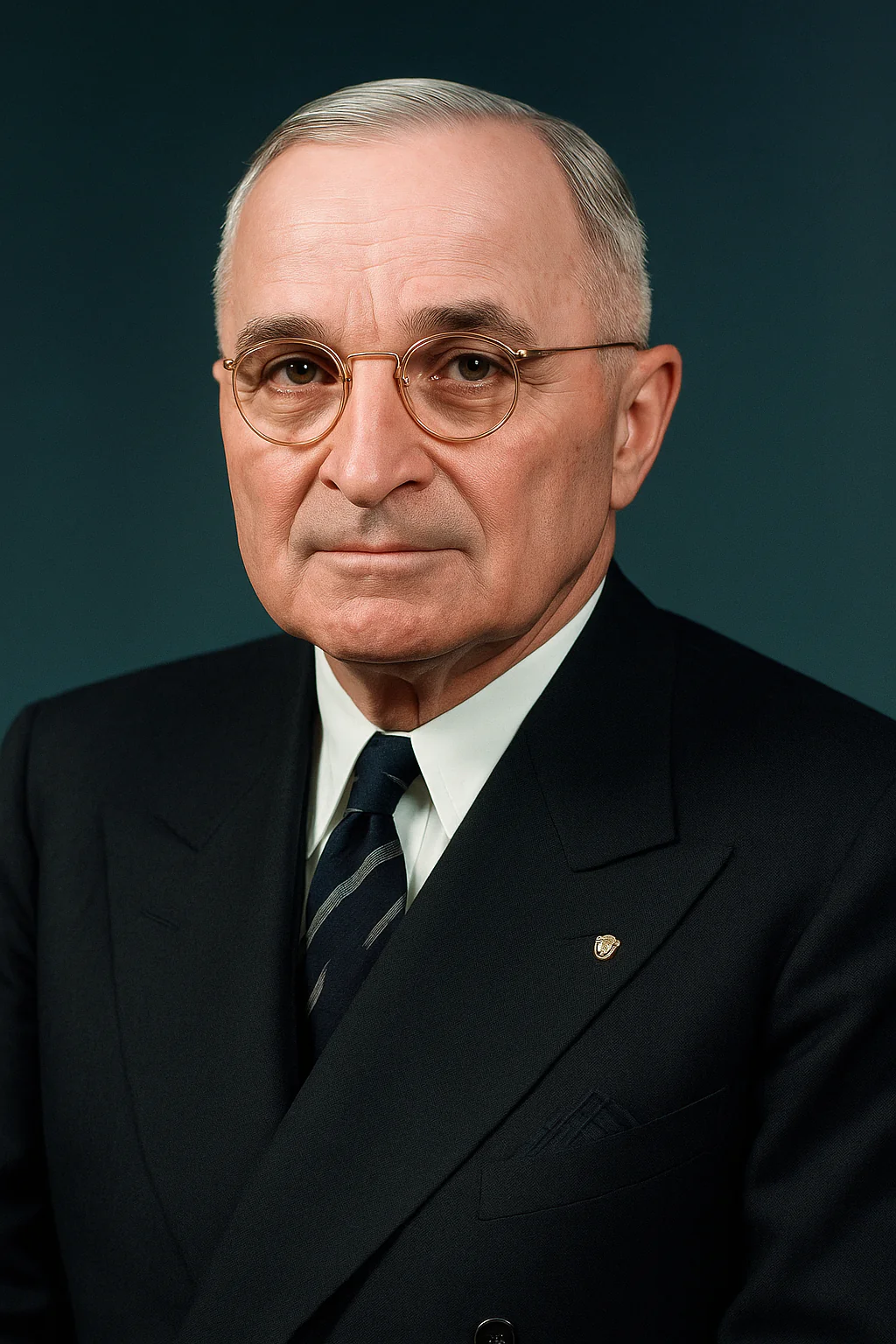
| 59 Quotes | |
| Occup. | President |
| From | USA |
| Spouse | Bess Wallace (1919) |
| Born | May 8, 1884 Lamar, Missouri, USA |
| Died | December 26, 1972 Kansas City, Missouri, USA |
| Aged | 88 years |
| Cite | |
Citation Formats
APA Style (7th ed.)
Harry s. truman biography, facts and quotes. (2026, February 1). FixQuotes. https://fixquotes.com/authors/harry-s-truman/
Chicago Style
"Harry S. Truman biography, facts and quotes." FixQuotes. February 1, 2026. https://fixquotes.com/authors/harry-s-truman/.
MLA Style (9th ed.)
"Harry S. Truman biography, facts and quotes." FixQuotes, 1 Feb. 2026, https://fixquotes.com/authors/harry-s-truman/. Accessed 22 Mar. 2026.
Early Life and Background
Harry S. Truman was born May 8, 1884, in Lamar, Missouri, and was raised mostly in Independence, a river-and-rail town where Baptist piety, Democratic partisanship, and small-business striving shaped civic life. His parents, John Anderson Truman and Martha Ellen Young Truman, gave him a family identity that was both frontier-proud and status-conscious: his mother carried stories of Confederate sympathy and local prominence, while his father moved through farming and livestock ventures that taught the boy how quickly fortune could thin. Truman grew up with poor eyesight, which pushed him toward indoor discipline - books, music, and the habit of memorizing facts - and away from the athletic hierarchy that governed boys his age.What he lacked in inherited ease he compensated for with a kind of tight self-command. The young Truman worked early, read constantly, and absorbed the moral cadence of a community that admired thrift and distrusted pretension. A formative romance, his long pursuit of Elizabeth "Bess" Wallace, also fixed his emotional center: he wanted the approval of a woman and a family that seemed more socially secure than his own. Independence became his lifelong compass point, the place to which he returned after global decisions, and the lens through which he judged political sophistication.
Education and Formative Influences
Truman graduated from Independence High School in 1901, but family finances kept him from college; instead he cycled through clerking jobs in Kansas City banks and offices, then returned to the family farm near Grandview. His real education was self-directed: Plutarch and history, the Bible and biographies of presidents, and years of serious piano practice that trained patience, touch, and an ear for structure. World War I completed his formation. In 1917 he joined the Missouri National Guard and went to France as an artillery officer; commanding Battery D, 129th Field Artillery, he learned to manage men under stress and to translate fear into procedure - a template he later applied to the presidency.Career, Major Works, and Turning Points
After the war Truman and a friend opened a Kansas City haberdashery; it failed in the 1921 downturn, leaving him in debt but also inoculated against glamour. With backing from the Kansas City Democratic machine led by Tom Pendergast, he won election in 1922 as a county judge (an administrative post) and, after a defeat, returned in 1926 as presiding judge, building roads and modernizing county finances with an engineer's attention to bids and audits. In the U.S. Senate (elected 1934), he rose from "machine" stigma to national credibility through the Truman Committee (1941-44), which investigated wartime contracting waste and saved billions while burnishing his reputation for blunt honesty. Franklin D. Roosevelt made him vice president in January 1945; on April 12, 1945, Truman became president. Within months he authorized the use of atomic bombs against Hiroshima and Nagasaki, recognized the state of Israel (1948), launched the Marshall Plan and NATO, and set the Cold War architecture. The Berlin Airlift (1948-49), the 1948 upset election victory, the desegregation of the armed forces (Executive Order 9981, 1948), and the decision to fight in Korea under UN auspices (1950) defined a presidency of continual crisis, culminating in his firing of Gen. Douglas MacArthur in 1951 and the contested limits of civilian control.Philosophy, Style, and Themes
Truman's inner life was a friction between humility and pride: he never stopped feeling like a man without elite credentials, yet he believed fiercely in the legitimacy of common judgment. His political philosophy was practical liberalism rooted in New Deal economics and constitutional boundaries - help citizens, but keep power accountable. He feared that efficiency could become an excuse for coercion, insisting, “When you have an efficient government, you have a dictatorship”. That suspicion of overconcentrated authority coexisted with his readiness to act decisively, even unilaterally, when he believed delay would cost lives or invite aggression.His style was direct, sometimes caustic, and stubbornly untheatrical. He valued loyalty but distrusted Washington's social ecology, a distrust captured in his bleak joke, “You want a friend in Washington? Get a dog”. Yet he also had a craftsman's view of leadership as work rather than performance, and he could be unusually indifferent to personal applause when pursuing a goal: “It is amazing what you can accomplish if you do not care who gets the credit”. The themes that recur in his decisions - civilian supremacy over the military, the moral necessity of alliances, the dignity of ordinary labor, and the belief that courage is a civic habit - were reinforced by a lifetime of setbacks that taught him to treat politics not as charm but as endurance.
Legacy and Influence
Truman left office in 1953 unpopular and exhausted, but his reputation rose as the Cold War order he helped design proved durable: containment, the Marshall Plan, NATO, and the precedent that presidents could commit U.S. power quickly while still insisting on civilian control. His desegregation order and his civil rights commission report, To Secure These Rights (1947), marked an early federal turn toward equality that later presidents expanded. In retirement in Independence he wrote memoirs, defended controversial choices, and lived plainly, becoming a model of the "accidental president" who nonetheless forged doctrine. Modern leadership lore still circles back to his combination of moral plainness and hard choice - a reminder that American power, in his hands, was less a performance of certainty than a discipline of decision under imperfect information.Our collection contains 59 quotes written by Harry, under the main topics: Witty One-Liners - Motivational - Truth - Wisdom - Art.
Other people related to Harry: Bess Truman (First Lady), Sam Rayburn (Politician), James F. Byrnes (Politician), George D. Aiken (Politician), Alexander Wiley (Politician), Tojo Hideki (Statesman), George Gallup (Businessman), Virginia Gildersleeve (Celebrity), Miguel Ferrer (Actor), James Bryant Conant (Scientist)
Frequently Asked Questions
- Bess Truman: His wife; U.S. First Lady, 1945–1953
- USS Harry S Truman: Nimitz-class aircraft carrier (CVN-75), commissioned 1998
- Harry S Truman books: Memoirs: Year of Decisions; Years of Trial and Hope; Mr. Citizen
- Harry S Truman political Party: Democratic Party
- How old was Harry S. Truman? He became 88 years old
Harry S. Truman Famous Works
- 1960 Mr. Citizen (Memoir)
- 1953 Farewell Address to the Nation (Speech)
- 1949 Inaugural Address, January 20, 1949 (Speech)
- 1947 Special Message to the Congress on Civil Rights (Speech)
- 1947 Special Message to the Congress on Greece and Turkey (The Truman Doctrine) (Speech)
- 1945 Statement by the President on the Bombing of Hiroshima (Speech)