
Helen Keller Biography Quotes 64 Report mistakes
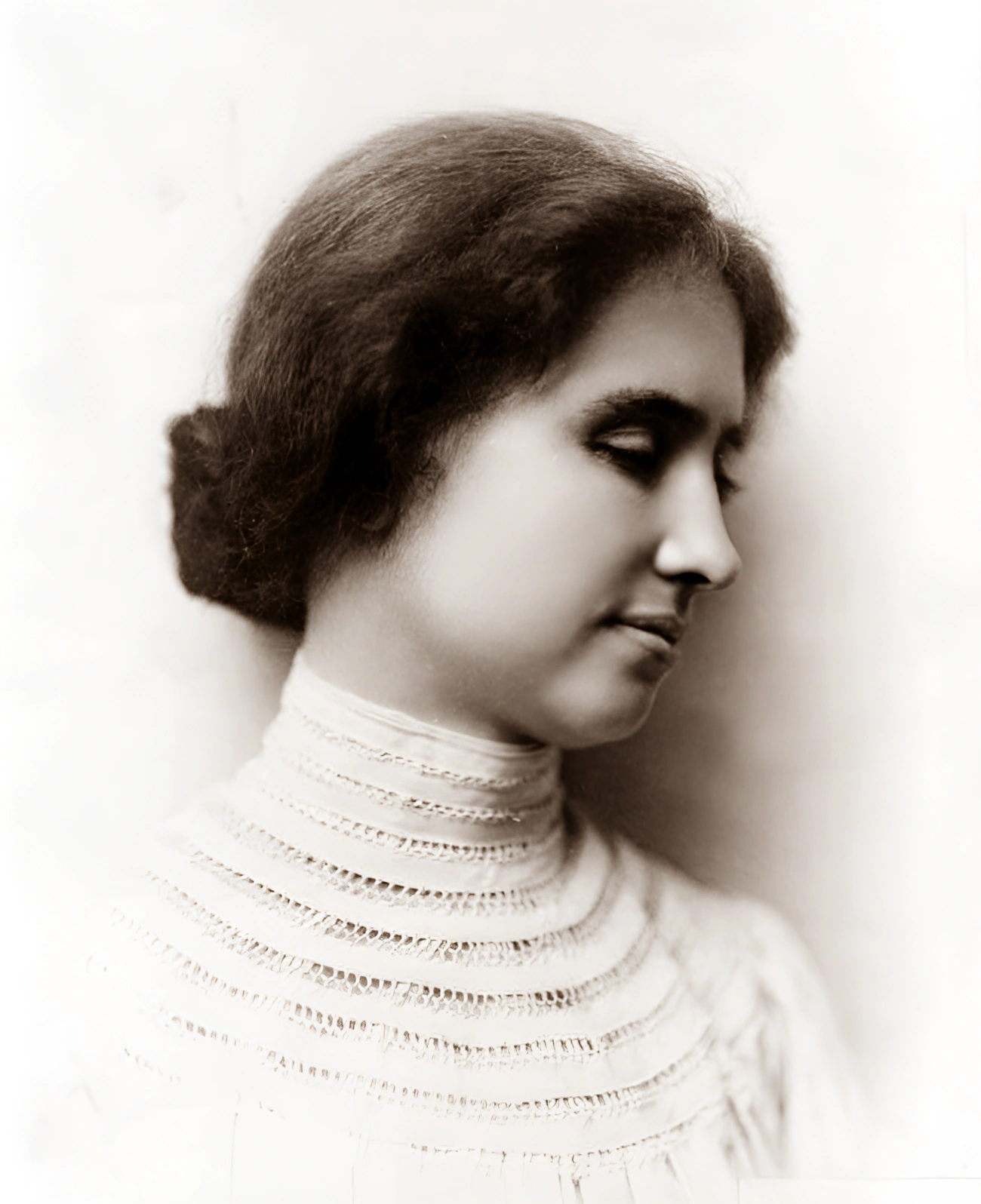
| 64 Quotes | |
| Born as | Helen Adams Keller |
| Occup. | Author |
| From | USA |
| Born | June 27, 1880 Tuscumbia, Alabama, USA |
| Died | June 1, 1968 Easton, Connecticut, USA |
| Cause | Natural causes |
| Aged | 87 years |
| Cite | |
Citation Formats
APA Style (7th ed.)
Helen keller biography, facts and quotes. (2026, February 11). FixQuotes. https://fixquotes.com/authors/helen-keller/
Chicago Style
"Helen Keller biography, facts and quotes." FixQuotes. February 11, 2026. https://fixquotes.com/authors/helen-keller/.
MLA Style (9th ed.)
"Helen Keller biography, facts and quotes." FixQuotes, 11 Feb. 2026, https://fixquotes.com/authors/helen-keller/. Accessed 5 Mar. 2026.
Early Life and Background
Helen Adams Keller was born on June 27, 1880, in Tuscumbia, Alabama, on the family homestead Ivy Green, a landscape shaped by the long aftershock of the Civil War and Reconstruction. Her father, Arthur H. Keller, edited the North Alabamian and had been a Confederate officer; her mother, Kate Adams Keller, came from a more affluent Alabama family. The household embodied the postwar South's hierarchies and tensions, yet Keller's earliest memories, as she later recalled, were of sensory abundance - sun on the porch, the feel of water, the rhythms of a rural town.In February 1882, a severe illness - likely scarlet fever or meningitis - left her deaf and blind at nineteen months. The loss did not make her passive; it made her furious at the boundaries of an unlit, soundless world. Before language, her intelligence expressed itself as will: she learned the geography of rooms by touch, communicated through improvised home signs, and fought to control her environment, a pattern that would later transform into disciplined activism. The family's search for help took them to specialists in the emerging field of deaf-blind education, reflecting a late-19th-century America newly confident in science and institutions, yet still uncertain about disability beyond charity.
Education and Formative Influences
In 1887 the Kellers brought seven-year-old Helen to Anne Mansfield Sullivan, a 20-year-old graduate of the Perkins Institution for the Blind in Boston, whose own childhood poverty and partial blindness had forged both empathy and rigor. At Ivy Green's pump, Sullivan spelled W-A-T-E-R into Helen's hand as water ran over the other - the famous moment when sensation clicked into symbol and the world acquired names. Keller's education became a three-way conversation among Keller's appetite for meaning, Sullivan's relentless method, and a wider network: Perkins faculty, Alexander Graham Bell (an advocate of oral education for the deaf), and later John Macy, a Harvard-educated editor who married Sullivan. Keller attended the Wright-Humason School for the Deaf in New York, then the Cambridge School for Young Ladies, and entered Radcliffe College in 1900, graduating cum laude in 1904, with Sullivan and a procession of readers and interpreters transmitting lectures into her hand.Career, Major Works, and Turning Points
Keller published while still a student, becoming both a literary figure and a public emblem: The Story of My Life (1903) offered a crafted autobiography that balanced intimacy with pedagogy, and The World I Live In (1908) explored her sensory cognition with philosophical ambition. Fame widened into authority, and authority into controversy when she embraced radical politics: she joined the Socialist Party in 1909, supported labor organizing, women suffrage, and later the American Civil Liberties Union (a founding member in 1920). After World War I, she became the best-known advocate of disability rights in the United States, working for the American Foundation for the Blind from 1924, raising funds and pressing for services, Braille access, and social inclusion. Her speaking tours across the United States, Europe, and Asia turned personal story into policy pressure, even as critics alternately sentimentalized her or tried to separate "inspiration" from her demands for economic justice.Philosophy, Style, and Themes
Keller wrote in a lucid, elevated prose shaped by 19th-century moral rhetoric and by her own dependence on precise conceptual scaffolding. She distrusted consolation that bypassed cognition, insisting, “I do not want the peace which passeth understanding, I want the understanding which bringeth peace”. Psychologically, that sentence reveals her central discipline: to convert deprivation into inquiry, and to treat knowledge not as ornament but as emotional survival. Her books and speeches return to the moment when an unnamed world became intelligible; from that origin she built an ethics of attention, arguing that the mind's light is neither automatic nor private, but made through effort, education, and shared language.Her themes also resist the lonely-hero narrative often imposed on her. Keller emphasized interdependence as a social fact, not a sentimental virtue: “Alone we can do so little; together we can do so much”. That conviction threads through her alliances with teachers, interpreters, donors, labor leaders, and blind communities; it also explains her impatience with charity that preserves inequality. Even her most quoted idealism is grounded in bodily experience and affective intelligence, insisting that value is apprehended through interior perception: “The best and most beautiful things in the world cannot be seen or even touched - they must be felt with the heart”. For Keller, "heart" was not a retreat from politics but a faculty that could recognize dignity where society trained itself not to.
Legacy and Influence
Helen Keller died on June 1, 1968, in Easton, Connecticut, having lived through industrialization, two world wars, the Great Depression, and the civil rights era - and having insisted that disability belonged within every one of those histories. Her legacy is double-edged: she remains an enduring symbol of education's power, yet her fuller influence lies in how she fused personal narrative with structural critique, linking blindness to poverty, workplace injury, and unequal access to culture. Writers, educators, and disability-rights advocates continue to argue with the myth and return to the record: a major American author who mastered the memoir form, expanded the public imagination of language and perception, and used celebrity not to soften conflict but to demand a more legible, more equal society.Our collection contains 64 quotes written by Helen, under the main topics: Motivational - Ethics & Morality - Wisdom - Truth - Justice.
Other people related to Helen: Patty Duke (Actress), Anne Sullivan (Educator)
Helen Keller Famous Works
- 1940 Let Us Have Faith (Book)
- 1929 Midstream: My Later Life (Autobiography)
- 1927 My Religion (Book)
- 1913 Out of the Dark (Book)
- 1908 The World I Live In (Book)
- 1903 The Story of My Life (Autobiography)
Source / external links