
Henry Ford Biography Quotes 50 Report mistakes
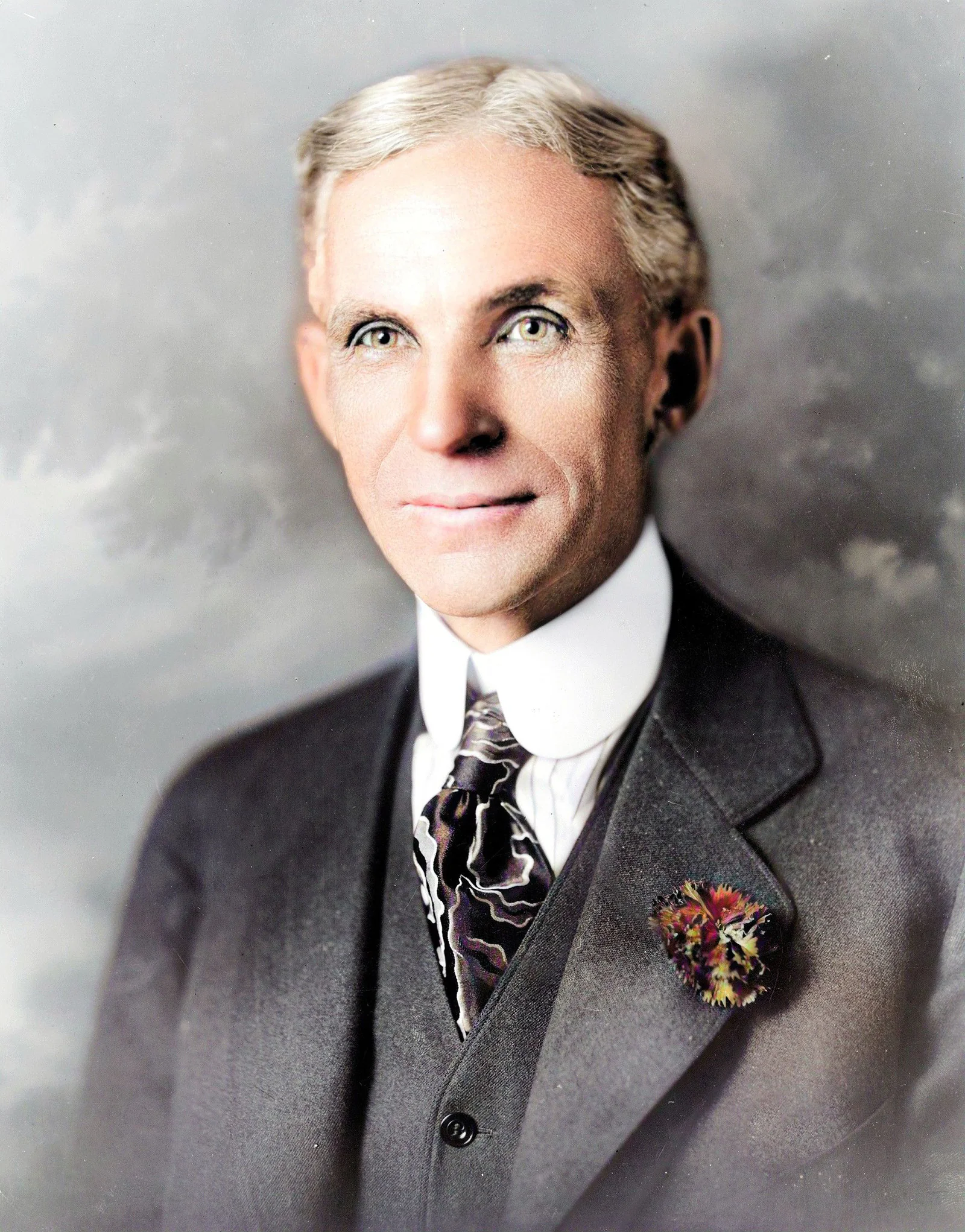
Attr: Hartsook
| 50 Quotes | |
| Occup. | Businessman |
| From | USA |
| Born | July 30, 1863 Greenfield Township, Michigan, USA |
| Died | April 7, 1947 Dearborn, Michigan, USA |
| Cause | Cerebral hemorrhage |
| Aged | 83 years |
| Cite | |
Citation Formats
APA Style (7th ed.)
Henry ford biography, facts and quotes. (2026, February 1). FixQuotes. https://fixquotes.com/authors/henry-ford/
Chicago Style
"Henry Ford biography, facts and quotes." FixQuotes. February 1, 2026. https://fixquotes.com/authors/henry-ford/.
MLA Style (9th ed.)
"Henry Ford biography, facts and quotes." FixQuotes, 1 Feb. 2026, https://fixquotes.com/authors/henry-ford/. Accessed 5 Mar. 2026.
Early Life and Background
Henry Ford was born July 30, 1863, on a farm in Springwells Township, Michigan, just outside Detroit, into the practical world of post-Civil War rural America. His parents, William and Mary Ford, were Irish immigrants and farmers, and the household ran on the strict arithmetic of seasons, tools, and debt. Ford later described the farm as a place that taught him endurance but not belonging - he disliked repetitive agricultural labor and felt more drawn to mechanisms than to soil.A childhood fascination with clocks and machinery became a private refuge and a quiet declaration of difference. After his mother died in 1876, the family structure that had anchored him loosened; he grew more determined to leave farm life behind. Detroit, a growing industrial city tied to railroads, engines, and machine shops, represented not only opportunity but an entire moral alternative: human-made systems that could be improved, accelerated, and standardized.
Education and Formative Influences
Ford had limited formal schooling, attending local one-room schools and learning mostly by observation, tinkering, and apprenticeship. At 16 he left for Detroit to work as a machinist apprentice, later returning intermittently to the farm while taking repair work and absorbing the culture of precision metalwork. In the 1890s he worked at Edison Illuminating Company in Detroit, rising to chief engineer; there he encountered the practical electricity boom and, crucially, gained the income and confidence to pursue gasoline engines. A celebrated meeting with Thomas Edison in 1896 validated Ford's instincts and pushed him toward building vehicles rather than merely repairing machines.Career, Major Works, and Turning Points
Ford built his first gasoline vehicle, the Quadricycle, in 1896; early ventures faltered, but in 1903 he co-founded Ford Motor Company and soon proved his engineering and promotional gifts with models like the 1908 Model T. The turning point came with manufacturing: the Highland Park plant perfected moving assembly-line methods by 1913-1914, radically reducing build time and cost, and Ford stunned industry with the 1914 five-dollar day, meant to stabilize labor, reduce turnover, and bind workers to a disciplined, moralized corporate order. The company expanded into River Rouge's vertically integrated complex and dominated mass automobility, yet Ford's era also included darker currents - his anti-union security regime, paternalistic "Sociological Department", and his antisemitic newspaper campaign in The Dearborn Independent (compiled as The International Jew) that damaged lives and his reputation. In the 1940s, as age and illness narrowed his control, labor conflict culminated in the 1941 recognition of the UAW; he died April 7, 1947, in Dearborn, Michigan.Philosophy, Style, and Themes
Ford's inner life mixed intense mechanical clarity with a moral absolutism about work, thrift, and "usefulness". He saw the factory not merely as a profit machine but as an instrument to reorganize society: regular wages, predictable schedules, standardized goods, and a disciplined workforce. His optimism about production was paired with suspicion of finance and intermediaries; he preferred tangible processes he could see and measure, and he often framed economic problems as failures of organization rather than limits of resources.This mentality appears in his aphorisms, which sound like shop-floor rules elevated to ethics. “Nothing is particularly hard if you divide it into small jobs”. The sentence captures both the assembly line and his psychological comfort with decomposition - breaking complex uncertainty into controllable tasks. The same sensibility underwrote his famous constraint-driven consumer strategy: “Any colour - so long as it's black”. It was not simply stubbornness; it was a wager that standardization could democratize technology, making the car a tool of ordinary life. Yet Ford's collectivist-sounding rhetoric also reveals his demand for conformity and coordination: “If everyone is moving forward together, then success takes care of itself”. In Ford's world, the group moves as one because the system has been engineered to allow few surprises - a vision that produced unprecedented abundance while narrowing room for dissent.
Legacy and Influence
Ford helped define the 20th century's mass-production economy and the social geography built around the automobile - suburbs, highways, commuting, and an expectation that industrial goods should be affordable to the many, not the few. "Fordism" became shorthand for high wages paired with high output, a model that influenced factories worldwide and even political debates about capitalism's stability. His legacy, however, is inseparable from the human costs of speedup, surveillance, and the prejudice he publicized; biographers return to him because he embodies the era's central contradiction: the capacity to enlarge everyday freedom through technology while attempting to control the people who made it.Our collection contains 50 quotes written by Henry, under the main topics: Witty One-Liners - Motivational - Wisdom - Truth - Justice.
Other people related to Henry: E. L. Doctorow (Author), Napolean Hill (Author), John L. Lewis (Leader), Mo Rocca (Writer)
Henry Ford Famous Works
- 1930 Moving Forward (Book)
- 1926 Today and Tomorrow (Book)
- 1922 My Life and Work (Autobiography)
- 1920 The International Jew: The World's Foremost Problem (Book)
Source / external links