
Heraclitus Biography Quotes 34 Report mistakes
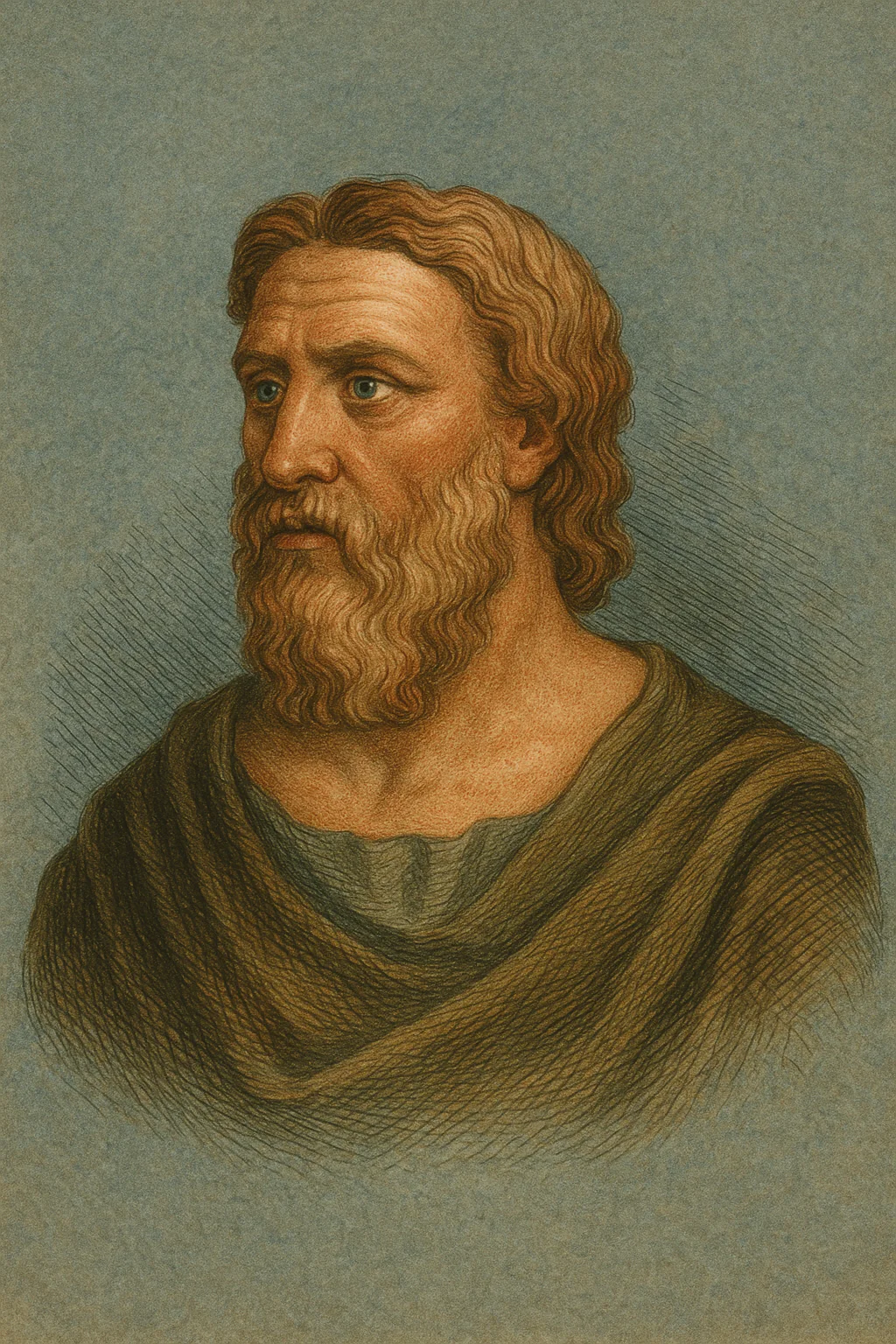
| 34 Quotes | |
| Known as | The Obscure |
| Occup. | Philosopher |
| From | Greece |
| Born | 544 BC Ephesus, Ionia, Greece |
| Died | 483 BC Ephesus, Ionia, Greece |
| Cause | Natural Causes |
| Cite | |
Citation Formats
APA Style (7th ed.)
Heraclitus biography, facts and quotes. (2026, February 1). FixQuotes. https://fixquotes.com/authors/heraclitus/
Chicago Style
"Heraclitus biography, facts and quotes." FixQuotes. February 1, 2026. https://fixquotes.com/authors/heraclitus/.
MLA Style (9th ed.)
"Heraclitus biography, facts and quotes." FixQuotes, 1 Feb. 2026, https://fixquotes.com/authors/heraclitus/. Accessed 25 Mar. 2026.
Early Life and Background
Heraclitus of Ephesus was born around 544 BCE in the Ionian Greek city of Ephesus, then a wealthy maritime crossroads on the coast of Anatolia where Greek, Lydian, and Persian worlds overlapped. His lifetime spanned the hardening of Achaemenid Persian rule in Ionia after Cyrus and the suppression of the Ionian Revolt (499-493 BCE), an era that made questions of law, power, and civic identity impossible to treat as abstractions. Ephesus itself was defined by the great sanctuary of Artemis and by an elite culture that prized lineage, public display, and competitive honor.Ancient reports portray him as aristocratic by birth and temperament, even said to have relinquished civic privilege rather than participate in the citys politics as he found them. Whether literal or emblematic, the story fits the tone of his surviving fragments: a thinker who preferred solitude to persuasion and who wrote as if addressing a city that would not listen. He became, in later memory, the "Obscure" philosopher not merely for his compressed style but for a certain disdainful privacy - the stance of someone convinced that most people sleep through their own lives.
Education and Formative Influences
Heraclitus was not a schoolman but an Ionian intellectual formed in the wake of the early natural philosophers - especially the Milesians (Thales, Anaximander, Anaximenes) who sought lawful patterns beneath appearances - and in conversation with poets and sages whose authority came from performance and proverb. He seems to have absorbed both the scientific impulse toward an underlying order and the archaic Greek sense that character, conflict, and divinity are intertwined; he also reacted sharply against the prestige of learned accumulation, mocking figures such as Homer and Hesiod in fragments preserved by later writers. The result was a voice that feels like an oracle turned inside out: anti-credential, anti-crowd, yet intensely committed to a logos, a rational account that can be heard if ones soul is tuned.Career, Major Works, and Turning Points
Heraclitus wrote a single book, conventionally titled On Nature, deposited according to later tradition in the temple of Artemis at Ephesus; only fragments survive, preserved by authors from Plato and Aristotle to the Stoics, Plutarch, and Christian polemicists. The work does not read like a treatise but like a sequence of charged theses, images, and rebukes, circling a few central claims: the unity of opposites, the world as process, and the necessity of conflict. His life is thinly documented and quickly becomes anecdote: a man who withdrew from public affairs, who spoke in riddles, and who died around 483 BCE - some sources claiming illness and an odd end - leaving behind not disciples in the usual sense but a book that provoked interpretation for centuries.Philosophy, Style, and Themes
At the core of Heraclitus thought is flux disciplined by law: reality is not a stable inventory of things but a continuous transformation in which opposites interpenetrate. His most famous metaphor, the river, is not mere poetry but a theory of identity - persistence as pattern amid replacement. “No man ever steps in the same river twice, for it's not the same river and he's not the same man”. That sentence compresses his psychology as well as his physics: the self is not a fixed possession but a task, renewed by each encounter, and human certainty is always belated to the moving world.Yet Heraclitus is not a celebrant of chaos. Change, for him, is intelligible because it obeys logos - a common measure that most people ignore in favor of private opinion. This is why his aphorisms oscillate between cosmology and moral provocation. “A man's character is his fate”. He treats ethics as the deepest metaphysics: the way a person is shaped - by habit, desire, and attention - determines the world that can be seen and the future that will be lived. In the same spirit, he warns that perception is not automatically knowledge; the senses can mislead when the inner instrument is crude. “Eyes and ears are poor witnesses to people if they have uncultured souls”. The sting of that line explains his reputation for severity: he wrote not to comfort but to cultivate, using obscurity as a training regimen that forces readers to work toward the logos rather than consume conclusions.
Legacy and Influence
Heraclitus became a touchstone for later philosophy precisely because his fragments resist closure. Plato engages his doctrine of flux while trying to secure stable knowledge; Aristotle critiques him as an extreme, sharpening his own account of substance and change. The Stoics adopted Heraclitean fire, logos, and cyclical world-order as resources for their physics and ethics, and later thinkers returned to him whenever history felt like motion without rest. In modernity he reappears as a patron of process - in Hegelian dialectic, in Nietzschean agon, and in 20th-century reflections on language and becoming - while his austerity continues to attract readers who sense that his real subject was the soul under pressure: how to live lucidly when nothing stands still, and when the common law of the world is easiest to miss.Our collection contains 34 quotes written by Heraclitus, under the main topics: Motivational - Ethics & Morality - Truth - Wisdom - Justice.
Other people related to Heraclitus: Oswald Spengler (Philosopher)
Frequently Asked Questions
- On Nature Heraclitus: Title of his lost book; only fragments quoted by later writers remain.
- Heraclitus pronunciation: huh-RACK-li-tus (IPA: hə-ˈræk-lɪ-təs).
- Heraclitus meaning: The pre-Socratic thinker known for the view that everything flows and opposites coincide (flux and the Logos).
- Fragments Heraclitus: Short sayings preserved by later authors, about 120+ fragments on flux, Logos, and opposites.
- Heraclitus: books: He wrote one work, On Nature (lost); his ideas survive in fragment collections and translations.
- Heraclitus' philosophy: Constant change (flux), unity of opposites, the Logos as an ordering principle, and fire as the primary element.
Heraclitus Famous Works
- -500 On Nature (Philosophical treatise)
Source / external links