
Herbert Hoover Biography Quotes 35 Report mistakes
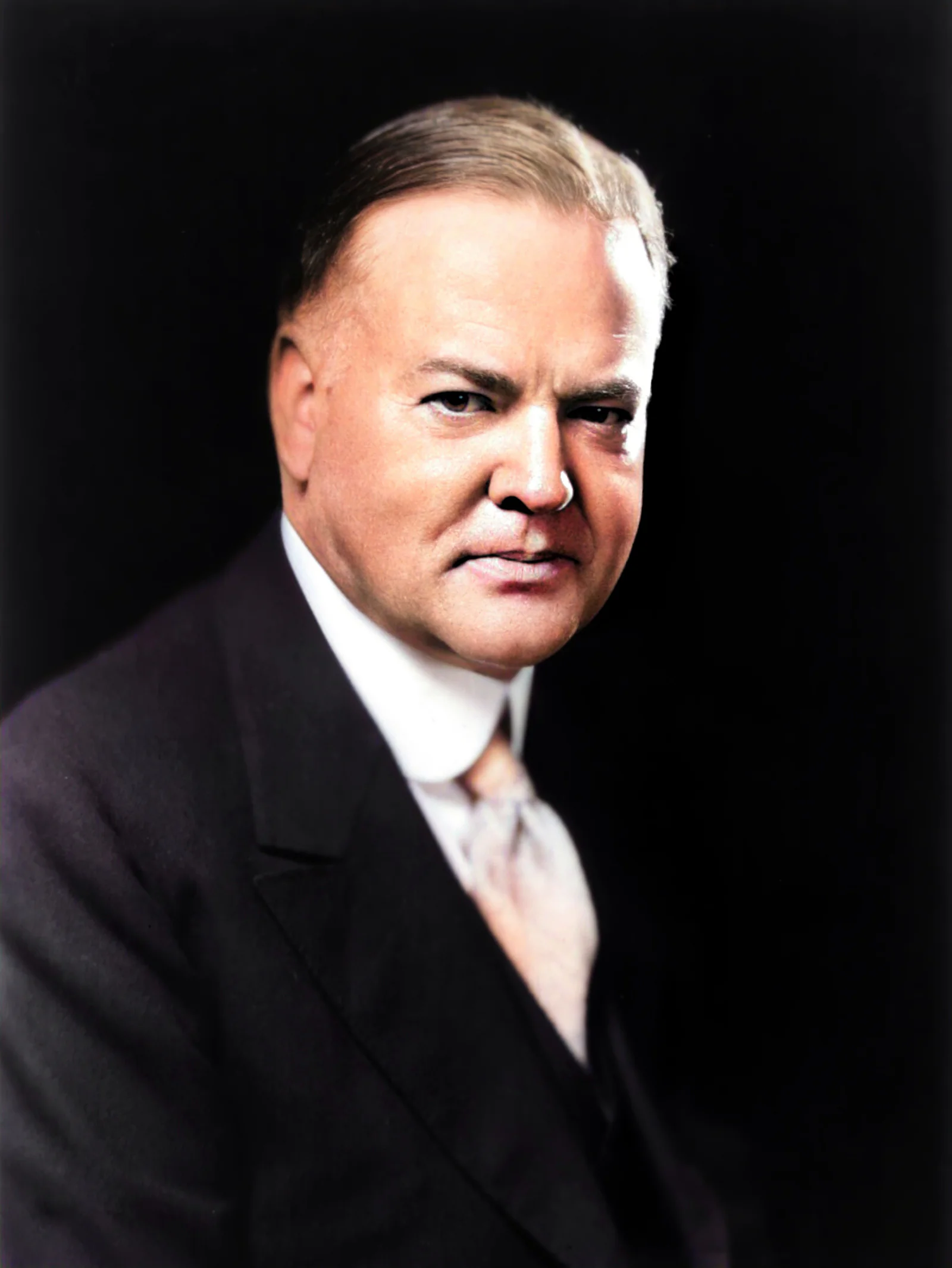
Attr: Library of Congress
| 35 Quotes | |
| Born as | Herbert Clark Hoover |
| Occup. | President |
| From | USA |
| Spouse | Lou Henry Hoover |
| Born | August 10, 1874 West Branch, Iowa, USA |
| Died | October 20, 1964 New York City, New York, USA |
| Cause | Heart attack |
| Aged | 90 years |
| Cite | |
Citation Formats
APA Style (7th ed.)
Herbert hoover biography, facts and quotes. (2026, February 1). FixQuotes. https://fixquotes.com/authors/herbert-hoover/
Chicago Style
"Herbert Hoover biography, facts and quotes." FixQuotes. February 1, 2026. https://fixquotes.com/authors/herbert-hoover/.
MLA Style (9th ed.)
"Herbert Hoover biography, facts and quotes." FixQuotes, 1 Feb. 2026, https://fixquotes.com/authors/herbert-hoover/. Accessed 25 Mar. 2026.
Early Life and Background
Herbert Clark Hoover was born on August 10, 1874, in West Branch, Iowa, a Quaker village shaped by plain speech, sobriety, and the moral idea that work should serve community. His father, Jesse Hoover, dealt in farm implements; his mother, Hulda Minthorn Hoover, was a ministerial figure in the local Friends meeting. The household blended piety with practicality, a mix that later surfaced in Hoover's lifelong urge to organize relief, balance ledgers, and speak of public life in the language of duty.Orphaned young - his father died when Herbert was six and his mother when he was nine - he became, early, a child of dislocation. He lived with relatives in Iowa and then moved to Oregon to the Minthorn side of the family, where his uncle, Dr. Henry Minthorn, ran a disciplined home and a bank. The experience left him with a private streak and an intense belief that stability is built, not given; it also trained his eye on how fragile family security can be when markets, illness, or accident break the chain.
Education and Formative Influences
Hoover entered the first class of Stanford University in 1891, studying geology under John Casper Branner and absorbing the engineering ethos of measurement, systems, and fieldwork. Stanford also introduced him to Lou Henry, a fellow Iowan and formidable scholar, whom he married in 1899; their partnership was intellectual as well as domestic, later producing a respected English translation of Georgius Agricola's De re metallica. The new West's optimism, the Progressive Era's faith in expertise, and Quaker restraint combined in Hoover into a distinctive temperament: intensely modern in method, morally conservative in tone, and suspicious of theatrical politics.Career, Major Works, and Turning Points
Starting as an engineer in the mining boom, Hoover built a global career from Western Australia to China, becoming a millionaire partner in international firms and a symbol of American technical prowess abroad; the Boxer Rebellion in 1900 even put the Hoovers in the orbit of violence and evacuation. World War I transformed him from engineer-capitalist to public organizer: he led the Commission for Relief in Belgium, then U.S. Food Administration, using data, persuasion, and voluntary compliance to feed allies without formal rationing. As Secretary of Commerce under Warren G. Harding and Calvin Coolidge, he pushed standardization, aviation and radio regulation, and conferences on unemployment and housing, making the department a laboratory for managerial government. Elected president in 1928, he faced the 1929 crash and the Great Depression; his administration backed the Reconstruction Finance Corporation, public works including the Boulder (later Hoover) Dam, and the controversial Smoot-Hawley tariff. Yet collapsing credit, bank failures, and mass unemployment outpaced his incrementalism, and the Bonus Army confrontation in 1932 hardened his image as aloof. Defeated by Franklin D. Roosevelt, he spent decades in opposition to the New Deal, then returned to public service after World War II by chairing the Hoover Commission (1947-49, 1953-55), reorganizing the executive branch and salvaging his reputation as a master of administrative architecture.Philosophy, Style, and Themes
Hoover's inner life was a contest between compassion and control. The relief administrator who moved ships, grain, and diplomacy to keep civilians alive did not lack empathy; but the president feared that compassion, once nationalized, could dissolve character and fiscal discipline. His public language often sounded like a moral engineer: incentives, credit, confidence, and voluntary association. He understood that modern economies run on trust as much as on steel, insisting, “Let me remind you that credit is the lifeblood of business, the lifeblood of prices and jobs”. In depression, he hesitated to treat the federal state as a direct employer of last resort, arguing instead that recovery must come through restored private circulation and production, a view he framed with almost biological imagery.That managerial worldview coexisted with a deeply held liberal fear of tyranny, sharpened by Europe's dictators and by wartime pressures on dissent. “It is a paradox that every dictator has climbed to power on the ladder of free speech. Immediately on attaining power each dictator has suppressed all free speech except his own”. For Hoover, liberty was not mere rhetoric but a condition of human dignity: “Freedom is the open window through which pours the sunlight of the human spirit and human dignity”. Those sentences reveal a man who, even when criticized for hardness at home, dreaded the moral corrosion of centralized power. His style - stiff, statistical, earnest - was less a failure of heart than an inability to translate private feeling into the consoling theater Americans wanted from a president amid catastrophe.
Legacy and Influence
Hoover died on October 20, 1964, in New York City, having lived long enough to see his era reinterpreted: the failed Depression president gradually rebalanced by recognition of his humanitarian achievements and his postwar institutional reforms. Historians still debate whether his caution was principled realism or tragic misreading of an unprecedented collapse, but his imprint endures in the modern presidency's administrative machinery, in the norms of international relief, and in the cautionary tale that technical competence alone cannot substitute for political empathy and narrative leadership when a nation is frightened.Our collection contains 35 quotes written by Herbert, under the main topics: Witty One-Liners - Ethics & Morality - Wisdom - Justice - Sarcastic.
Other people related to Herbert: Henry L. Stimson (Statesman), Charles Curtis (Vice President), Warren G. Harding (President), George William Norris (Politician), Henry Cantwell Wallace (Politician), Edward Bok (Editor)
Herbert Hoover Famous Works
- 1958 The Ordeal of Woodrow Wilson (Book)
- 1938 Addresses Upon The American Road (Book)
- 1934 The Challenge to Liberty (Book)
- 1922 American Individualism (Book)
- 1909 Principles of Mining (Book)
Source / external links