
Herbert Hoover Biography Quotes 35 Report mistakes
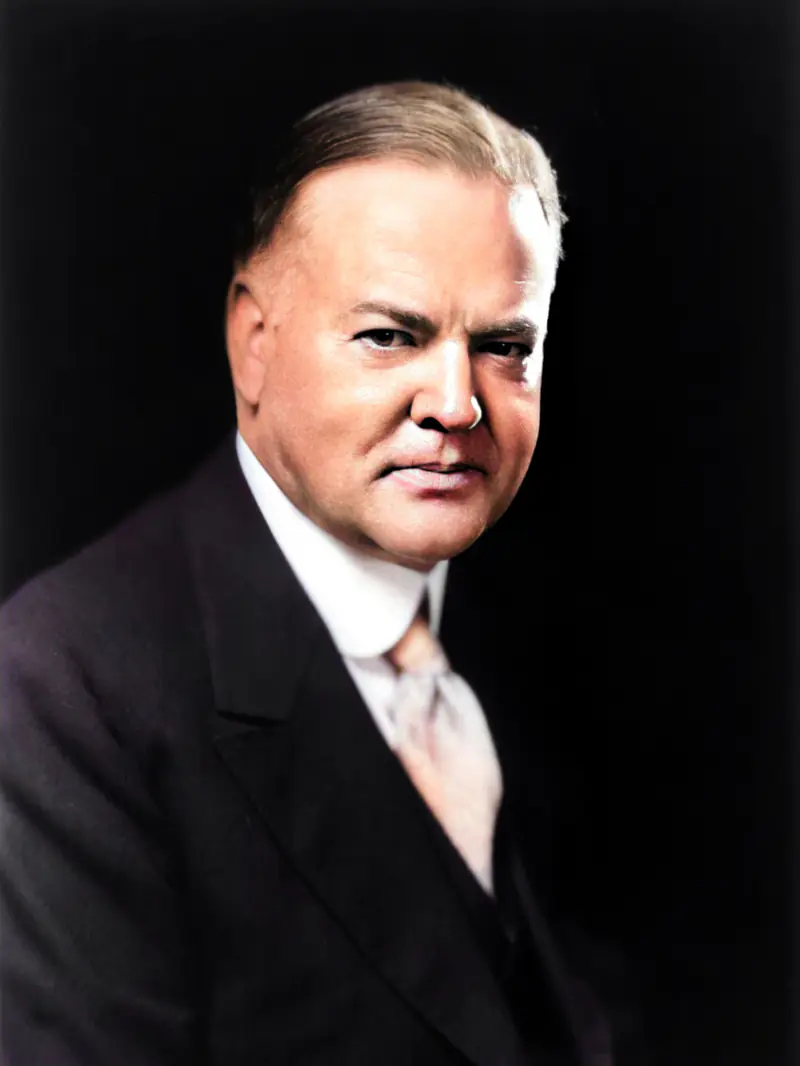
Attr: Library of Congress
| 35 Quotes | |
| Born as | Herbert Clark Hoover |
| Occup. | President |
| From | USA |
| Spouse | Lou Henry Hoover |
| Born | August 10, 1874 West Branch, Iowa, USA |
| Died | October 20, 1964 New York City, New York, USA |
| Cause | Heart attack |
| Aged | 90 years |
Herbert Clark Hoover was born on August 10, 1874, in West Branch, Iowa, to a Quaker family. Orphaned at a young age, he was taken in by relatives on his mother's side and raised in Oregon. The ethic of self-reliance, thrift, and public service he absorbed in his childhood remained a constant thread throughout his life.
Education and Early Engineering Career
Hoover entered the first class at Stanford University in 1891 and studied geology. Upon graduating in 1895, he became a mining engineer and quickly built a reputation for technical skill and organizational efficiency. His work took him to Australia and China, among other places. In 1899 he married Lou Henry, a fellow Stanford graduate; the partnership shaped the rest of his life. The couple were in Tientsin during the Boxer Rebellion of 1900, where they helped organize emergency efforts for besieged civilians. Over the next decade Hoover managed and reorganized mining operations on several continents, became financially independent, and with Lou Henry translated the classic mining treatise De Re Metallica into English. Their family grew to include two sons.
Humanitarian Leadership in World War I
When World War I broke out, Hoover emerged as a prominent organizer of relief. He initially coordinated assistance for Americans stranded in Europe, then led the Commission for Relief in Belgium. Working with Belgian leaders such as Emile Francqui and with the cooperation of warring governments, he oversaw the transport of massive quantities of food to civilians in Belgium and northern France. In 1917, President Woodrow Wilson asked him to head the U.S. Food Administration, where Hoover promoted conservation, voluntary rationing, and efficient distribution under the slogan that food could help win the war. After the armistice, he directed the American Relief Administration, which fed millions across a devastated Europe.
Secretary of Commerce
From 1921 to 1928 Hoover served as Secretary of Commerce under Presidents Warren G. Harding and Calvin Coolidge. He expanded the department's reach, promoted standardization in industry, and encouraged cooperation between business and government to improve productivity and safety. He sponsored national conferences on radio, traffic, and housing, helping shape emerging fields like broadcasting and aviation. His high-profile leadership of relief during the 1927 Mississippi River flood added to his national stature.
Election of 1928
In 1928 Hoover won the presidency as the Republican nominee, with Charles Curtis as his vice president, defeating Alfred E. Smith. He entered office with a reputation as an engineer-administrator who could apply practical methods to public problems. As president-elect, he traveled widely in Latin America and signaled a less interventionist approach that foreshadowed later policy developments.
Presidency and the Great Depression
The stock market crash in October 1929 was followed by a global economic collapse. Hoover responded with measures rooted in voluntarism and in his belief in balanced budgets and local responsibility, but he also endorsed federal initiatives as the crisis deepened. His administration encouraged businesses to maintain wages, expanded public works, and created the Federal Farm Board to stabilize agriculture. He signed the Smoot-Hawley Tariff in 1930, a decision that became controversial as world trade contracted.
By 1932 Hoover sought broader remedies. He supported the Reconstruction Finance Corporation to provide emergency credit to banks, railroads, and other institutions, backed legislation to expand Federal Reserve lending, and approved the Emergency Relief and Construction Act. Internationally, he proposed a moratorium on intergovernmental debts in 1931 to ease financial pressures in Europe. His Secretary of State, Henry L. Stimson, pursued arms limitation and managed difficult diplomatic issues amid rising global tensions.
Hoover's presidency was also tested by social unrest. The 1932 Bonus Army encampment in Washington, D.C., and its dispersal by the U.S. Army damaged his standing. In the 1932 election he was decisively defeated by Franklin D. Roosevelt.
Citizen, Author, and Adviser
Out of office, Hoover became an influential critic of the New Deal, arguing that certain experiments undermined constitutional limits and economic freedom. Yet he continued humanitarian work, and his relationship with President Harry S. Truman evolved into a notable example of bipartisan cooperation. In 1946 Truman sent Hoover on a global mission to assess food needs and coordinate relief as millions faced postwar shortages. Truman later asked him to chair the Commission on Organization of the Executive Branch of the Government, widely known as the Hoover Commission, which recommended administrative reforms to improve efficiency; a second commission followed in the 1950s under President Dwight D. Eisenhower.
Hoover also invested his energies in scholarship and institution building. He had founded the Hoover War Library at Stanford University in 1919, which grew into the Hoover Institution. He wrote extensively, including multi-volume memoirs that chronicled his engineering, relief, and political careers. From his residence in New York's Waldorf-Astoria, he remained an active correspondent and adviser, and he maintained ties with figures across the political spectrum, including former colleagues from the Wilson, Harding, Coolidge, and Roosevelt years.
Personal Life and Character
Lou Henry Hoover, who had been an accomplished linguist and outdoors enthusiast as well as a partner in translation and public service, died in 1944. Their marriage was both personal and professional, reflected in shared endeavors and a commitment to civic duty. Friends and critics alike noted Hoover's methodical mind, distrust of grandstanding, and faith in volunteer action and managerial solutions. Those qualities drove both his greatest successes in relief and some of the limitations of his response to the Depression, when structural collapse outpaced voluntary coordination.
Death and Legacy
Herbert Hoover died on October 20, 1964, in New York City. He was laid to rest in West Branch, Iowa, near his birthplace. His papers, library, and the presidential museum preserve a record of a life that spanned frontier America, global industrial expansion, two world wars, and the Cold War. Remembered as the 31st President of the United States, he is also recognized as one of the 20th century's most consequential humanitarians and administrators, whose work with figures such as Woodrow Wilson, Calvin Coolidge, Henry Stimson, Harry S. Truman, and Franklin D. Roosevelt forms part of the broader story of American public life.
Our collection contains 35 quotes who is written by Herbert, under the main topics: Witty One-Liners - Ethics & Morality - Wisdom - Justice - Leadership.
Other people realated to Herbert: Will Rogers (Actor), Babe Ruth (Athlete), David Sarnoff (Inventor), Andrew Mellon (Businessman), John McCarthy (Politician), Amelia Earhart (Aviator), Charles Curtis (Vice President), Frank B. Kellogg (Politician), Garet Garrett (Journalist), David Starr Jordan (Writer)
Herbert Hoover Famous Works
- 1958 The Ordeal of Woodrow Wilson (Book)
- 1938 Addresses Upon The American Road (Book)
- 1934 The Challenge to Liberty (Book)
- 1922 American Individualism (Book)
- 1909 Principles of Mining (Book)
Source / external links