
Herbert Spencer Biography Quotes 37 Report mistakes
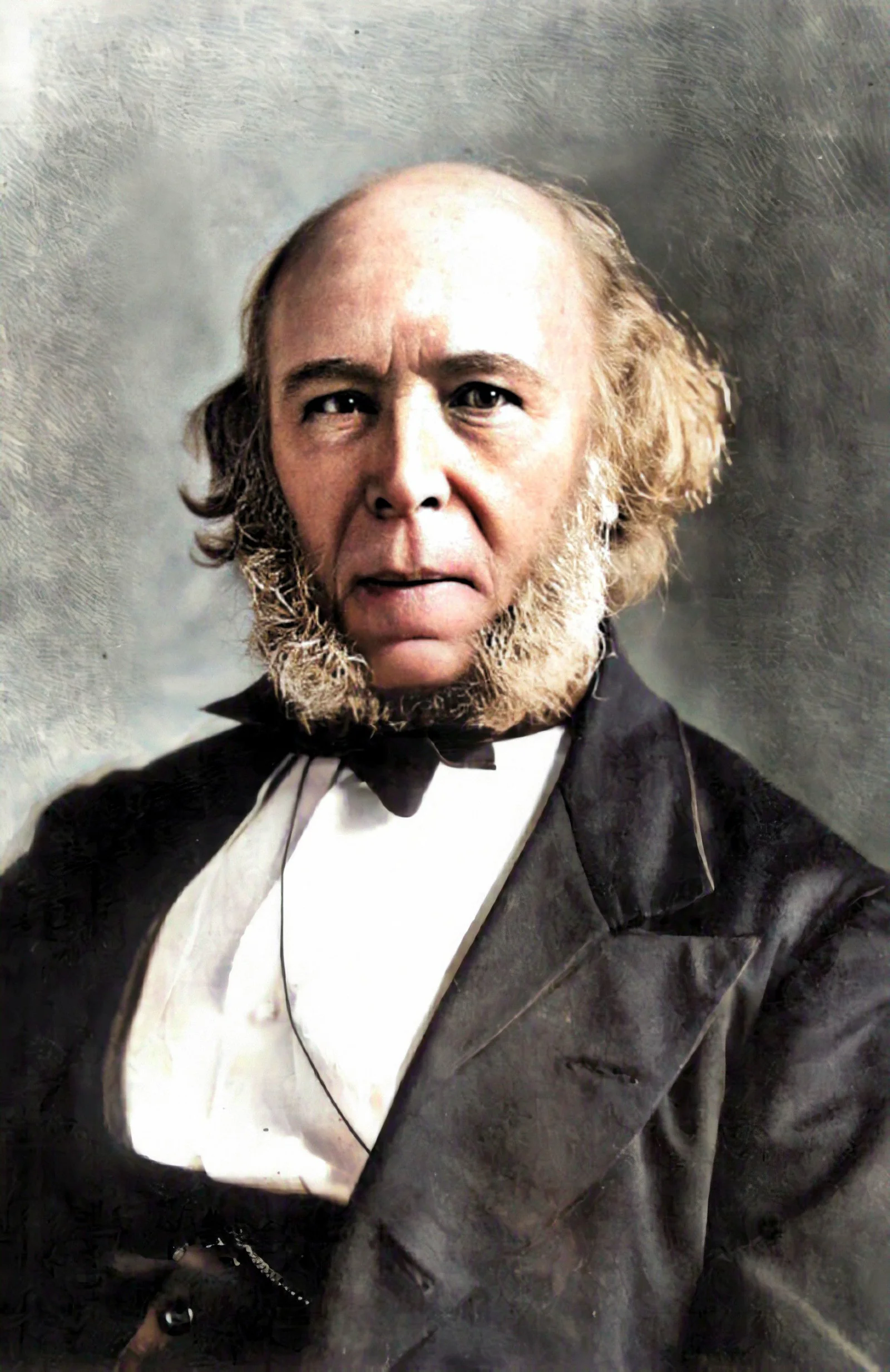
Attr: See page for author
| 37 Quotes | |
| Occup. | Philosopher |
| From | England |
| Born | April 27, 1820 Derby, England |
| Died | December 8, 1903 Brighton, England |
| Cause | Heart Failure |
| Aged | 83 years |
| Cite | |
Citation Formats
APA Style (7th ed.)
Herbert spencer biography, facts and quotes. (2026, February 11). FixQuotes. https://fixquotes.com/authors/herbert-spencer/
Chicago Style
"Herbert Spencer biography, facts and quotes." FixQuotes. February 11, 2026. https://fixquotes.com/authors/herbert-spencer/.
MLA Style (9th ed.)
"Herbert Spencer biography, facts and quotes." FixQuotes, 11 Feb. 2026, https://fixquotes.com/authors/herbert-spencer/. Accessed 28 Mar. 2026.
Early Life and Background
Herbert Spencer was born on April 27, 1820, in Derby, England, into a Nonconformist, intellectually combative household that prized independence over deference. His father, William George Spencer, taught school and cultivated in his son a distrust of rote learning and an appetite for self-directed inquiry; his uncle, the Rev. Thomas Spencer, represented a stricter, more systematizing rationalism. The England of Spencer's childhood was being re-made by canals, factories, and political agitation, and in that setting he learned early to read social change as something with causes and laws rather than as the whim of rulers.Physically frail and often ill, Spencer grew inward, learning to rely on private reasoning and long solitary walks more than on institutional approval. His temperament was a mixture of confidence in logic and sensitivity to strain - a pattern that later expressed itself in bouts of exhaustion and an intensely protected daily routine. This combination helped produce the curious duality that marked his career: a public architect of vast systems and a private man wary of crowds, conflict, and the demands of social life.
Education and Formative Influences
Spencer received no university education; his formation was a disciplined self-education shaped by mathematics, mechanics, and the scientific spirit of the age. After schooling under his father and guidance from his uncle, he absorbed the rational dissenting tradition, early evolutionary speculation (from figures such as Lamarck and, later, the wider pre-Darwinian debates), and the political economy of the Industrial Revolution. The Reform era's arguments over the Corn Laws, representation, and the reach of the state furnished him with a lifelong question: how could social order arise from free individuals rather than command?Career, Major Works, and Turning Points
Spencer began as a railway engineer in the 1830s and early 1840s, an experience that trained his sense of structure, stress, and incremental improvement; he then turned to journalism and intellectual life in London. His first major book, Social Statics (1851), argued for a stringent "law of equal freedom" and a radical suspicion of state power, while later essays pushed him toward a general theory of development. After Darwin's On the Origin of Species (1859) transformed the intellectual landscape, Spencer became one of evolution's most ambitious synthesizers, publishing First Principles (1862) and then the multi-volume Synthetic Philosophy - including The Principles of Biology (1864-67), The Principles of Psychology (1855; expanded 1870-72), The Principles of Sociology (1876-96), and The Principles of Ethics (1879-93). A turning point came as his fame grew internationally in the 1870s and 1880s: he doubled down on system-building even as chronic insomnia and nervous collapse narrowed his life, and late works such as The Man Versus the State (1884) fought what he saw as creeping collectivism.Philosophy, Style, and Themes
Spencer's inner life can be read in his central definition of life as adaptation: he framed mind, body, and society as systems struggling to balance themselves against an environment that never stops shifting. “Life is the continuous adjustment of internal relations to external relations”. It is not only a biological claim; it is also autobiography. Spencer guarded his own "internal relations" with near-ritual care, suspicious of anything - social obligations, political programs, even excessive sympathy - that threatened equilibrium. His prose, built from definitions, classifications, and long chains of inference, mirrors that temperament: an attempt to make existence legible enough to be bearable.Across his philosophy runs a single developmental story, applied everywhere from embryos to empires: “Civilization is a progress from an indefinite, incoherent homogeneity toward a definite, coherent heterogeneity”. The phrase captures both his optimism and his anxiety. He believed complexity and differentiation could yield greater freedom, yet he feared that modern states, claiming to manage complexity, would restore coercive simplicity. Hence the notorious severity of his political ethic: “Government is essentially immoral”. In Spencer's psychology, moral progress required restraint - not only of appetites but of rulers, reformers, and majorities who wanted to do good with other people's lives. That distrust made him a hero to some liberals and libertarians, while also blinding him to how industrial power and poverty could constrain freedom as effectively as law.
Legacy and Influence
By the time Spencer died on December 8, 1903, his reputation had already begun to change: once the most translated living English philosopher, he became, in the 20th century, a symbol of Victorian system-making and an easy target for critics of "Social Darwinism" - a label often applied to him more crudely than his texts warrant. Yet his impact endured in the professionalization of sociology, in functional and evolutionary approaches to institutions, and in debates over individual liberty versus social provision. Spencer's grand ambition - to unify science, psychology, ethics, and social theory under an evolutionary logic - now reads less as a final system than as a revealing artifact of an era that believed progress could be reasoned into shape, and of a mind that sought freedom by turning the flux of history into a comprehensible law.Our collection contains 37 quotes written by Herbert, under the main topics: Witty One-Liners - Motivational - Ethics & Morality - Truth - Wisdom.
Other people related to Herbert: Auberon Herbert (Philosopher), Theodore Dreiser (Novelist), Albert J. Nock (Philosopher), William Winwood Reade (Historian), Emile Durkheim (Sociologist)
Frequently Asked Questions
- Herbert Spencer: theory sociology: His sociological theory emphasizes evolutionary progress and the adaptation of societies over time.
- What is Herbert Spencer known for: He is known for developing evolutionary theory in the context of sociology and for coining 'survival of the fittest.'
- Herbert Spencer major works: His major works include 'The Principles of Sociology' and 'The Synthetic Philosophy' series.
- Herbert Spencer Social Darwinism: He applied Darwin's biological ideas to society, advocating that competition and natural selection drive social progress.
- Herbert Spencer theory of evolution: Spencer's theory of evolution extends Darwinian principles to all aspects of life, including society and culture.
- Herbert Spencer survival of the fittest: He coined the term 'survival of the fittest' to describe how societies evolve and adapt over time.
- Herbert Spencer theory: He is best known for his theory of social evolution, likening society to a biological organism.
- Herbert Spencer contribution to sociology: He introduced the concept of evolutionary sociology and applied natural selection principles to societal development.
- How old was Herbert Spencer? He became 83 years old
Herbert Spencer Famous Works
- 1884 The Man Versus the State (Book)
- 1876 The Principles of Sociology (Book)
- 1864 The Principles of Biology (Book)
- 1862 First Principles (Book)
- 1855 The Principles of Psychology (Book)
- 1851 Social Statics (Book)
Source / external links