
Hesiod Biography Quotes 36 Report mistakes
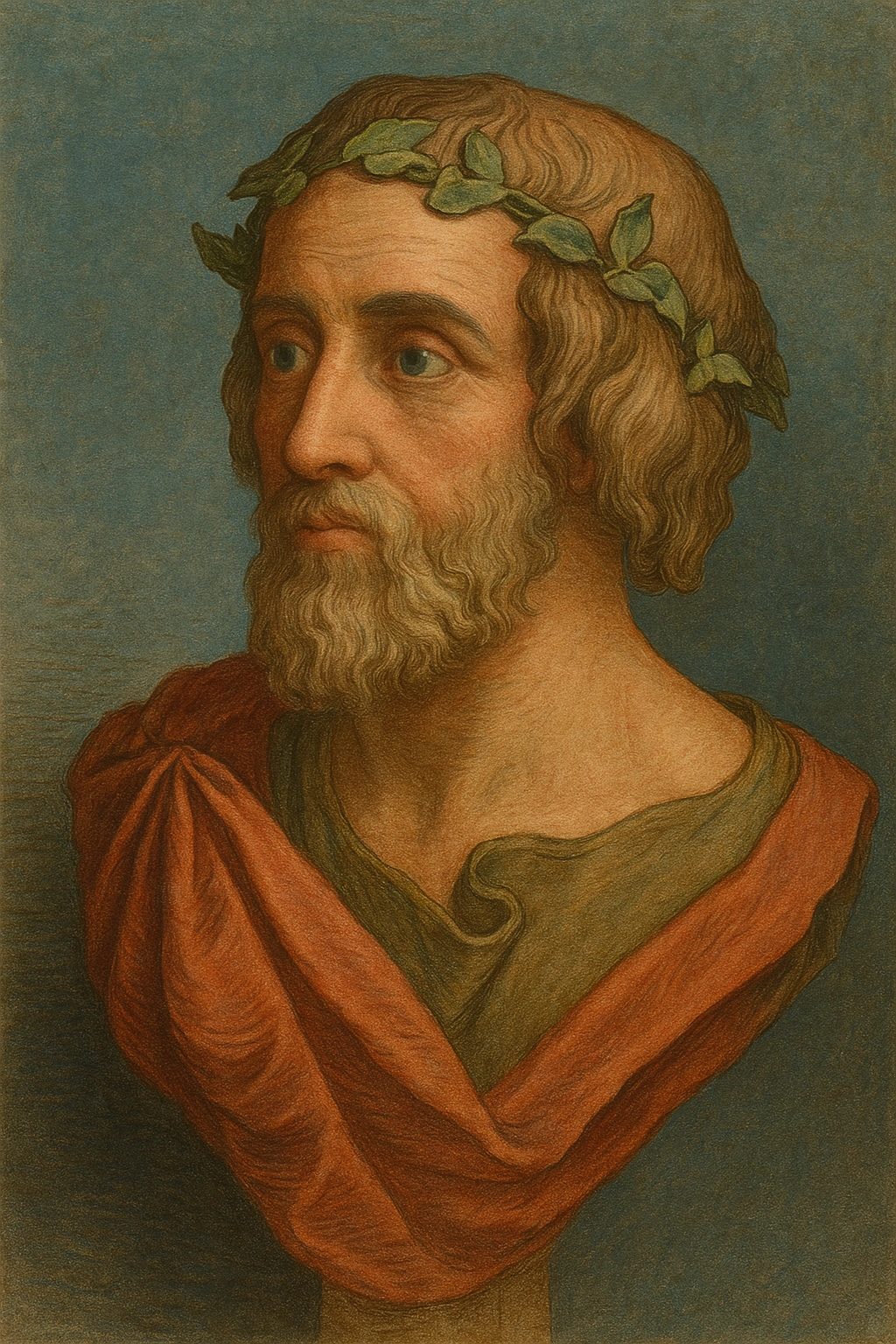
| 36 Quotes | |
| Known as | Hesiod of Ascra |
| Occup. | Poet |
| From | Greece |
| Born | 800 BC Ascra, Boeotia |
| Died | 720 BC Ascra, Boeotia |
| Cite | |
Citation Formats
APA Style (7th ed.)
Hesiod biography, facts and quotes. (2026, February 11). FixQuotes. https://fixquotes.com/authors/hesiod/
Chicago Style
"Hesiod biography, facts and quotes." FixQuotes. February 11, 2026. https://fixquotes.com/authors/hesiod/.
MLA Style (9th ed.)
"Hesiod biography, facts and quotes." FixQuotes, 11 Feb. 2026, https://fixquotes.com/authors/hesiod/. Accessed 27 Mar. 2026.
Early Life and Background
Hesiod was born around 800 BCE in Boeotia, the agrarian heartland north of Athens, and he locates his life not in palaces but in the hard margins of smallholders. In Works and Days he names Ascra, a village near Mount Helicon, "bad in winter, hard in summer, never good", a line that carries more autobiography than scenery: he writes as a man shaped by thin soil, uncertain harvests, and the social friction of neighbors forced into close competition.He presents his family as migrants of necessity. His father, he says, left Cyme in Aeolis across the Aegean and came to mainland Greece seeking livelihood, a reminder that the early Archaic world was mobile, entrepreneurial, and precarious. Hesiod's own household drama becomes his entry point to law and ethics: a dispute with his brother Perses over an inheritance, allegedly distorted by "gift-devouring kings", becomes the moral engine of his most personal poem, turning private grievance into a public meditation on justice, labor, and survival.
Education and Formative Influences
Hesiod was not schooled in the later classical sense; his education was the oral culture of song, proverb, and ritual, and he frames his vocation as a divine summons. In the proem to Theogony he tells of the Muses meeting him while he tended sheep on Helicon and giving him a staff and a voice, a claim that establishes authority in a society where poetry preserved memory, settled disputes through shared norms, and made the gods present. His diction, formulas, and cataloging techniques show deep immersion in the Panhellenic epic tradition associated with Homer, while his content reflects local Boeotian concerns: seasons, boundaries, lawsuits, and the moral calculus of exchange.Career, Major Works, and Turning Points
Two works define Hesiod's surviving corpus: Theogony, a genealogical epic that organizes the divine world from Chaos through the reign of Zeus, and Works and Days, a didactic poem addressed to Perses that mixes myth (Prometheus and Pandora, the Ages of Man), practical farming instructions, and civic warning. A smaller poem, the Shield of Heracles, survives but is widely treated as later or at least contested. His turning point, as he narrates it, is the shift from herding to singing for a wider audience - including a famous contest at Chalcis in Euboea where he claims a tripod prize - yet the deeper pivot is conceptual: he moved epic from heroic exploits to the moral weather of ordinary life, making the peasant household a stage on which Zeus and Justice silently arbitrate.Philosophy, Style, and Themes
Hesiod's inner life is governed by anxiety about scarcity and a fierce desire for order. He sees the cosmos as intelligible because it is ruled - not kindly, but reliably - by Zeus, whose mind cannot be sidestepped: “It is not possible either to trick or escape the mind of Zeus”. That sentence is less theology than psychology: it reveals a man who answers unpredictability by insisting that consequences are woven into the structure of things, that cheating in court, neglecting work, or violating ritual will return as hunger, shame, or civic disaster.His ethics are practical and incremental, built for people who live season to season. “Work is no disgrace: it is idleness which is a disgrace”. This is not the romance of toil; it is a discipline against envy and a rebuttal to Perses, who wants an easier share without the harder effort. The same temperament appears in his advice on accumulation and foresight - “If you add a little to a little, and then do it again, soon that little shall be much”. - a creed suited to marginal land, where salvation is not heroic windfalls but repeated, measured acts. Stylistically, he weds epic authority to gnomic compression: lists of days, tasks, and taboos; vivid myths that function as moral proofs; and a voice that is simultaneously admonishing, wounded, and instructive, as if the poet is trying to talk himself into endurance while he lectures his brother.
Legacy and Influence
Hesiod became the other foundation stone of Greek hexameter beside Homer: the poet not of Troy but of time, work, and the divine constitution. Theogony offered later Greece a shared map of the gods that informed cult, drama, philosophy, and even political thought about sovereignty; Works and Days supplied a moral and economic vocabulary for household management, civic justice, and the psychology of envy. From archaic sages to Plato and Hellenistic scholars, writers returned to his mixture of myth and instruction as evidence that truth could be sung in plain speech, and that the cosmos of gods and the calendar of fields were, in the end, one continuous order.Our collection contains 36 quotes written by Hesiod, under the main topics: Ethics & Morality - Wisdom - Justice - Friendship - Resilience.
Other people related to Hesiod: Epicurus (Philosopher), Xenophanes (Philosopher)
Frequently Asked Questions
- Hesiod Works and Days: Didactic poem on farming, justice, and seasons; includes Pandora and the Five Ages; addressed to his brother Perses.
- Hesiod Theogony: Poem on the origins and genealogy of the Greek gods; key mythic source.
- Hesiod Greek mythology: Major early source: gods’ genealogy, Pandora, and the Ages of Man.
- Hesiod meaning: Often glossed as “he who sends forth song/voice”; etymology uncertain.
- Hesiod books: Theogony; Works and Days; Shield of Heracles (attrib.); Catalogue of Women (fragments/attrib.)
- Hesiod pronunciation: HEE-see-uhd (ˈhiː-si-əd)
Source / external links