
Hesiod Biography Quotes 36 Report mistakes
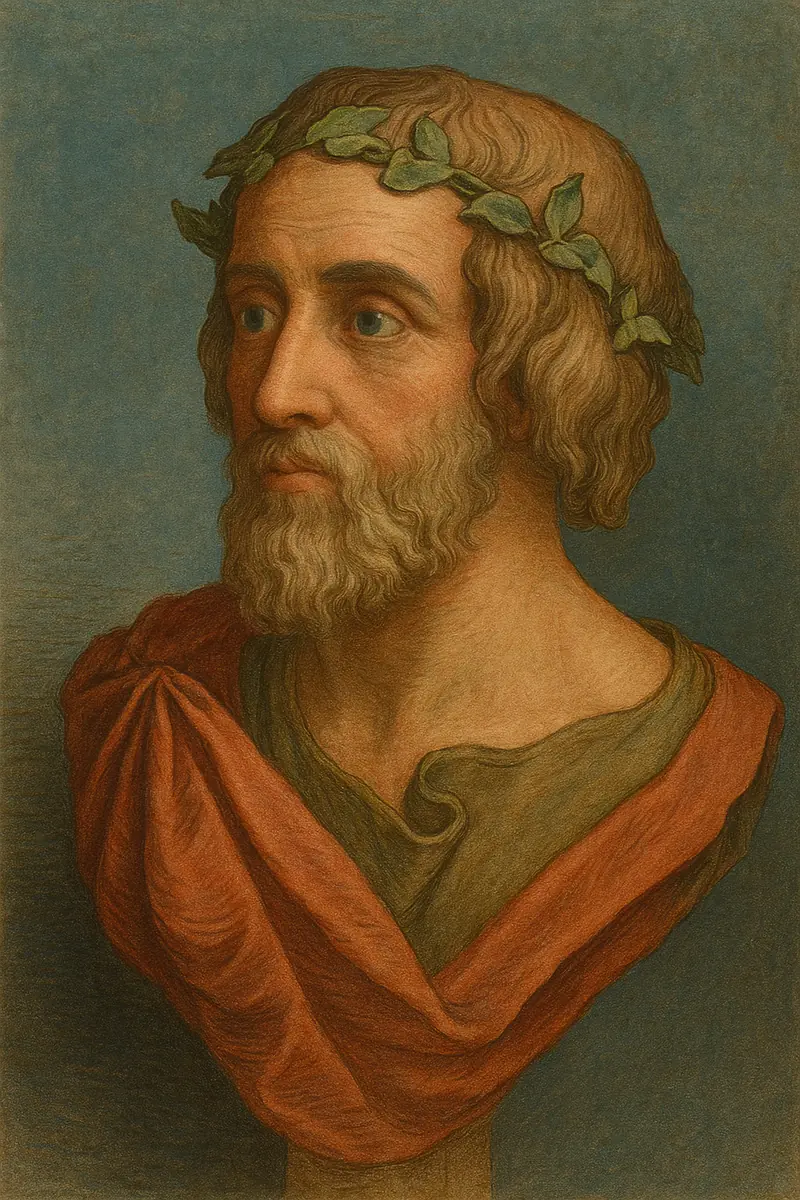
| 36 Quotes | |
| Known as | Hesiod of Ascra |
| Occup. | Poet |
| From | Greece |
| Born | 800 BC Ascra, Boeotia |
| Died | 720 BC Ascra, Boeotia |
Hesiod is traditionally placed in the early archaic period of Greece, with many scholars situating his lifetime somewhere in the eighth to early seventh centuries BCE. He himself names Boeotia as his home region and calls the village of Ascra his dwelling place, depicting it as a harsh locality beneath Mount Helicon. His own verses remember the site as cold in winter, hard in summer, and never good, suggesting a rural community of smallholders coping with thin soils and demanding seasons. Hesiod also mentions that his father migrated from Aeolian Cyme across the Aegean to Boeotia, a detail that locates the family within the broader patterns of mobility and exchange that characterized the era. The setting that emerges is one of local basileis (chieftain-judges), village agriculture, and regional festivals, tied together by seafaring and by a shared epic song tradition.
Family and People Around Him
Hesiod addresses his most famous work to his brother Perses, whose name and figure are central to the poet's self-presentation. In that poem, Perses is admonished to abandon lawsuits and unjust gains and instead to value honest labor, fairness, and piety. The relationship between the two brothers, strained by disputes over inheritance and justice, becomes a lens through which Hesiod speaks to his community about the everyday ethics of survival. Hesiod also evokes his father, an enterprising migrant who took up small-scale commerce and ultimately settled as a farmer. These two figures, the father and the brother, stand closest to Hesiod in his own telling, and around them hover the village judges and neighbors to whom he directs broader counsel about work, justice, and respect for the gods.
Hesiod's poems remember a public occasion at Chalcis in Euboea, where he says he won a tripod in a contest held during the funeral games for Amphidamas. The prize, he adds, was dedicated to the Muses of Helicon. Amphidamas and his sons, as hosts of the games and givers of the award, represent the kind of local notables who organized civic and poetic competition in this period. Later traditions surround Hesiod with other figures, above all Homer. Though there is no direct evidence that the two men met, later biographers imagined a contest between them, reflecting the reception of Hesiod as one of the earliest and most authoritative Greek poets alongside the Homeric singer.
Works and Authorship
Two poems are securely associated with Hesiod: Works and Days and Theogony. Both are composed in dactylic hexameter, sharing the epic meter with the Homeric poems but pursuing different aims. Works and Days is a didactic address to Perses and, by extension, to the broader agrarian audience. It offers advice on farming cycles, seafaring, household management, and the proper observance of days. Within it, Hesiod places myths and moral reflections: the story of Pandora and the jar, the Five Ages of humankind (from the Golden Age downward to the Iron Age), and the distinction between two forms of Strife, one destructive and one that spurs men to excellence. Theogony presents a genealogy of the gods from primordial beginnings, narrating the succession of divine powers and culminating in the rule of Zeus. It frames its authority with a vision of the Muses of Helicon, who grant the poet a staff and a calling to sing truth or seeming truth.
Other poems circulate under his name in antiquity. The Shield of Heracles and fragments of genealogical epics, often grouped as the Hesiodic Catalogue of Women, were credited to Hesiod by later tradition. Their authorship remains debated, and they likely represent a broader Hesiodic corpus shaped by performance, transmission, and the interests of collectors and scholars. Nonetheless, these works helped consolidate Hesiod's image as both a theologian of the Greek pantheon and a moral teacher of common life.
Voice, Themes, and Method
Hesiod's voice is unusually personal for early Greek epic. He names himself, his brother, his father's origin, his village, and a specific victory in a poetic contest. He complains about crooked judges and warns against hubris, anchoring his teaching in the rhythms of ploughing, sowing, harvesting, and storing. Seasonal markers, the risings and settings of stars such as the Pleiades and Orion, and a calendar of auspicious and inauspicious days organize his practical advice. The ethical pivot of Works and Days is Justice (Dike), under the oversight of Zeus, whose favor or anger is felt in the fertility of fields and the prosperity of households. In Theogony, the narrative principle is order: how a world of contending powers came under the governance of Zeus and how divine lineages relate to one another and to humankind.
While Homeric song foregrounds heroes and their public deeds, Hesiod addresses householders, craftsmen, and farmers. He warns Perses that lawsuits fade while stored grain endures, that the sea is dangerous except in its proper season, and that competition can elevate honest work. He embraces inherited tradition but reshapes it into a guide for living, reflecting the realities of small communities under local authority.
Performance, Contest, and Public Life
The note about the funeral games of Amphidamas at Chalcis places Hesiod within a world of competitive performance. Festivals, funerary honors, and public gatherings were venues where poets could recite, compete, and win prizes offered by prominent families. Amphidamas and his sons, identifiable as civic leaders in Euboea, anchor this memory in a recognizable social structure. The later legend of a contest with Homer, while not historical evidence, attests to the cultural pairing of the two poets and to the habit of defining Hesiod's contribution by contrast: where Homer sang of war and heroes, Hesiod sang of gods and work.
Transmission, Reception, and Debate
Hesiod's poems were transmitted orally and then preserved in textual form, entering the libraries and curricula of classical Greece. Philosophers and lawmakers drew on or disputed his authority. Xenophanes criticized the anthropomorphic gods of Homer and Hesiod, signaling the poems' centrality to Greek thought. Plato and Aristotle cite Hesiod, the former for mythic and ethical reflections, the latter for observations about natural and human orders. Hellenistic scholars collected, edited, and commented on the poems, while Roman authors adapted Hesiodic themes: Virgil's Georgics echo the agricultural instruction of Works and Days, and Ovid's account of the Ages of the World reworks Hesiod's scheme.
In later antiquity, biographers embroidered Hesiod's life with tales of his death and burial, including stories of a fatal quarrel and a remarkable recovery of his remains. These narratives, though vivid, belong to the realm of legend rather than documented history. What remains most secure are the self-referential passages of his own poems and the enduring influence those poems exerted.
Legacy
Hesiod stands as a foundational figure for didactic poetry and for the systematic presentation of Greek myth. His Works and Days preserves the texture of small-scale agrarian life and the moral vocabulary of an age negotiating labor, fairness, and dependence on divine order. Theogony provides a structured account of the gods that later poets and dramatists treated as a reference point, whether to inherit, revise, or challenge. Around him cluster the people who animate his lines: Perses, the brother he exhorts; the unnamed father who crossed the sea to start anew; local judges and neighbors who test the meaning of justice; Amphidamas and his sons, who frame a public stage for poetry; and, in the distant echo of later tradition, Homer, his imagined counterpart. Through this network of kin, community, and audience, Hesiod fashioned a poetic persona whose authority rests not on royal blood or martial exploits but on the credibility of a farmer-poet speaking to the hard facts of work and the abiding claims of the gods.
Our collection contains 36 quotes who is written by Hesiod, under the main topics: Ethics & Morality - Wisdom - Justice - Friendship - Parenting.
Other people realated to Hesiod: Xenophanes (Philosopher)
Frequently Asked Questions
- Hesiod Works and Days: Didactic poem on farming, justice, and seasons; includes Pandora and the Five Ages; addressed to his brother Perses.
- Hesiod Theogony: Poem on the origins and genealogy of the Greek gods; key mythic source.
- Hesiod Greek mythology: Major early source: gods’ genealogy, Pandora, and the Ages of Man.
- Hesiod meaning: Often glossed as “he who sends forth song/voice”; etymology uncertain.
- Hesiod books: Theogony; Works and Days; Shield of Heracles (attrib.); Catalogue of Women (fragments/attrib.)
- Hesiod pronunciation: HEE-see-uhd (ˈhiː-si-əd)
Source / external links