
Heston Blumenthal Biography Quotes 20 Report mistakes
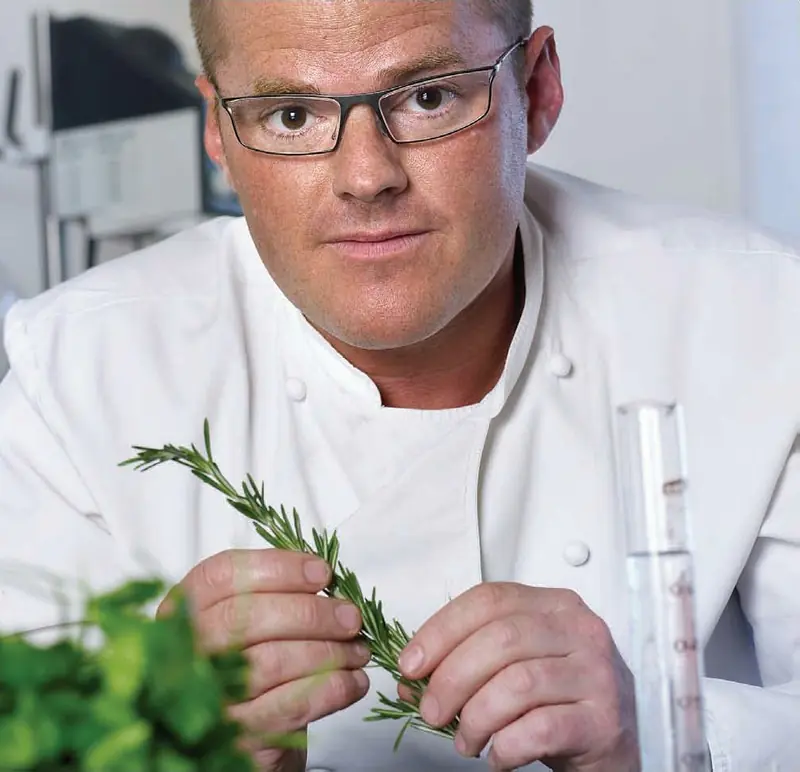
| 20 Quotes | |
| Born as | Heston Marc Blumenthal |
| Occup. | Chef |
| From | England |
| Born | May 17, 1966 London, England, United Kingdom |
| Age | 59 years |
Heston Marc Blumenthal was born on 27 May 1966 in London, England, and grew up in Buckinghamshire. A formative moment arrived when, as a teenager, he dined with his parents at L Oustau de Baumaniere in Provence. The theatre of service, the aromas wafting from the kitchen, and the interplay of sound, light, and taste left an imprint he would spend his career exploring. Largely self-taught rather than schooled through a traditional brigade system, he read voraciously about food science and classic technique, developing an abiding fascination with the why behind cooking.
Self-Taught Path and Opening The Fat Duck
In the early 1990s he immersed himself in French technique and the chemistry of the kitchen, taking short stages where possible and learning by relentless experiment. In 1995 he opened The Fat Duck in Bray, a modest former pub that became the laboratory for his ideas. He cooked, tested, and refined dishes late into the night, chasing repeatable precision. The restaurant steadily drew attention for playful, technically exacting food that paired memory with novelty: snail porridge, bacon-and-egg ice cream, and later the Sound of the Sea, which arrived with waves heard through a hidden earpiece.
Scientific Cooking and Collaborations
Blumenthal sought out thinkers who could help him ground intuition in evidence. The food writer and scientist Harold McGee's work was a key early guide, and the two would exchange ideas as Blumenthal refined techniques such as low-temperature cooking and triple-cooked chips. He collaborated with experimental psychologist Charles Spence on the role of sound, sight, and expectation, building menus that engaged multiple senses. Physicist Peter Barham offered further insights into gels, foams, and the behavior of proteins. These relationships anchored a style often grouped under modernist cuisine, though Blumenthal preferred to frame it as curiosity-driven and rooted in flavor.
Restaurants and Teams
From Bray, his world grew through carefully chosen openings. The Hinds Head, a historic inn in the same village, celebrated hearty British cooking with technical finesse. Dinner by Heston Blumenthal in London, developed closely with long-standing colleague Ashley Palmer-Watts, mined historical British recipes with research support from historians and the British Library, yielding dishes like Meat Fruit, a trompe-l oeil chicken liver parfait disguised as a mandarin. The Crown at Bray and other ventures extended his group, but the Bray kitchens remained the crucible. Blumenthal consistently credited the Fat Duck team, from chefs to front-of-house, as collaborators in an evolving approach that treated service, storytelling, and technique as one.
Television, Books, and Public Profile
He communicated his ideas widely through television and books. Series such as In Search of Perfection charted the engineering of iconic dishes; Heston's Feasts explored historical banquets; Heston's Mission Impossible tackled institutional food at scale; and How to Cook Like Heston translated core techniques for home cooks. The Big Fat Duck Cookbook and later volumes documented method, research, and recipes in unusual detail, merging culinary literature with scientific annotation and personal narrative.
Awards and Recognition
The Fat Duck achieved three Michelin stars in 2004 and topped Restaurant magazine's World's 50 Best Restaurants list in 2005, cementing Blumenthal's international profile. He was appointed OBE in 2006 for services to British gastronomy. Dinner by Heston Blumenthal in London earned two Michelin stars, while The Hinds Head won accolades as one of the country's finest pubs. Academic institutions and professional bodies recognized his contributions to culinary science, including an honorary fellowship from the Royal Society of Chemistry.
Challenges and Resilience
Success brought scrutiny and tests. In 2009 The Fat Duck temporarily closed following an outbreak of illness that prompted investigation and sweeping reviews of systems. The episode reinforced Blumenthal's focus on traceability, hygiene, and the rigor of risk assessment in complex, multi-course service. In 2015, during a major refurbishment of The Fat Duck, he and his core brigade temporarily relocated to Australia for a seasonal residence, an experiment in transplanting not just recipes but an entire ecosystem of service, research, and storytelling. On returning to Bray, he unveiled a reimagined tasting menu structured as a journey through memory, sound, and scent.
Philosophy and Influence
Blumenthal's work reframed the restaurant as an immersive environment where taste is shaped by psychology as much as by ingredients. He embraced dyslexia and a highly associative way of thinking as creative strengths, connecting ideas across science, art, and craft. By asking diners to listen to seashells, smell edible perfumes, or revisit childhood flavors through precise technique, he fused nostalgia with modern research. His influence is visible in kitchens that value measurement and iteration as much as intuition, in dining rooms that stage narrative experiences, and in a broader public conversation about how flavor is perceived.
Personal and Ongoing Work
Private by nature, he has occasionally discussed the support of family and close colleagues in sustaining a demanding schedule that spans restaurants, media, and research. He continues to mentor teams across his group, to collaborate with scientists and historians, and to refine the interface between cooking and cognition. For Blumenthal, craft and curiosity remain inseparable: the search is not simply for new dishes, but for deeper understanding of why those dishes move us.
Our collection contains 20 quotes who is written by Heston, under the main topics: Witty One-Liners - Learning - Work Ethic - Work - Perseverance.
Source / external links