
H.G. Wells Biography Quotes 41 Report mistakes
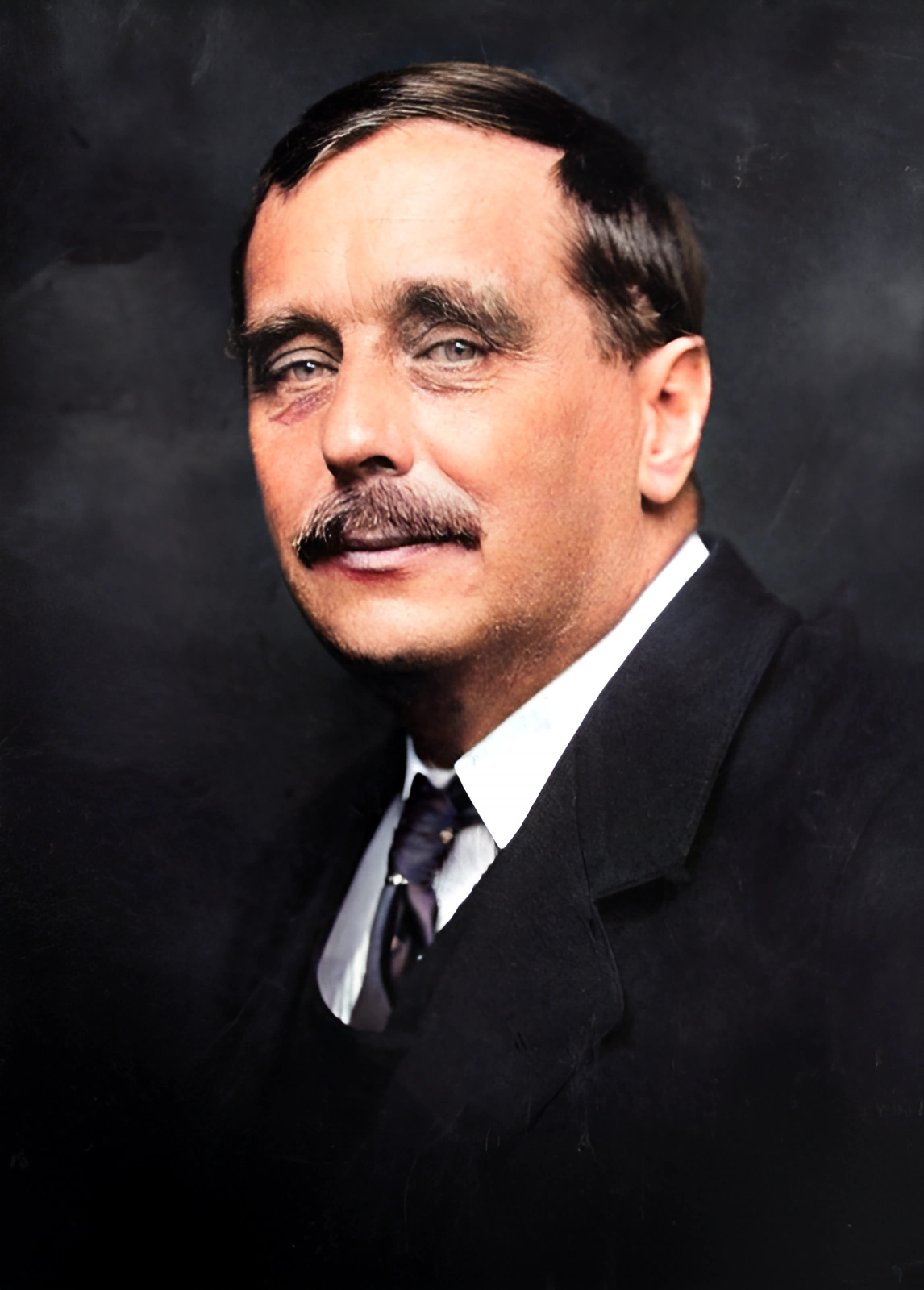
Attr: George Charles Beresford
| 41 Quotes | |
| Born as | Herbert George Wells |
| Occup. | Author |
| From | England |
| Spouse | Catherine Helen Spalding (1895–1927) |
| Born | September 21, 1866 Bromley, Kent, England |
| Died | August 13, 1946 London, England |
| Aged | 79 years |
| Cite | |
Citation Formats
APA Style (7th ed.)
H.g. wells biography, facts and quotes. (2026, February 11). FixQuotes. https://fixquotes.com/authors/hg-wells/
Chicago Style
"H.G. Wells biography, facts and quotes." FixQuotes. February 11, 2026. https://fixquotes.com/authors/hg-wells/.
MLA Style (9th ed.)
"H.G. Wells biography, facts and quotes." FixQuotes, 11 Feb. 2026, https://fixquotes.com/authors/hg-wells/. Accessed 26 Mar. 2026.
Early Life and Background
Herbert George Wells was born on September 21, 1866, in Bromley, Kent, the son of Joseph Wells, a failed shopkeeper turned semi-professional cricketer, and Sarah Neal Wells, a domestic servant who later worked as a housekeeper on a country estate. The family hovered on the edge of respectability, close enough to feel the pull of Victorian aspiration and insecure enough to understand how quickly a life could slide. That tension - between improvement and precarity - became a lifelong motor: he wrote as someone who had seen class as a physical environment, not an abstraction.A childhood accident that left him confined for weeks became a private turning point. Books arrived not as ornament but as rescue, opening a parallel world to the narrow geography of Bromley. He absorbed popular science, adventure, and social debate with the appetite of someone who suspected that ideas were also tools. Even before he had a public voice, Wells developed the habit that defined him: turning personal vulnerability into intellectual reach, and turning speculation into a plan for how society might be rebuilt.
Education and Formative Influences
Wells was apprenticed to drapery and other forms of lower-middle-class labor he disliked, then fought his way into education through scholarships and sheer velocity of will. He studied biology at the Normal School of Science in South Kensington (later Imperial College London) under T.H. Huxley, whose Darwinian rigor gave Wells both method and metaphor: life as adaptation, struggle, and change rather than fixed hierarchy. Scientific training did not make him a narrow specialist; it armed him with a way of thinking that could move from cells to cities, from evolutionary time to political urgency, and it taught him to write with the authority of mechanism while remaining alert to the human costs of being treated like one.Career, Major Works, and Turning Points
After early work as a teacher and journalist, Wells erupted into prominence in the 1890s with scientific romances that used speculative premises to expose contemporary society: The Time Machine (1895) turned class division into evolutionary nightmare, The Island of Doctor Moreau (1896) anatomized cruelty and the instability of the human, The Invisible Man (1897) explored alienation and unchecked entitlement, and The War of the Worlds (1898) reversed imperial confidence by making England the invaded colony. He then widened into social comedy and realism (Kipps, 1905; Tono-Bungay, 1909), polemics and prophecy (Anticipations, 1901; The Open Conspiracy, 1928), and panoramic synthesis (The Outline of History, 1920). His politics moved through Fabian circles toward a more restless, global reformism; his personal life, including multiple relationships and marriages, fed a reputation for provocation. Two world wars hardened his urgency: the future he had once treated as imaginative space became an emergency.Philosophy, Style, and Themes
Wells wrote with a scientist's impatience for mystique and a storyteller's instinct for shock. Evolution, for him, was not only a biological theory but a moral pressure: “Adapt or perish, now as ever, is nature's inexorable imperative”. That sentence captures his inner tempo - an anxious drive to push individuals and institutions toward flexibility before events made the decision for them. In Wells's fiction, the catastrophe is rarely random; it is the bill coming due for complacency, greed, or intellectual laziness. His preferred narrative engine is the experiment: a new technology, a new species, a new vantage point that makes ordinary assumptions look naive.Yet he was not merely a prophet of doom. He believed in education as the hinge between barbarism and a workable future, compressing his worldview into a stark aphorism: “History is a race between education and catastrophe”. That is Wells's psychology in miniature - hopeful enough to keep arguing, fearful enough to keep escalating the stakes. His utopianism was international rather than patriotic; he imagined the nation-state as a passing phase and insisted, “Our true nationality is mankind”. Even his humor and satire serve that project, pricking vanity while trying to re-train the reader's loyalties from local pride to planetary responsibility.
Legacy and Influence
Wells died on August 13, 1946, in London, having lived to see total war, aerial bombardment, and the political fragmentation that made his dream of coordinated world reform feel both necessary and remote. He endures as a founder of modern science fiction and as a public intellectual who treated the future as a civic arena. Later writers, filmmakers, and political thinkers have mined his images - time travel, alien invasion, biological horror, technological invisibility - because they are not just clever devices but arguments about power and empathy. If his predictions were uneven, his deeper achievement was to make speculative imagination a tool of social diagnosis, and to insist that the human story is not finished, only contested.Our collection contains 41 quotes written by Wells, under the main topics: Witty One-Liners - Motivational - Ethics & Morality - Truth - Wisdom.
Other people related to Wells: Gilbert K. Chesterton (Writer), Ray Bradbury (Writer), Rebecca West (Author), George Gissing (Novelist)
H.G. Wells Famous Works
- 1933 The Shape of Things to Come (Novel)
- 1901 The First Men in the Moon (Novel)
- 1899 The Sleeper Awakes (Novel)
- 1898 The War of the Worlds (Novel)
- 1897 The Invisible Man (Novel)
- 1896 The Island of Dr. Moreau (Novel)
- 1895 The Time Machine (Novel)
Source / external links