
H.G. Wells Biography Quotes 41 Report mistakes
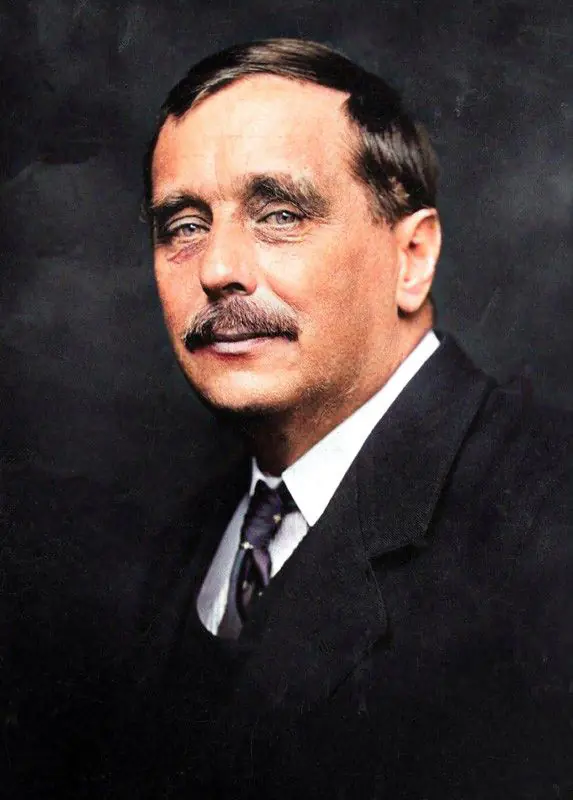
Attr: George Charles Beresford
| 41 Quotes | |
| Born as | Herbert George Wells |
| Occup. | Author |
| From | England |
| Spouse | Catherine Helen Spalding (1895–1927) |
| Born | September 21, 1866 Bromley, Kent, England |
| Died | August 13, 1946 London, England |
| Aged | 79 years |
Herbert George Wells was born on 21 September 1866 in Bromley, Kent, England, the son of Joseph Wells, a shopkeeper and professional cricketer, and Sarah Neal, a former lady's maid. Known as Bertie within the family, he grew up amid financial insecurity that shaped his view of class and opportunity. A childhood accident that left him with a broken leg kept him indoors for months and fostered an intense appetite for reading. He attended local schools, became a pupil-teacher at Midhurst, and won a scholarship to the Normal School of Science in South Kensington (later part of Imperial College), where he studied under the biologist T. H. Huxley. Huxley's teaching gave him a rigorous grounding in evolutionary theory and scientific method, training that would profoundly influence his imagination and lend authority to his later writing.
Apprenticeship, Teaching, and Early Writing
Before his time with Huxley, Wells had worked as a draper's apprentice, an experience of long hours and petty humiliations that later informed the social novels Kipps and The History of Mr. Polly. After leaving the Normal School of Science, he earned his living by teaching and by writing short pieces for periodicals. He produced science primers and journalism, explaining contemporary scientific ideas for general readers. The discipline of simplifying complex topics for correspondence students and magazines honed his style: brisk, lucid, and argumentative. By the early 1890s, his short stories began to appear in well-known journals, and his experiments with speculative fiction coalesced into a new form he called scientific romance.
Breakthrough and the Scientific Romances
Wells achieved immediate fame with The Time Machine (1895), a compact parable built from evolutionary speculation and social critique. It was swiftly followed by The Island of Doctor Moreau, The Invisible Man, and The War of the Worlds. These novels took the latest scientific concepts, evolution, vivisection, optics, astronomical conjecture, and pushed them to moral and political conclusions. During a period living in Surrey, he drew on local landscapes to ground extraordinary events in ordinary settings, a method that made his visions of Martian invasion or invisible mischief feel disturbingly plausible. While he admired contemporaries such as Jules Verne, he set himself apart by making ideas the protagonists of his stories. His debates with writers like Henry James, and the reactions of friends such as George Bernard Shaw and Arnold Bennett, show how these books forced a reckoning with the boundaries between realism and romance.
From Fantasies to Social Comedies
Wells soon turned to the intricacies of English social life. Kipps (1905), Tono-Bungay (1909), The History of Mr. Polly (1910), and Ann Veronica (1909) examine class mobility, enterprise, gender, and the texture of everyday aspiration. The New Machiavelli (1911), a thinly veiled portrait of contemporary politics, satirized reformers and intellectuals, including figures in the Fabian Society such as Sidney and Beatrice Webb, and irritated allies like Shaw. These novels show Wells's fascination with how institutions and personal choices shape character. They also record his impatience with caution and compromise, an impatience that often spilled over into his public disputes.
Politics, Prediction, and the World State
A committed socialist, Wells joined the Fabian Society but frequently clashed with its leadership over strategy. He argued for bold, technocratic reorganization, while others preferred granular, incremental reform. His non-fiction became a vehicle for mass education and grand designs: The Outline of History (1920) offered a sweeping narrative of human development; The Work, Wealth and Happiness of Mankind and The Open Conspiracy urged planned, global solutions to modern problems. In The World Set Free (1914) he imagined atomic bombs derived from the new physics of radioactivity, illustrating both the promise and peril of scientific power. The First World War hardened his determination to replace anarchic national rivalries with international governance. He coined the rallying phrase about "the war that will end war", only to watch hopes for a settled peace falter.
In the interwar years he traveled widely, talked with statesmen and intellectuals, and measured ideologies against outcomes. He visited the Soviet Union and interviewed Joseph Stalin, probing the claims of centralized planning. In the United States he spoke with Franklin D. Roosevelt about economic crisis and social reform. Though impressed by energy and scale, he remained critical of authoritarian methods. The Shape of Things to Come (1933) distilled his anxieties and aspirations into a future history, soon adapted for the cinema in collaboration with producer Alexander Korda, bringing his world-state vision to a broad audience.
Craft, Colleagues, and Public Debates
Wells's circle connected literature to politics and science. Besides Shaw and the Webbs, he interacted with writers like Joseph Conrad, Henry James, and later critics such as George Orwell, who engaged with and contested Wells's beliefs about progress. He had friendly and quarrelsome exchanges with philosophers like Bertrand Russell. Journalism and lectures kept him in the thick of public debate, where he defended popular science against mystification and argued for education as a civic duty. The 1938 radio adaptation of The War of the Worlds by Orson Welles demonstrated the enduring power of his narratives to unsettle modern listeners, and it renewed attention to his early fiction even as he pressed late campaigns for human rights and global coordination.
Personal Life
Wells's private life was as energetic as his public one. He married his cousin Isabel Mary Wells in 1891; the marriage ended a few years later. In 1895 he married Amy Catherine Robbins, known as Jane, a steady, intellectually companionable partner during the years of his greatest productivity. They had two sons, George Philip and Frank Richard. Wells believed in personal freedom and maintained several relationships outside marriage, among them with Amber Reeves, the writer Rebecca West, Odette Keun, and the cosmopolitan Moura Budberg. With West he had a son, Anthony West, who later became a notable critic and biographer. The openness of Wells's arrangements, and the candor with which he wrote about them in Experiment in Autobiography (1934), fed controversy but also revealed the extent to which he wished to align private conduct with modern ideals.
War, Late Writings, and Health
During the First World War, Wells became a prominent commentator; Mr. Britling Sees It Through (1916) was a best-selling account of a liberal intellectual grappling with loss, duty, and betrayal. In the 1920s and 1930s he alternated sweeping surveys with visionary fiction and policy tracts, making himself a one-man institute of futures thinking. As totalitarianism rose in Europe, he advocated civil liberties, social welfare, and a codified statement of rights; he argued that human survival required institutions capable of acting at a planetary scale. The blitz and the devastations of the Second World War intensified his pessimism. Mind at the End of Its Tether (1945) is a stark, troubled meditation on whether humankind could master the crises it had unleashed.
Wells had long struggled with health issues, including diabetes. In response, he worked with the physician R. D. Lawrence to found the Diabetic Association, promoting education and support for those living with the condition. Even as his energy diminished, he continued to write and correspond, urging younger colleagues to connect scientific insight with social imagination.
Death and Legacy
H. G. Wells died in London on 13 August 1946. He left behind an immense and varied body of work: scientific romances that set the template for modern science fiction; social novels that anatomized class, gender, and aspiration; histories and essays that tried to give the public a usable past and a plausible future. Friends and antagonists alike, from Shaw to the Webbs, from Henry James to Orwell, recognized in him a restless advocate for the modern mind. His books dramatized the ethical stakes of technology; his non-fiction insisted that education and planning were not luxuries but necessities. The impact of his storytelling can be traced in later writers, in cinema, and in the language of futurists who still debate the perils and possibilities he first sketched. In the figure of H. G. Wells, Herbert George Wells, the draper's apprentice who studied with T. H. Huxley and argued with statesmen, Victorian ambition meets twentieth-century turbulence, and the dream of a rational, humane order meets the stubbornness of history.
Our collection contains 41 quotes who is written by Wells, under the main topics: Witty One-Liners - Motivational - Ethics & Morality - Wisdom - Truth.
Other people realated to Wells: Alfred Noyes (Poet), Philip Gibbs (Journalist), Lord Alfred Douglas (Poet)
H.G. Wells Famous Works
- 1933 The Shape of Things to Come (Novel)
- 1901 The First Men in the Moon (Novel)
- 1899 The Sleeper Awakes (Novel)
- 1898 The War of the Worlds (Novel)
- 1897 The Invisible Man (Novel)
- 1896 The Island of Dr. Moreau (Novel)
- 1895 The Time Machine (Novel)
Source / external links