
Homer Biography Quotes 27 Report mistakes
Early Life and Origins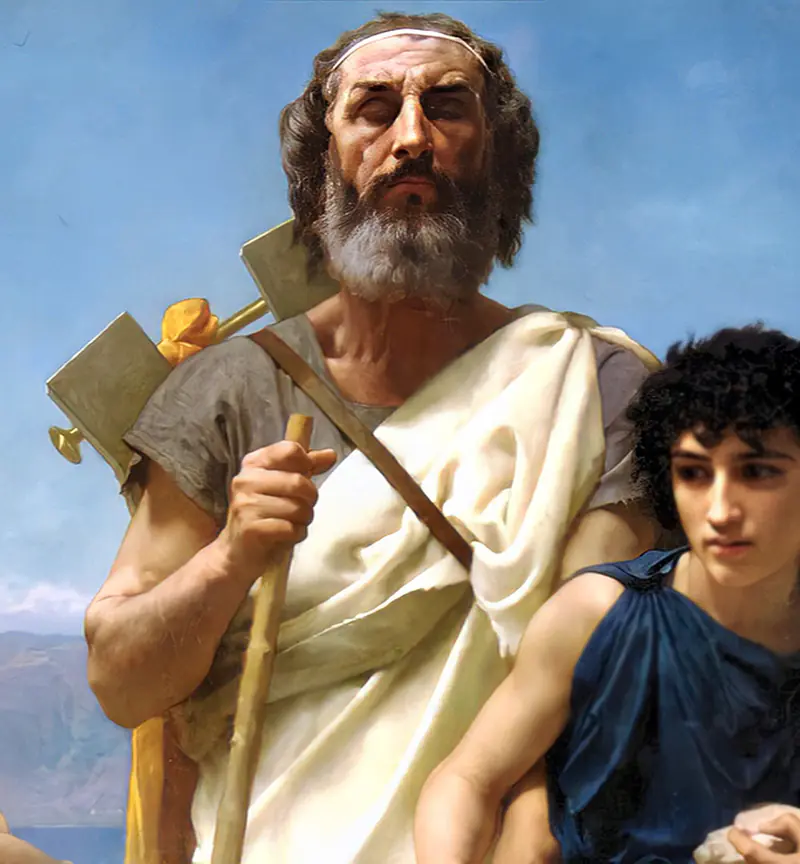
Homer is the name traditionally given to the poet to whom the Iliad and the Odyssey are attributed, a figure placed by ancient and modern reckoning in the 8th century BCE, roughly around 750 to 700 BCE. Little about his life can be stated with certainty, and all ancient testimonies are late and often contradictory. Multiple Greek cities laid claim to him, with Ionia in western Asia Minor prominent among the candidates: Smyrna and Chios are the most commonly named, while other traditions mention Colophon, Ithaca, and elsewhere on the Greek mainland and islands. The image of Homer as a blind singer, an aoidos who composed and performed orally, derives from later biography and from suggestive scenes in the Odyssey, but it cannot be verified. Nevertheless, the portrait of a professional singer working within the evolving performance culture of archaic Greece remains plausible for a poet active in this period.
Language, Education, and Environment
The language of the Homeric poems, a distinctive blend of Ionic with notable Aeolic elements, points to an eastern Aegean milieu in which different dialects circulated through long oral performance. The education of such a poet would have been practical and performative rather than scholastic: mastery of hexameter verse, a large repertoire of traditional themes and episodes, and the ability to tailor songs to audiences at courts, festivals, and communal gatherings. If Homer was indeed from Chios, the later guild known as the Homeridae, rhapsodes who claimed lineage from him, suggests an institutional memory of such training. Even if that claim is genealogical in name only, it highlights that he was imagined as standing at the head of a professional lineage of performers.
Works and Authorship
By antiquity, two epics in dactylic hexameter were everywhere associated with his name: the Iliad, focused on a segment of the Trojan War, and the Odyssey, recounting Odysseus's return home. Whether one person created both poems has been debated since antiquity. Some ancient scholars already distinguished the style and interests of the two epics. The Epic Cycle and the Homeric Hymns were at times linked to him in public imagination, but the consensus of ancient scholarship increasingly separated them from the core Homeric corpus. Modern analysis of formulaic diction and type-scenes, especially the work of Milman Parry and Albert Lord, made a strong case that the poems crystallized from a long oral tradition. In this view Homer, whatever his exact identity, stands as a consummate singer whose artistry forged expansive compositions from inherited materials.
Peers, Rivals, and Near-Contemporaries
Hesiod is often placed as a near-contemporary poet, with ancient tradition even staging a contest between Homer and Hesiod. While the Certamen is not a reliable historical report, it reflects an early sense that Homer and Hesiod represented complementary poetic domains: heroic warfare and journeying on the one hand, agriculture and moral instruction on the other. Other archaic poets such as Archilochus, though probably later, show how performance poetry flourished across genres in the generations after Homer, reinforcing the idea that he worked within a vibrant and competitive poetic environment rather than in isolation.
Performance, Patronage, and Athenian Organization
Rhapsodes, professional reciters of epic, preserved and propagated Homeric poetry. In Athens, later tradition credited the tyrant Peisistratus and his circle, including Hipparchus, with organizing official recitations of Homer at the Panathenaic festival and with imposing a more stable textual order on the poems. Whether a single Peisistratean recension occurred is debated, but the story captures an important phase in which performance and text began to interact more intensively. Plato cast a rhapsode named Ion as a performer inspired chiefly by Homer, offering a glimpse of how central Homeric verse had become in city festivals and civic education by the classical period.
Historical Setting and Imagination
Homer belongs to a generation looking back on a mythic Bronze Age through the lens of early archaic society. The poems evoke palaces, councils, and assemblies that blend memory and imagination, reaching from Ionia across the Mediterranean. The moral and political concerns of the epics reflect the experience of small communities negotiating authority, custom, and reputation. Central values such as kleos (glory) and nostos (homecoming) imply an audience immersed in maritime trade, colonization, and shifting alliances. The sophisticated portrayal of gods and humans together in a shared narrative space suggests that the poet had deep familiarity with traditional myth while molding it to the expectations of a changing world.
Ancient Witnesses and Critique
By the classical era Homer stood at the center of Greek education. Herodotus offered a date that placed him several generations before his own time, treating Homer as an authoritative voice on matters of myth and geography. Plato, while often critical of the moral influence of epic in works such as the Republic, reveals by that very critique the unrivaled cultural authority Homer enjoyed. Aristotle, in the Poetics, praised Homeric composition, analyzing plot structure and character with Homer as a primary exemplar of epic craft. These philosophers do not supply reliable biographical facts about Homer, but they chart his stature and the centrality of his verse in Greek thought.
Textual Scholarship and Transmission
With the rise of Hellenistic scholarship in Alexandria and beyond, editors and librarians turned sustained attention to the text. Zenodotus is often credited as the first major editor of Homer at the Library of Alexandria, followed by Aristophanes of Byzantium, who refined accentuation and critical signs, and Aristarchus of Samothrace, whose judgments on readings and authenticity shaped the tradition for centuries. Scholia in medieval manuscripts preserve many of their observations. Theagenes of Rhegium, earlier, typifies an allegorical approach that tried to reconcile Homer with philosophical ideas, an impulse that continued through late antiquity. The textual tradition passed through papyri and codices, including manuscripts such as the Venetus A, and reached Rome, where poets like Virgil engaged Homer in creative rivalry.
Themes, Style, and Innovation
The Iliad and the Odyssey are capacious poems that balance formulaic language and improvisational technique with large-scale narrative design. The interplay of fate, divine will, and human choice, the depth of characterization, and the integration of simile and scene-setting produce a world that readers recognize as both traditional and newly imagined. Scenes of assembly, supplication, hospitality, and battle are rendered with technical precision gained over generations of singers. If Homer stands as a single author, he did so by mastering and reorganizing this inherited craft into enduring wholes.
Legends, Lives, and the Homeric Question
Ancient biographies, sometimes attributed to figures like Herodotus or Plutarch but compiled much later, wove legends about Homer's parentage, travels, and death. These Lives cannot be verified, yet they testify to the desire to anchor an extraordinary poetic achievement in a human story. The Homeric Question, the inquiry into the authorship, unity, and formation of the poems, has persisted from antiquity to modern times. While modern scholarship emphasizes the oral background and the probability of a long gestation and performance history, the name Homer remains a useful and venerable sign for the creative intelligence that shaped the epics that bear his name.
Death and Enduring Presence
Homer is said to have died sometime after the composition or performance of the poems, with ancient chronologies placing his death generally in the same century as his supposed birth. Where and how he died is unknown. Yet the tradition that grew around him, from the Homeridae on Chios to the Athenian festival culture, from philosophers like Plato and Aristotle to editors like Aristarchus, ensured that the epics became the shared heritage of the Greek-speaking world and, later, of the Mediterranean and beyond. In this sense, even when the details of the life retreat into shadow, the life work remains luminous: a pair of poems that defined epic and set a standard for narrative art down to the present.
Our collection contains 27 quotes who is written by Homer, under the main topics: Motivational - Wisdom - Friendship - Free Will & Fate - Honesty & Integrity.
Other people realated to Homer: Alexander Pope (Poet), Matt Groening (Cartoonist), Thomas Hobbes (Philosopher), Dan Castellaneta (Actor), John Keats (Poet), William Cowper (Poet), William C. Bryant (Poet), Alexander the Great (Leader), Nikos Kazantzakis (Writer), E. L. Doctorow (Author)
Homer Famous Works
- -725 The Odyssey (Epic Poem)
- -762 The Iliad (Epic Poem)
Source / external links