
Horace Biography Quotes 84 Report mistakes
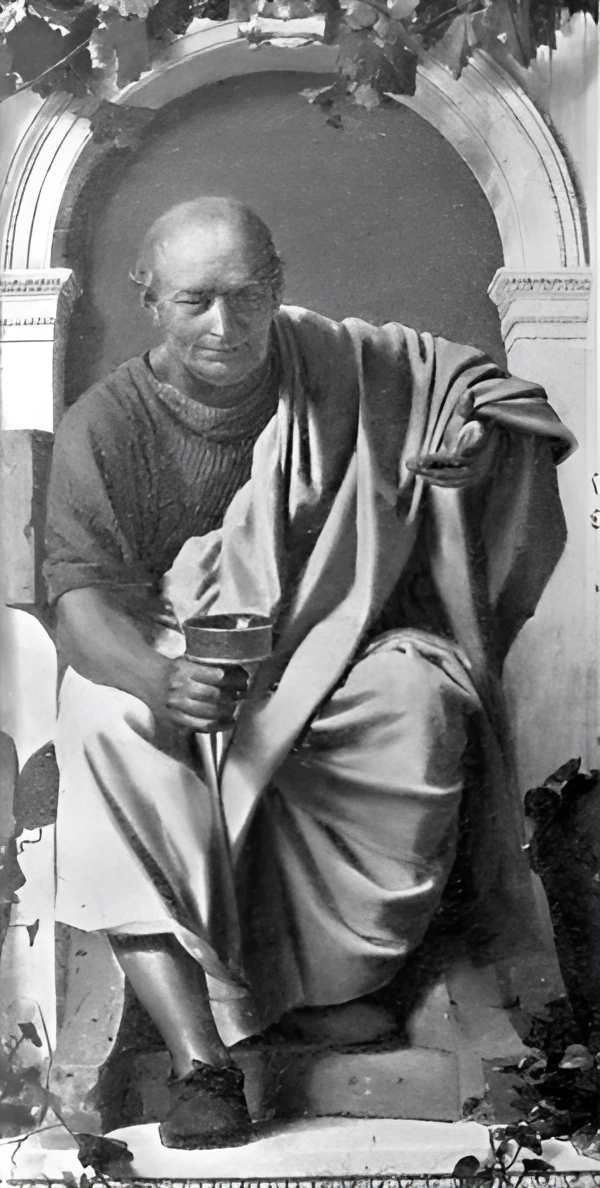
| 84 Quotes | |
| Occup. | Poet |
| From | Rome |
| Born | 65 BC |
| Died | 8 BC |
| Cite | |
Citation Formats
APA Style (7th ed.)
Horace biography, facts and quotes. (2026, February 11). FixQuotes. https://fixquotes.com/authors/horace/
Chicago Style
"Horace biography, facts and quotes." FixQuotes. February 11, 2026. https://fixquotes.com/authors/horace/.
MLA Style (9th ed.)
"Horace biography, facts and quotes." FixQuotes, 11 Feb. 2026, https://fixquotes.com/authors/horace/. Accessed 6 Mar. 2026.
Early Life and Background
Quintus Horatius Flaccus was born in 65 BCE at Venusia (modern Venosa) on the Apulian-Lucanian frontier, a zone where Latin, Oscan, and Greek currents met and where Roman expansion was felt as daily fact. He grew up in the long aftershock of Rome's civil wars, when citizenship, property, and even speech could be fatal liabilities. His father, a freedman who had worked as a collector at auctions or a tax-related agent, is the first great moral presence in Horace's story - a man without aristocratic pedigree who nevertheless bought his son the one inheritance that could not be confiscated: formation.That background planted a double consciousness that never left him. Horace learned early how quickly status can be manufactured and undone, and he developed a lifelong suspicion of political theater and social climbing even as he mastered their codes. The freedman's son would later write as an insider-outsider, at home in elite circles but psychologically anchored in the virtues of restraint, self-sufficiency, and plain dealing that he credited to his father's discipline and example.
Education and Formative Influences
His father took him to Rome for schooling under the grammarian Orbilius, whose regime of memorization and strictness Horace later recalled with a mix of satire and grudging gratitude; from there he went to Athens to study philosophy and Greek literature, absorbing Epicurean ethics, Stoic moral vocabulary, and above all the lyric and iambic masters - Alcaeus, Sappho, Archilochus, and the Hellenistic poets. The experience coincided with Rome's rupture after Caesar's assassination (44 BCE): in Athens, youthful republican idealism still had a stage, and Horace's education became inseparable from the era's violent argument over liberty, authority, and survival.Career, Major Works, and Turning Points
In 44-42 BCE Horace joined Brutus' cause and served as a military tribune; after the defeat at Philippi (42 BCE) he returned to Italy to find his property lost in the confiscations. He obtained a post as a clerk in the treasury, wrote to stabilize both finances and identity, and was drawn into the circle of Virgil and Varius, who introduced him to Maecenas around 38 BCE. Maecenas' patronage - including the gift of a Sabine farm - gave Horace the material independence to refine his art while remaining close to the new Augustan power. His early Satires and Epodes sharpened Roman conversational verse with Greek bite; the Odes (Books 1-3, 23 BCE; Book 4, later) remade Latin lyric into a medium for love, politics, friendship, wine, time, and mortality; the Epistles matured into moral letters in hexameters; and the Ars Poetica became a compact treatise on craft and taste. A culminating public moment came when Augustus commissioned the Carmen Saeculare (17 BCE), a civic hymn that placed Horace at the ceremonial heart of the restored state even as his private work kept testing the costs of restoration.Philosophy, Style, and Themes
Horace's inner life is a negotiation between appetite and measure, ambition and retreat. The civil wars taught him how quickly grand slogans become blood, so his poetry often chooses the human scale - the dinner table, the country path, the quiet morning - as a laboratory for ethics. His famous counsel, “Seize the day, and put the least possible trust in tomorrow”. , is not hedonism so much as an anti-delusion: a technique for living lucidly under political uncertainty and bodily fragility. The same realism fuels his insistence that character is not a costume. “You may drive out nature with a pitchfork, yet she'll be constantly running back”. In Horace, "nature" is desire, temperament, mortality, the stubborn givens that ideology and self-deception cannot erase; wisdom is learning to live with them without becoming their slave.Technically, he is the poet of controlled intensity. He imports Greek meters into Latin with meticulous economy, and his voice turns on tonal poise - irony without cynicism, praise that keeps a private margin, confession that never becomes self-pity. His themes of moderation (aurea mediocritas), friendship, and the avoidance of extremes are not timid; they are strategies for integrity in an age that rewarded extremes with office and punished them with exile. His moral imagination also includes social interdependence: “It is your concern when your neighbor's wall is on fire”. The line reads like civic common sense, but in Horace it doubles as psychological counsel - a reminder that private serenity depends on public stability, and that the self cannot be fully insulated from the city's flames.
Legacy and Influence
Horace died in 8 BCE, shortly after Maecenas, leaving behind a body of work that became a classroom, a handbook, and a provocation for two millennia. His Odes set the template for European lyric self-fashioning; his Satires and Epistles modeled a humane, talkative moral poetry; and the Ars Poetica shaped critical language about decorum, unity, and the labor of revision. From Renaissance humanists to Dryden, Pope, and beyond, writers returned to Horace for a voice that could praise power without surrendering to it, enjoy pleasure without worshiping it, and speak of death without theatrics. His enduring influence lies in that disciplined inwardness: a poetry that converts historical trauma into calibrated speech, teaching readers how to live sanely when history will not be sane.Our collection contains 84 quotes written by Horace, under the main topics: Witty One-Liners - Motivational - Ethics & Morality - Wisdom - Art.
Other people related to Horace: Alexander Pope (Poet), Pierre Corneille (Dramatist), John Dryden (Poet), Joseph Addison (Writer), Juvenal (Poet), Horace Walpole (Author), Sextus Propertius (Poet), Helena Rubinstein (Businessman), Joachim du Bellay (Poet), Ausonius (Poet)
Horace Famous Works
- -18 Ars Poetica (Book)
- -20 Epistles (Book)
- -23 Odes (Book)
- -30 Epodes (Book)
- -35 Satires (Book)
Source / external links