
Hubert H. Humphrey Biography Quotes 40 Report mistakes
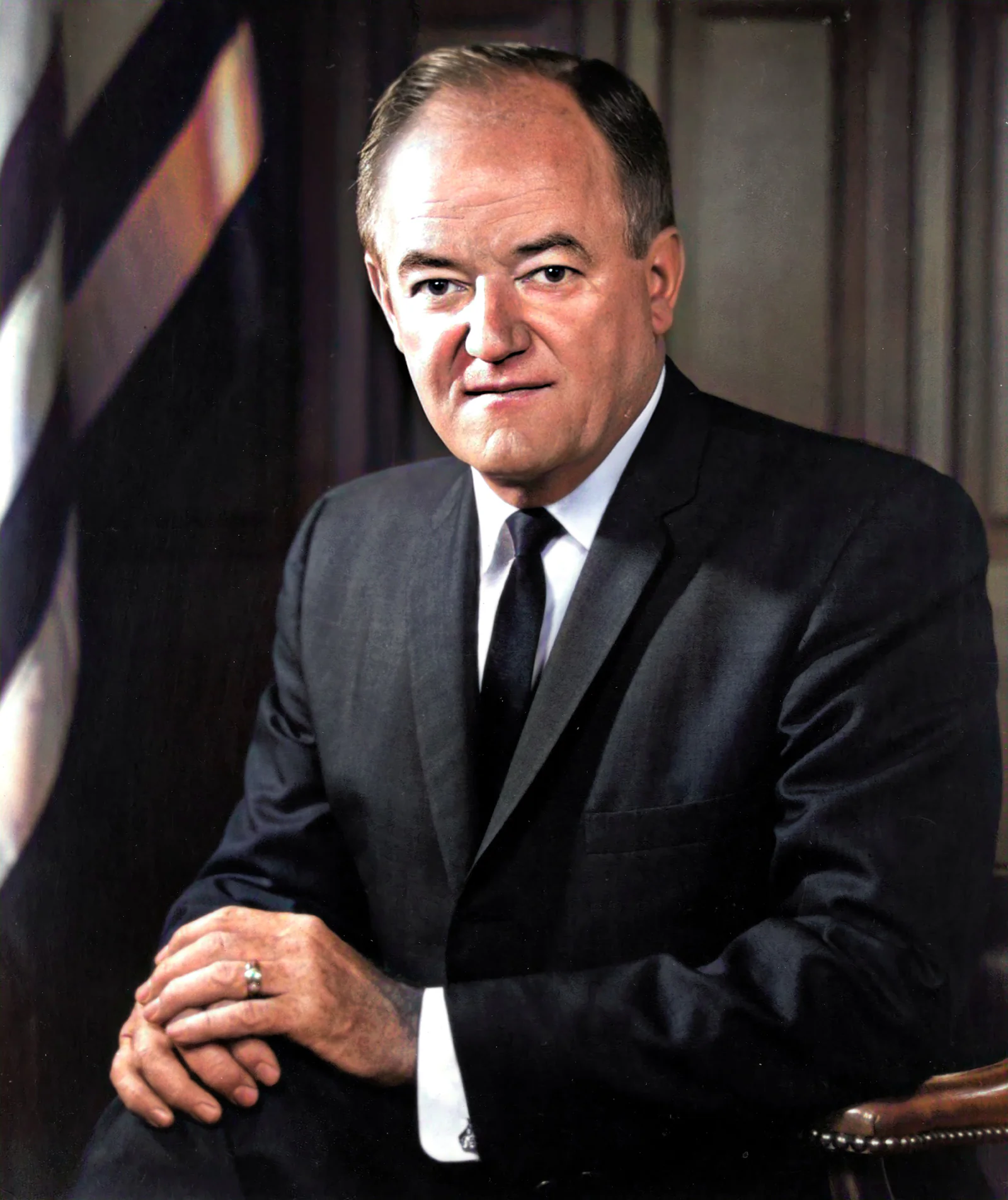
| 40 Quotes | |
| Born as | Hubert Horatio Humphrey Jr. |
| Occup. | Politician |
| From | USA |
| Born | May 27, 1911 Wallace, South Dakota |
| Died | January 13, 1978 |
| Aged | 66 years |
| Cite | |
Citation Formats
APA Style (7th ed.)
Hubert h. humphrey biography, facts and quotes. (2026, February 11). FixQuotes. https://fixquotes.com/authors/hubert-h-humphrey/
Chicago Style
"Hubert H. Humphrey biography, facts and quotes." FixQuotes. February 11, 2026. https://fixquotes.com/authors/hubert-h-humphrey/.
MLA Style (9th ed.)
"Hubert H. Humphrey biography, facts and quotes." FixQuotes, 11 Feb. 2026, https://fixquotes.com/authors/hubert-h-humphrey/. Accessed 22 Mar. 2026.
Early Life and Background
Hubert Horatio Humphrey Jr. was born on May 27, 1911, in Wallace, South Dakota, into the precarious world of small-town commerce and prairie politics. His father, Hubert Humphrey Sr., was a pharmacist and local booster whose drugstore doubled as a community listening post. The rhythms of the Upper Midwest - neighborliness, Protestant moral language, and the hard arithmetic of farm credit - formed Humphrey early, along with the instability of the interwar economy that could make a family business feel like a public trust one month and a gamble the next.The Great Depression sharpened his sense that private misfortune and public policy were inseparable. After high school he worked as a druggist in the family store in Huron, South Dakota, absorbing the daily stories of sickness, unemployment, and foreclosure. That apprenticeship in face-to-face problem solving became his emotional baseline: politics, for him, was a form of applied compassion carried out in institutions large enough to matter.
Education and Formative Influences
Humphrey studied at the University of Minnesota and later at Louisiana State University, where he completed an M.A. in political science in 1940. Minnesota progressivism, the Social Gospel tradition, and the practical organizing culture of the Farmer-Labor movement shaped him as much as classroom theory did. He learned to speak the language of ideals without losing the instincts of a retail politician, and he returned to Minneapolis convinced that liberalism had to be built precinct by precinct, union hall by union hall, not merely proclaimed.Career, Major Works, and Turning Points
Humphrey rose quickly in wartime and postwar Minneapolis as a municipal reformer, becoming mayor in 1945 and pushing civil rights enforcement and fair employment measures in a city strained by migration and labor conflict. His national breakthrough came at the 1948 Democratic National Convention, where he urged the party to move from "states' rights" equivocation toward explicit civil rights, helping drive a platform that helped fracture the Dixiecrats but set a moral direction. Elected to the U.S. Senate in 1948, he became a central architect of modern liberal legislation, championing the 1964 Civil Rights Act and 1965 Voting Rights Act while also backing Cold War containment. As Lyndon B. Johnson's vice president (1965-1969), he was instrumental in passing Great Society programs but was politically consumed by the Vietnam War, a conflict he privately agonized over yet publicly defended in loyalty to the administration. In 1968 he won the Democratic nomination and lost narrowly to Richard Nixon, then returned to the Senate in 1971, fighting for employment policy and arms control while facing the illness that would end his life on January 13, 1978.Philosophy, Style, and Themes
Humphrey's inner life mixed exuberant sociability with a deep need to be useful, a temperament that made him both resilient and vulnerable. He believed government existed to widen the circle of belonging, and he treated legislation as moral craftsmanship rather than abstract ideology. “Compassion is not weakness, and concern for the unfortunate is not socialism”. The line is revealing: he expected his opponents to weaponize the word "compassion" as softness, and he answered by reframing care as civic strength - a Midwestern rebuttal to the idea that empathy disqualifies leadership.His political imagination was also intensely domestic, even when he spoke about the world. “Foreign policy is really domestic policy with its hat on”. For Humphrey, international choices were never distant chess moves; they were reflections of a society's priorities, its industries, its soldiers, and its moral coherence. That sensibility sharpened his tragedy in the 1960s: a politician formed to relieve human suffering became tethered to a war increasingly seen as multiplying it. Yet his moral metric remained consistent, summed up in his best-known test of public ethics: “It was once said that the moral test of government is how that government treats those who are in the dawn of life, the children; those who are in the twilight of life, the elderly; and those who are in the shadows of life, the sick, the needy and the handicapped”. It is both creed and self-portrait - the son of a druggist transposing the pharmacy counter into national policy.
Legacy and Influence
Humphrey endures as one of the pivotal builders of postwar American liberalism: an orator who pushed civil rights into the Democratic Party's center, a Senate craftsman who helped translate movement demands into durable law, and a case study in the costs of executive loyalty during wartime. His career left institutions and precedents - from civil rights enforcement to the expectation that Democrats publicly defend an activist social state - while his personal story remains a caution and an inspiration: that decency can be politically potent, that coalition-building is a moral art, and that the hardest test for a reformer is not how fiercely they believe, but how they act when power asks for compromise.Our collection contains 40 quotes written by Hubert, under the main topics: Witty One-Liners - Motivational - Truth - Wisdom - Justice.
Other people related to Hubert: Muriel Humphrey (Celebrity), George D. Aiken (Politician), Don Fraser (Politician)
Source / external links