
Igor Stravinsky Biography Quotes 29 Report mistakes
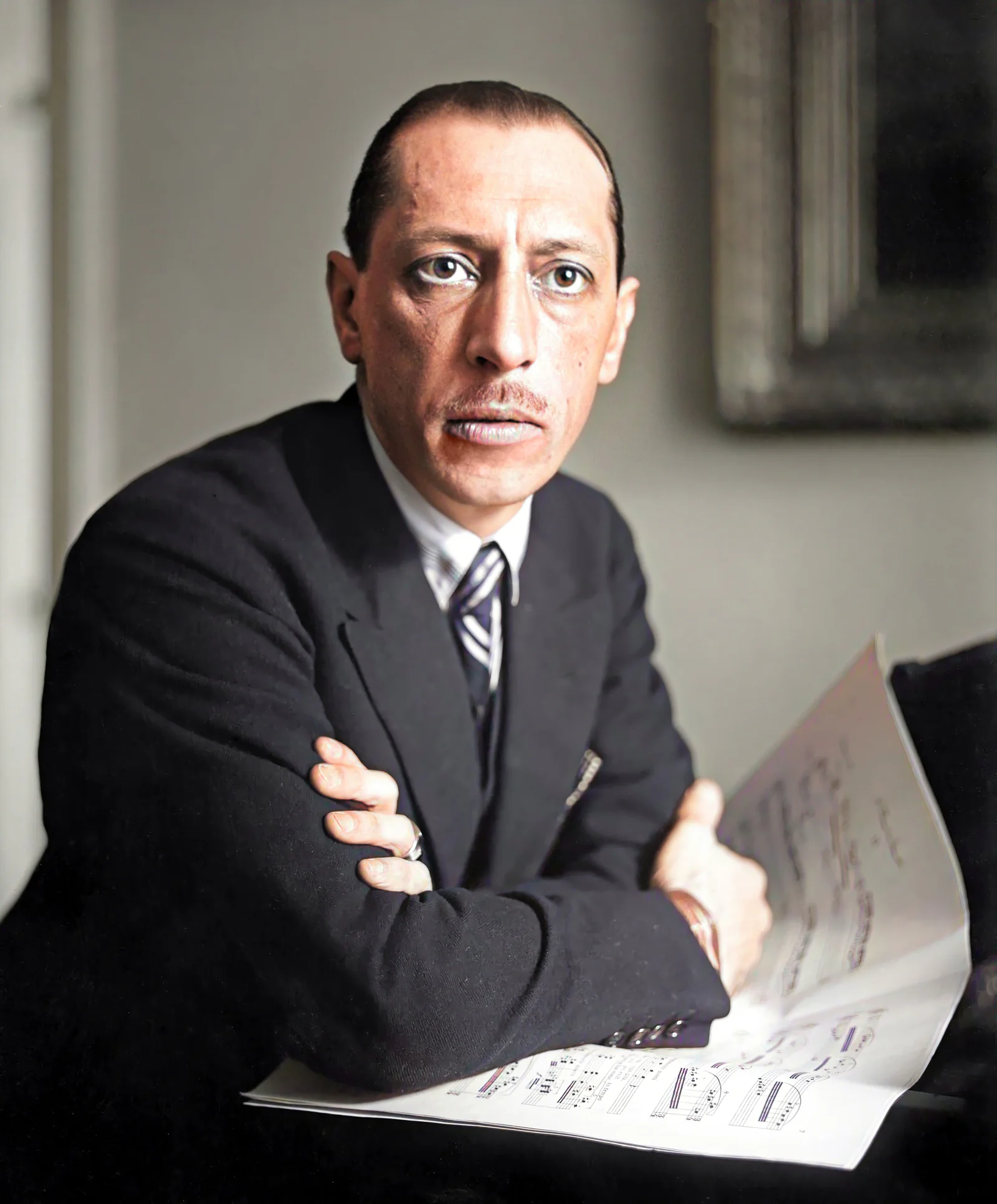
| 29 Quotes | |
| Born as | Igor Fyodorovich Stravinsky |
| Occup. | Composer |
| From | Russia |
| Spouses | Catherine Nossenko (1906–1939) Vera de Bosset (1940–1971) |
| Born | June 17, 1882 Oranienbaum, Russian Empire |
| Died | April 6, 1971 New York City, New York, United States |
| Cause | Heart attack |
| Aged | 88 years |
| Cite | |
Citation Formats
APA Style (7th ed.)
Igor stravinsky biography, facts and quotes. (2026, February 11). FixQuotes. https://fixquotes.com/authors/igor-stravinsky/
Chicago Style
"Igor Stravinsky biography, facts and quotes." FixQuotes. February 11, 2026. https://fixquotes.com/authors/igor-stravinsky/.
MLA Style (9th ed.)
"Igor Stravinsky biography, facts and quotes." FixQuotes, 11 Feb. 2026, https://fixquotes.com/authors/igor-stravinsky/. Accessed 5 Mar. 2026.
Early Life and Background
Igor Fyodorovich Stravinsky was born on 1882-06-17 in Oranienbaum (now Lomonosov), near St Petersburg, in the last, tense decades of imperial Russia. His father, Fyodor Stravinsky, was a celebrated bass at the Mariinsky Theatre, and the household moved in circles where opera singers, conductors, and courtly patrons treated music not as a hobby but as a public language of power and taste. The young Stravinsky absorbed that professional atmosphere early - the backstage discipline, the craft behind the glamour, and the idea that musical style was something one could consciously choose and refine.Yet his personality formed in the shadow of both privilege and constraint. He grew up amid the rituals of Orthodox culture and the cosmopolitan aspirations of the capital, while Russia itself was fracturing under modernity, war, and political unrest. Those contradictions - archaic rite versus urban sophistication, communal myth versus individual will - became the emotional fuel of his later work: a lifelong need to impose order on volatility, and to convert memory into structure rather than confession.
Education and Formative Influences
Stravinsky initially followed a safer path, enrolling at the University of St Petersburg to study law, but music kept asserting itself with increasing seriousness. A decisive influence came through his family connection to Nikolai Rimsky-Korsakov, under whose guidance Stravinsky learned orchestration as an exacting, almost architectural craft. Early pieces such as the Symphony in E-flat and the exuberant Fireworks revealed a young composer testing how color, rhythm, and formal control could create personality - not by romantic self-display, but by the strategic deployment of technique. The era mattered: Paris was hungry for "Russian" modernism, and Stravinsky was poised to become its most shocking and disciplined emissary.Career, Major Works, and Turning Points
His breakthrough arrived when Sergei Diaghilev commissioned ballets for the Ballets Russes: The Firebird (1910) made him famous, Petrushka (1911) sharpened his gift for rhythm and collage, and The Rite of Spring (1913) detonated expectations of decorum with its primal accents and ritual dramaturgy, famously provoking tumult at its premiere in Paris. World War I forced him into Swiss exile, where smaller forces and leaner means spurred works like L'Histoire du soldat (1918); the 1920s brought the turn to neoclassicism, with Pulcinella (1920) and later the Symphony of Psalms (1930) and the opera-oratorio Oedipus Rex (1927) balancing antique forms with modern bite. After settling in the United States in 1939, he continued to reinvent himself, moving in his late years toward serial procedures in works such as Agon (1957) and Threni (1958), not as surrender to fashion but as another chosen discipline - a new set of limits to think inside, until his death on 1971-04-06.Philosophy, Style, and Themes
Stravinsky's inner life is often misread through the mask of his public persona - witty, severe, allergic to sentimentality. But the psychological core of his art was less coldness than vigilance: a fear of formlessness, a distrust of indulgent emotion, and a belief that freedom is earned by rules. “The more constraints one imposes, the more one frees one's self. And the arbitrariness of the constraint serves only to obtain precision of execution”. That credo clarifies the stylistic zigzags that so baffled contemporaries: the point was not to be "new" or "old", but to set a problem, then solve it with ruthless clarity. In The Rite of Spring, the problem is ritual energy without romantic narrative; in neoclassicism, it is distance - how to make inherited forms speak without nostalgia; in the late serial works, it is how to preserve lucidity inside a rigorous grid.His themes circle time, ritual, and the body - music as an engine that organizes human experience rather than mirrors private feeling. “Music is given to us with the sole purpose of establishing an order in things, including, and particularly, the coordination between man and time”. That sense of temporal architecture explains his obsession with pulse, repetition, and abrupt blocks of sound, and also his religious turn, most nobly in the Symphony of Psalms, where choral austerity and orchestral restraint enact faith as disciplined attention. Creative life, for Stravinsky, was not lightning but labor: “Just as appetite comes by eating, so work brings inspiration, if inspiration is not discernible at the beginning”. The remark exposes a mind that trusted routine, craft, and the slow accumulation of certainty more than romantic "genius" - a composer who made psychology audible by controlling it.
Legacy and Influence
Stravinsky reshaped 20th-century music by proving that modernism could be both radical and controlled, and that stylistic identity could be a sequence of deliberate choices rather than a single confession. His rhythmic innovations became foundational for composers from Bartok to Copland and beyond, while his neoclassical turn offered a model of reinvention that influenced Poulenc, Britten, and countless film and concert composers seeking clarity without regression. Just as enduring is the ethical stance implied by his work: art as an act of ordering time, attention, and community - a vision forged in the upheavals of Russia, tempered in exile, and broadcast from Paris to Hollywood, leaving a repertoire that still feels like a set of living challenges rather than museum pieces.Our collection contains 29 quotes written by Igor, under the main topics: Witty One-Liners - Wisdom - Art - Love - Music.
Other people related to Igor: Frank Zappa (Musician), Jean Cocteau (Director), Karl Amadeus Hartmann (Composer), Arnold Newman (Photographer), Sergei Prokofiev (Composer)
Source / external links