
Isaac Asimov Biography Quotes 34 Report mistakes
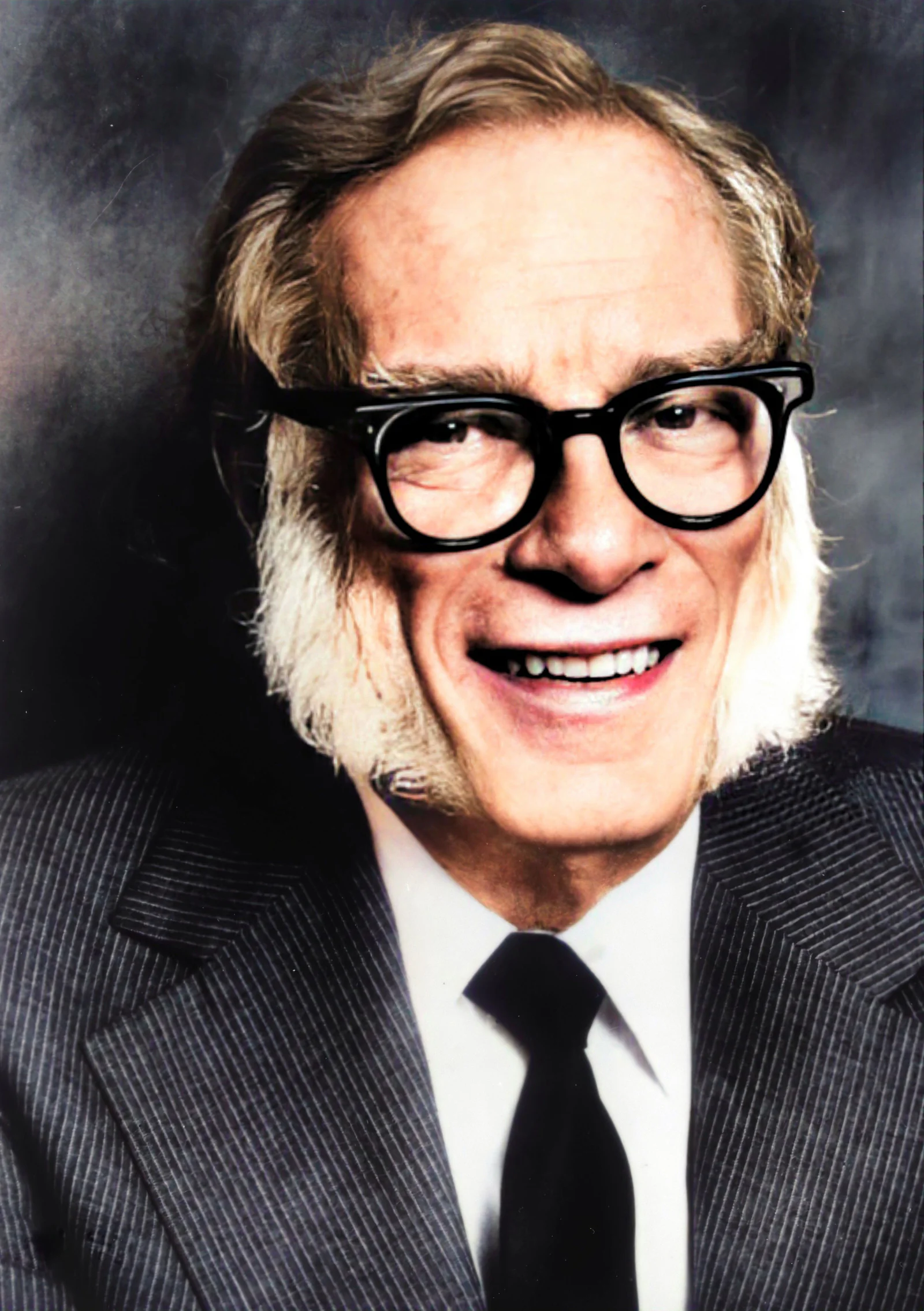
| 34 Quotes | |
| Native name | Исаак Азимов |
| Occup. | Scientist |
| From | USA |
| Spouses | Gertrude Blugerman (1942–1970) Janet Jeppson (1973–1992) |
| Born | January 2, 1920 Petrovichi, Smolensk Oblast, Russian SFSR |
| Died | April 6, 1992 Brooklyn, New York, United States |
| Cause | Heart and kidney failure |
| Aged | 72 years |
| Cite | |
Citation Formats
APA Style (7th ed.)
Isaac asimov biography, facts and quotes. (2026, February 11). FixQuotes. https://fixquotes.com/authors/isaac-asimov/
Chicago Style
"Isaac Asimov biography, facts and quotes." FixQuotes. February 11, 2026. https://fixquotes.com/authors/isaac-asimov/.
MLA Style (9th ed.)
"Isaac Asimov biography, facts and quotes." FixQuotes, 11 Feb. 2026, https://fixquotes.com/authors/isaac-asimov/. Accessed 26 Mar. 2026.
Early Life and Background
Isaac Asimov was born on January 2, 1920, in Petrovichi, a small village in the Smolensk region of the former Russian Empire, to Jewish parents Judah Asimov and Anna Rachel Berman. His earliest years were marked by the aftershocks of revolution and civil unrest, and by the precariousness that pushed countless families westward. Though his birthdate was later recorded and celebrated in the United States, Asimov himself noted uncertainty about the exact day - a fitting ambiguity for a writer who would spend his life turning hard facts into lucid stories.In 1923 the family emigrated to New York City, settling in Brooklyn, where they operated a succession of candy stores. The neighborhood storefront became his first laboratory of human behavior and his first library: pulp magazines and science fiction periodicals passed through the shop, and the boy who learned English by immersion also learned appetite - for narrative, for explanation, for the crisp authority of printed pages. The immigrant household valued practical work, but Asimov's temperament leaned toward comprehension and system-building, traits that would later fuse his identities as scientist, educator, and world-builder.
Education and Formative Influences
Asimov attended New York City public schools, graduated from Boys High School in Brooklyn, and entered Columbia University, earning a BS in 1939 and an MA in 1941 in chemistry. He began doctoral work, paused during World War II for civilian service at the Philadelphia Navy Yard, and ultimately completed his PhD in biochemistry at Columbia in 1948. The era mattered: the Depression sharpened his thrift of style, the war and the atomic age sharpened his ethical interest in technology's consequences, and the booming American magazine market taught him that ideas traveled fastest when written with clarity, pace, and a minimum of ornament.Career, Major Works, and Turning Points
Asimov sold his first story in 1939 and soon entered the high-velocity ecosystem of editors like John W. Campbell at Astounding, where he published the Robot stories that introduced the Three Laws of Robotics, beginning with "Runaround" (1942). In the early 1940s he conceived his most influential fictional architecture: psychohistory and the long decline-and-renewal arc of the Foundation series, launched with stories that became Foundation (1951) and later expanded into sequels and prequels. After a period teaching at Boston University School of Medicine - eventually as a tenured associate professor - he chose writing full time, producing an output that crossed genres with unusual ease: popular science (The Intelligent Man's Guide to Science, 1960), mysteries, essays, and expansive later novels such as The Gods Themselves (1972) and the robot-Federation bridge novels that knit his universes together. A late-life turning point was the 1983 heart surgery after which he received a blood transfusion that, he later revealed, transmitted HIV; complications led to his death in New York City on April 6, 1992. Even then, the biography of his mind remained defined less by tragedy than by an almost industrial devotion to explanation.Philosophy, Style, and Themes
Asimov's inner life was driven by an almost physiological need to convert confusion into structure. He treated knowledge not as a trophy but as a process, and his best work - fiction and nonfiction alike - staged the pleasure of method: hypotheses tested, assumptions corrected, systems revised. That psychology is audible in his credo that “The true delight is in the finding out rather than in the knowing”. The line is not merely inspirational; it reveals a temperament that distrusted static certainty and found emotional regulation in inquiry itself. For Asimov, to understand was to steady the world, and to write was to make that steadiness contagious.His themes repeatedly pit intelligence against immaturity, and science against the social lag that misuses it. Robots, psychohistorians, and patient educators become his stand-ins for the rational conscience, while superstition and authoritarianism supply the antagonistic pressure. He was famously optimistic about tools and wary of the human failure to govern them, a tension he crystallized when he observed, “The saddest aspect of life right now is that science gathers knowledge faster than society gathers wisdom”. Yet he refused nihilism: “Suppose that we are wise enough to learn and know - and yet not wise enough to control our learning and knowledge, so that we use it to destroy ourselves? Even if that is so, knowledge remains better than ignorance”. Stylistically, this became his signature: clean sentences, conversational authority, and plots built like proofs. Even his futures are less prophecy than argument - a disciplined insistence that reason, though imperfectly managed, remains humanity's best instrument.
Legacy and Influence
Asimov endures as a defining architect of modern science fiction and one of the most effective popularizers of science in American letters, a rare figure whose authority came from both laboratory training and narrative instinct. The Three Laws became a cultural reference point for debates about AI ethics, while Foundation helped set the template for large-scale, idea-driven saga storytelling in literature, film, and television. Equally lasting is his example of intellectual citizenship: a writer who treated curiosity as a moral practice, who trusted ordinary readers with complex concepts, and who left behind not just famous titles but a model of how a scientist can inhabit the public sphere - explaining, questioning, and insisting that the future is built, sentence by sentence, from what we choose to understand.Our collection contains 34 quotes written by Isaac, under the main topics: Witty One-Liners - Ethics & Morality - Wisdom - Mortality - Writing.
Other people related to Isaac: Larry Niven (Writer), Frederik Pohl (Writer), James Gunn (Writer), John W. Campbell (Writer), Harlan Ellison (Writer), Clifford D. Simak (Writer), Paul Kurtz (Philosopher)
Isaac Asimov Famous Works
- 1972 The Gods Themselves (Novel)
- 1954 The Caves of Steel (Novel)
- 1951 Foundation (Novel)
- 1950 I, Robot (Short Story Collection)
- 1941 Nightfall (Short Story)
Source / external links