
Isaac Newton Biography Quotes 13 Report mistakes
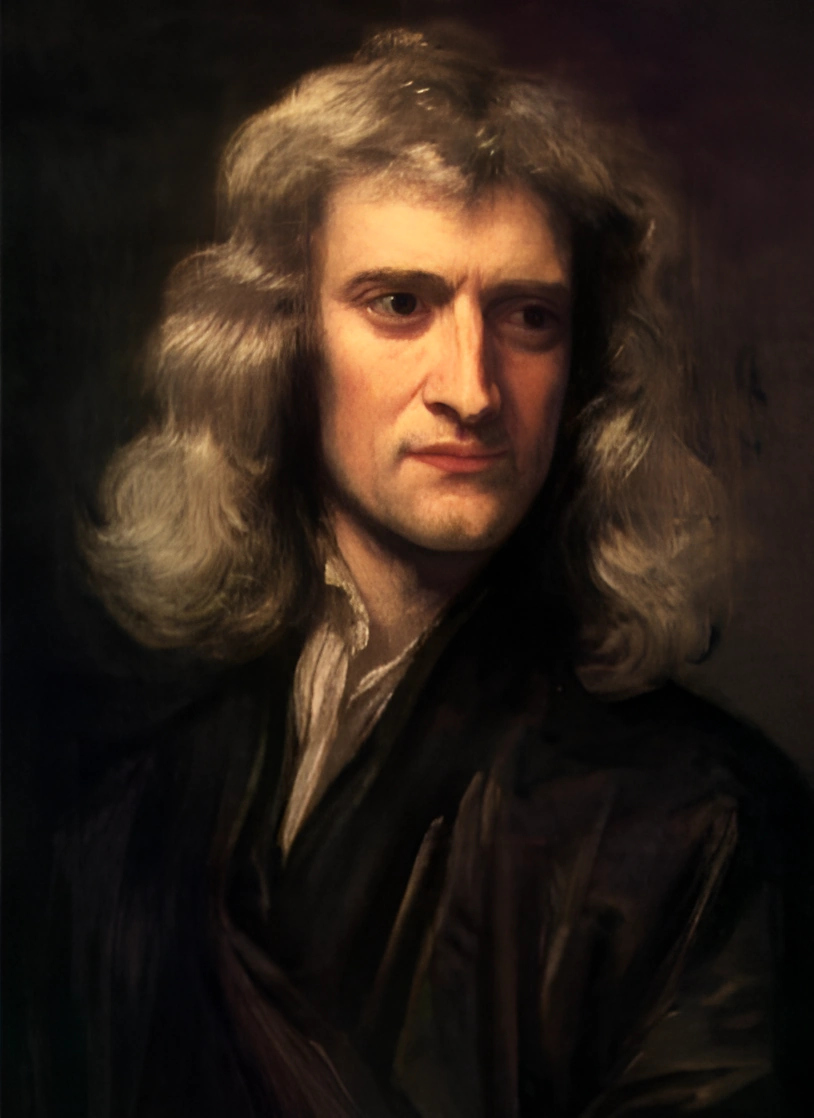
| 13 Quotes | |
| Occup. | Mathematician |
| From | England |
| Born | December 25, 1642 Woolsthorpe-by-Colsterworth, England |
| Died | March 20, 1727 London, England |
| Cause | Natural causes |
| Aged | 84 years |
| Cite | |
Citation Formats
APA Style (7th ed.)
Isaac newton biography, facts and quotes. (2026, February 11). FixQuotes. https://fixquotes.com/authors/isaac-newton/
Chicago Style
"Isaac Newton biography, facts and quotes." FixQuotes. February 11, 2026. https://fixquotes.com/authors/isaac-newton/.
MLA Style (9th ed.)
"Isaac Newton biography, facts and quotes." FixQuotes, 11 Feb. 2026, https://fixquotes.com/authors/isaac-newton/. Accessed 27 Mar. 2026.
Early Life and Background
Isaac Newton was born on 1642-12-25 (Old Style; 1643-01-04 New Style) in Woolsthorpe-by-Colsterworth, Lincolnshire, the only son of a yeoman farmer also named Isaac Newton who died before his birth. England was sliding toward civil war, and the instability of the 1640s framed a childhood marked less by politics than by fragility and absence. Premature and fatherless, Newton grew up with the early sense that the world was not arranged for his comfort, an emotional undertone that later hardened into self-reliance and secrecy.When his mother, Hannah Ayscough, remarried the rector Barnabas Smith, Newton was left behind at Woolsthorpe with his maternal grandmother. That separation is one of the clearest psychological fault lines in his biography: a boy trained early to endure abandonment and to distrust dependence. He returned to live with his mother after Smith's death, but domestic reconciliation never made him domestic. Sent briefly toward managing the family farm, he showed little interest in routine labor and strong interest in mechanisms, drawing, and solitary contrivance - a temperament already bending toward the private workshop and the inner tribunal of proof.
Education and Formative Influences
Newton attended The King's School in Grantham, lodging with the apothecary William Clarke, where he encountered chemical practice and a culture of instruments, powders, and experiments that anticipated his later blend of mathematics and hands-on trial. In 1661 he entered Trinity College, Cambridge, as a subsizar, absorbing the standard Aristotelian curriculum while privately reading the newer mechanical philosophy of Descartes, Gassendi, Galileo, and especially Kepler and Wallis. The plague closure of 1665-1667 sent him back to Woolsthorpe for the period later mythologized as his annus mirabilis: in isolation he sharpened his methods, not as sudden inspiration but as prolonged, obsessive concentration that made solitude productive rather than merely lonely.Career, Major Works, and Turning Points
Returning to Cambridge, Newton became Lucasian Professor of Mathematics (1669), built reflecting telescopes, and reshaped optics, arguing in his 1672 papers that white light is a mixture of colors and defending experiment against learned skepticism in bruising disputes. His mathematics matured into the method of fluxions, but his most decisive turning point came through Edmond Halley's visit in 1684, which drew from him the proof that an inverse-square gravitational force could yield Keplerian orbits. The result was Philosophiae Naturalis Principia Mathematica (1687), a synthesis of dynamics, celestial mechanics, and mathematical method that refounded natural philosophy. Later he left Cambridge for London life: he served as Warden (1696) and then Master (1699) of the Royal Mint, led the Great Recoinage, pursued counterfeiters with prosecutorial zeal, and became President of the Royal Society (1703) and knight (1705). Opticks followed in 1704, more accessible than the Principia and rich with experimental reasoning, even as he guarded priority against rivals - most famously in the long calculus controversy with Leibniz.Philosophy, Style, and Themes
Newton's inner life was a paradox of humility before nature and fierce defensiveness before people. He could write, “To myself I am only a child playing on the beach, while vast oceans of truth lie undiscovered before me”. , and the metaphor is not performative modesty so much as a confession of appetite: he experienced knowledge as an endless coastline where small victories only enlarged the sense of what remained. Yet the same man also lived by vigilance, drafting private lists of sins in youth, hoarding unpublished notes, and retreating when controversy threatened his control. The precision of his science was paired with an emotional economy that spent lavishly on ideas and sparingly on intimacy.His public method demanded that understanding be anchored to what can be compelled by reason and experiment, a stance captured in, “A man may imagine things that are false, but he can only understand things that are true, for if the things be false, the apprehension of them is not understanding”. In the Principia he made that discipline architectural: definitions, axioms, and propositions form a rhetorical machine designed to leave as little room as possible for persuasion by personality. At the same time he recognized the turbulence of social life that proof cannot tame: “I can calculate the motion of heavenly bodies, but not the madness of people”. That tension helps explain his alternating withdrawal and dominance - a man who sought certainty in nature partly because human motives, including his own resentments, were harder to integrate.
Legacy and Influence
Newton died on 1727-03-20 in London and was buried in Westminster Abbey, an honor that signaled the new social authority of scientific achievement in Britain. His synthesis of mechanics and universal gravitation became the backbone of the Enlightenment's confidence that nature is intelligible in mathematical law; his optics shaped later experimental physics; and his style of argument - disciplined, quantitative, and explicitly methodical - became a template for what "science" would mean. Yet the deeper legacy is also psychological and cultural: the image of the solitary thinker, armed with patient calculation and an almost monastic intensity, remade the ideal of genius. Even as later physics revised his framework, Newton remains the central figure through whom the modern imagination learned to believe that the universe is not merely observed, but can be demonstrated.Our collection contains 13 quotes written by Isaac, under the main topics: Truth - Wisdom - Knowledge - Reason & Logic - Science.
Other people related to Isaac: Lord Kelvin (Scientist), William Emerson (Mathematician), Michael Apted (Director), Peter Ackroyd (Author), Julian Barbour (Scientist), William Whewell (Philosopher), Isaac Barrow (Mathematician)
Isaac Newton Famous Works
- 1728 The Chronology of Ancient Kingdoms Amended (Book)
- 1707 Arithmetica Universalis (Book)
- 1704 Opticks: Or, A Treatise of the Reflections, Refractions, Inflections, and Colours of Light (Book)
- 1687 Mathematical Principles of Natural Philosophy (Book)
Source / external links