
J. M. Barrie Biography Quotes 8 Report mistakes
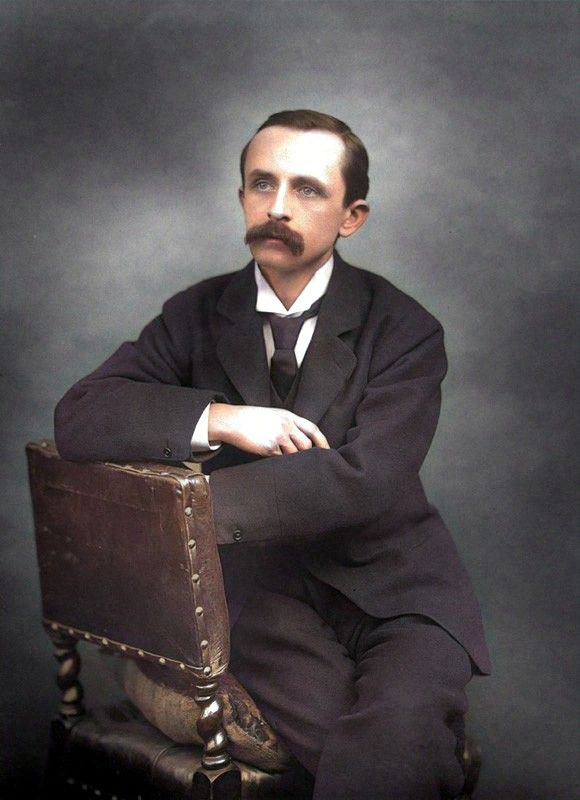
Attr: Herbert Rose Barraud, Public domain
| 8 Quotes | |
| Born as | James Matthew Barrie |
| Occup. | Novelist |
| From | Scotland |
| Spouse | Mary Ansell (1894-1909) |
| Born | May 9, 1860 Kirriemuir, Angus, Scotland |
| Died | June 19, 1937 London, England |
| Aged | 77 years |
| Cite | |
Citation Formats
APA Style (7th ed.)
J. m. barrie biography, facts and quotes. (2026, February 11). FixQuotes. https://fixquotes.com/authors/j-m-barrie/
Chicago Style
"J. M. Barrie biography, facts and quotes." FixQuotes. February 11, 2026. https://fixquotes.com/authors/j-m-barrie/.
MLA Style (9th ed.)
"J. M. Barrie biography, facts and quotes." FixQuotes, 11 Feb. 2026, https://fixquotes.com/authors/j-m-barrie/. Accessed 5 Mar. 2026.
Early Life
James Matthew Barrie was born on 9 May 1860 in Kirriemuir, Angus, Scotland, the son of a handloom weaver, David Barrie, and Margaret Ogilvy. He grew up in a large family in which stories, the Bible, and village folklore mixed with the rhythms of a small weaving town. The death of his elder brother David in a skating accident, when James was still a child, cast a long shadow over the household and profoundly shaped his imagination and his bond with his mother. Seeking to comfort her, he learned early to turn life into narrative, an instinct he later transformed into literature; he would pay a lasting tribute to her in his memoir Margaret Ogilvy.Education and Early Career
Barrie was schooled in Scotland and went on to the University of Edinburgh, where he read literature and began to imagine a life in letters. After university he earned his living as a journalist and essayist and soon moved to London, where the burgeoning press and publishing world offered a wider stage. His early prose sketches of Scottish life, including Auld Licht Idylls and A Window in Thrums, drew on Kirriemuir and its people with affection and irony. They brought him recognition and led to popular novels such as The Little Minister and Sentimental Tommy, works that displayed his gift for mingling humor with yearning and memory.Turn to the Theatre
Drawn to the immediacy of performance, Barrie increasingly wrote for the stage. His plays balanced fantasy and social observation, and he found champions among actors and producers on both sides of the Atlantic. The American producer Charles Frohman became a close collaborator and friend, helping to shepherd Barrie's work into leading theaters. In London, Gerald du Maurier brought suave intensity to roles that fused menace and charm, and Nina Boucicault gave a sprightly, androgynous vitality to a new hero Barrie was shaping. In the United States, Maude Adams embodied several of his heroines and later took on his boy who would not grow up, amplifying his fame in America.Peter Pan and the Llewelyn Davies Family
The genesis of Peter Pan lay in Barrie's walks in Kensington Gardens and in his friendship with Arthur and Sylvia Llewelyn Davies and their sons, George, Jack, Peter, Michael, and Nico. He told the boys stories, played elaborate games of make-believe, and spun a mythology that merged the landscapes of the Gardens with pirates, mermaids, and flight. The character first appeared in prose in The Little White Bird and then took full life on stage in 1904 as Peter Pan, Or the Boy Who Wouldn't Grow Up. The first London production, supported by Frohman at the Duke of York's Theatre, captivated audiences; Gerald du Maurier doubled as Mr. Darling and Captain Hook, and Nina Boucicault created the original Peter on the London stage. The novel Peter and Wendy followed, carrying the tale to new readers and securing Barrie's place in literary history.The relationship with the Llewelyn Davies family deepened as years passed. After Arthur and Sylvia died, Barrie helped care for the boys, acting as guardian and guide through schooldays and wartime. The losses of the First World War touched them all: George fell in action, and Frohman was lost in the sinking of the Lusitania. These bereavements darkened Barrie's middle years, and their aftershocks can be felt in the wistfulness and moral searching of plays such as Dear Brutus and Mary Rose.
Marriage, Friendships, and Collaborations
Barrie married the actress Mary Ansell in 1894. Their union, companionable at first, gradually unraveled amid the demands of theatrical life and his absorption in work and friendships; they had no children and eventually divorced. He maintained lively ties with writers and performers. He co-wrote the comic opera Jane Annie with Arthur Conan Doyle, and he played cricket and traded banter with fellow authors such as Conan Doyle and H. G. Wells. His circle of actors and managers formed a practical artistic laboratory in which he refined his plays through rehearsal, attention to audiences, and the alchemy of casting.Public Role and Honors
By the early twentieth century Barrie was among the most celebrated dramatists in Britain. He received a baronetcy in 1913, becoming Sir James M. Barrie, and was frequently called upon for public addresses. His rectorial address, Courage, delivered to university students, captured his belief in resilience and imagination amid hardship. His philanthropy was notable and quiet; most famously, in 1929 he gave the copyright of Peter Pan to Great Ormond Street Hospital for Children, ensuring that the adventures of Peter and Wendy would help care for generations of young patients.Later Work and Legacy
Barrie continued to write into his later years, returning again and again to themes of memory, longing, and the elusive borders between childhood and adulthood. Works such as The Admirable Crichton, Quality Street, What Every Woman Knows, and Mary Rose revealed his range, from social comedy to eerie fable, and sustained his reputation on the stage. Yet it was Peter Pan, sustained by performers like Maude Adams and the interpretive ingenuity of producers including Charles Frohman, that remained his emblem. The character's mix of joy, cruelty, freedom, and fear spoke to Barrie's central insight: that growing up is both necessary and perilous, and that the consolations of play and story are among the deepest we possess.J. M. Barrie died in London on 19 June 1937. He was laid to rest in Kirriemuir, returning in death to the small Scottish town that had fueled his earliest dreams. His legacy endures in literature and theater and in the enduring gift to Great Ormond Street Hospital, where the boy who would not grow up continues to serve children in need. Those closest to him, his mother Margaret Ogilvy, his wife Mary Ansell, his friends and collaborators such as Charles Frohman, Gerald du Maurier, Maude Adams, Arthur Conan Doyle, and the Llewelyn Davies family, shaped the man and the artist, and in their company he fashioned a body of work that has never ceased to fly.
Our collection contains 8 quotes written by M. Barrie, under the main topics: Wisdom - Sarcastic - Live in the Moment - Failure - Equality.
Other people related to M. Barrie: Radha Mitchell (Actress), Cathy Rigby (Athlete), Andrew Lang (Poet), Daphne du Maurier (Novelist), Daisy Ashford (Writer)
J. M. Barrie Famous Works
- 1917 Dear Brutus (Play)
- 1911 Peter Pan (Novel)
- 1906 Peter Pan in Kensington Gardens (Novel)
- 1902 The Admirable Crichton (Play)
- 1901 Quality Street (Play)
- 1891 The Little Minister (Novel)
Source / external links