
J. R. R. Tolkien Biography Quotes 13 Report mistakes
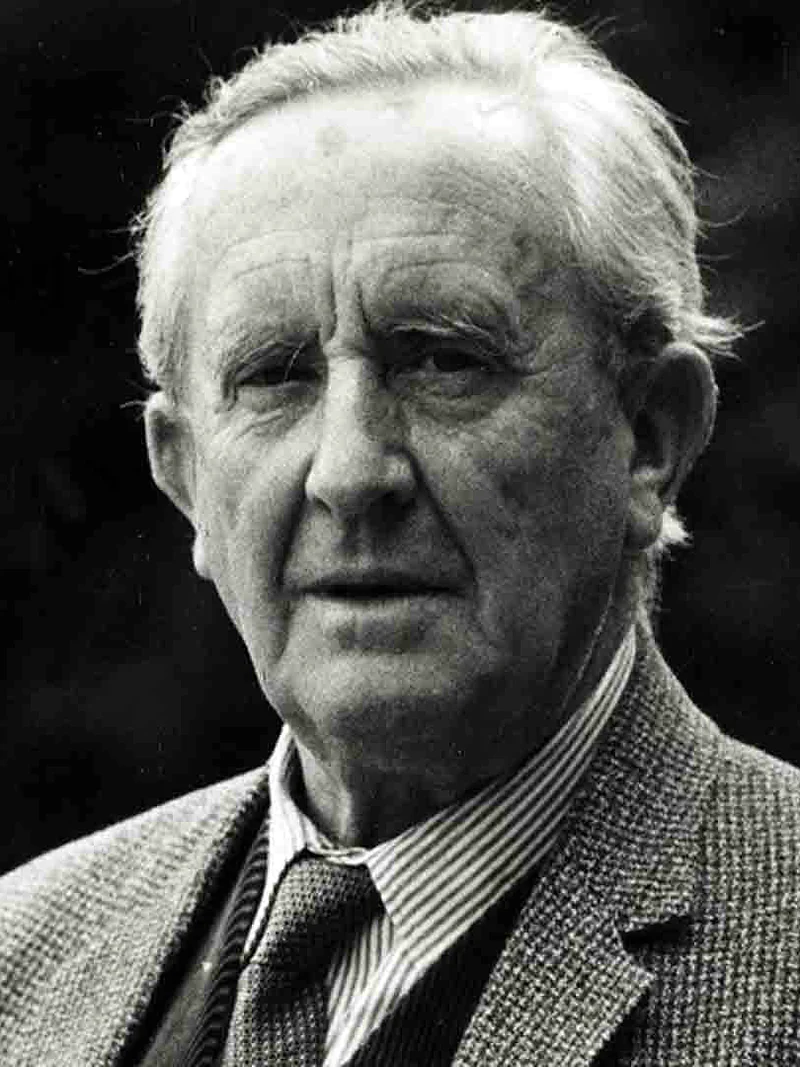
| 13 Quotes | |
| Born as | John Ronald Reuel Tolkien |
| Known as | J. R. R. Tolkien; JRR Tolkien |
| Occup. | Novelist |
| From | England |
| Born | January 3, 1892 Bloemfontein, Orange Free State, South Africa |
| Died | September 2, 1973 Bournemouth, Hampshire, England |
| Aged | 81 years |
| Cite | |
Citation Formats
APA Style (7th ed.)
J. r. r. tolkien biography, facts and quotes. (2026, February 11). FixQuotes. https://fixquotes.com/authors/j-r-r-tolkien/
Chicago Style
"J. R. R. Tolkien biography, facts and quotes." FixQuotes. February 11, 2026. https://fixquotes.com/authors/j-r-r-tolkien/.
MLA Style (9th ed.)
"J. R. R. Tolkien biography, facts and quotes." FixQuotes, 11 Feb. 2026, https://fixquotes.com/authors/j-r-r-tolkien/. Accessed 12 Feb. 2026.
Early Life and Background
John Ronald Reuel Tolkien was born on 1892-01-03 in Bloemfontein, in the Orange Free State (today South Africa), to Arthur Reuel Tolkien, a bank manager, and Mabel Suffield Tolkien. Though later claimed by England, his earliest memories were shaped by displacement: a hot colonial outpost, then the decisive move back to the Midlands after his mother brought Ronald and his brother Hilary to England in 1895. Arthur died in 1896, and the family never returned to South Africa, leaving Tolkien with an origin story marked by abrupt severance - a pattern that would echo in his fiction as exile, loss, and the ache for a vanished home.Raised chiefly in Sarehole on the edge of Birmingham, he absorbed a semi-rural landscape of mills, hedgerows, and small farms that later resurfaced as the Shire. Industrial Birmingham pressed in as he grew, and the contrast between green quiet and mechanical expansion became a lifelong emotional grammar. In 1900 his mother converted to Roman Catholicism, a decision that isolated her from some family support; when she died in 1904, Tolkien, still a teenager, carried both grief and a sense of embattled fidelity. Father Francis Xavier Morgan of the Birmingham Oratory became his guardian, and the young Tolkien learned early the disciplines of duty, restraint, and chosen allegiance.
Education and Formative Influences
At King Edward's School, Birmingham, Tolkien excelled in languages and philology, building a private passion for Latin, Greek, Old English, and especially the sound-patterns of Welsh and Finnish. He formed the schoolboy circle that became the TCBS (Tea Club and Barrovian Society), whose intense friendships trained him to think of art as a shared vocation. In 1911 he went up to Exeter College, Oxford, first reading Classics, then switching to English Language and Literature, and discovering in Beowulf, Sir Gawain, and Icelandic saga a model of myth as serious history. He fell in love with Edith Bratt, and after a period of enforced separation by his guardian, they became engaged in 1913, a personal commitment that paralleled his growing commitment to an interior world of invented languages and legends.Career, Major Works, and Turning Points
Commissioned in the Lancashire Fusiliers during World War I, Tolkien served on the Western Front and endured the Somme in 1916; the war shattered the TCBS and left him with trench fever and lifelong awareness of sudden mass loss. In the years that followed he worked on the mythic materials that became The Book of Lost Tales and, later, The Silmarillion, while building a professional career as a philologist: he helped compile the Oxford English Dictionary, then became Professor of Anglo-Saxon at Oxford (Rawlinson and Bosworth, 1925) and later Merton Professor of English Language and Literature (1945). His children's story The Hobbit (1937) unexpectedly made him a public author; its sequel, The Lord of the Rings (1954-1955), written through the strains of World War II and academic life, turned his private legendarium into a vast modern epic. Late fame brought both admiration and fatigue; he spent his final years revising, answering readers, and protecting the integrity of a world that had outgrown its maker. He died on 1973-09-02 in Bournemouth, England.Philosophy, Style, and Themes
Tolkien's inner life was a blend of meticulous scholarship and intensely guarded longing. He believed words carried history in their bones, and he wrote as if sound itself could summon a civilization. The result was a style that could be plainspoken in moments of homely comedy, then suddenly ceremonial, as if the narrative were lifting into liturgy. His Catholic imagination did not preach, but it insisted on moral texture: pity could alter fate, pride could rot even noble intentions, and the smallest choices accrued cosmic weight. His wartime experience sharpened his distrust of mechanized domination, yet he refused cynicism, shaping stories in which endurance mattered even when victory looked unlikely.In his fiction, wisdom often arrives as warnings against simplification and overconfidence. "Go not to the elves for counsel, for they will say both yes and no". The line captures his psychological realism about authority: the ancient and beautiful may still be ambiguous, and certainty can be a temptation rather than a virtue. His heroes repeatedly discover that stewardship is not ownership, and that joy is a moral act, not an indulgence - "If more of us valued food and cheer and song above hoarded gold, it would be a merrier world". Yet he never sentimentalized danger; evil is not only abstract but also practical, like a force of nature in one's neighborhood - "It does not do to leave a live dragon out of your calculations, if you live near him". That blend of wonder, sobriety, and affection for ordinary pleasures became his signature: epic stakes carried by fallible, hungry, frightened people.
Legacy and Influence
Tolkien reshaped 20th-century literature by restoring myth to the modern novel without irony, providing a linguistic and historical density that made fantasy feel like recovered tradition rather than escapist invention. The Lord of the Rings became a cornerstone for later writers, role-playing games, and film adaptations, while his academic work - especially his Beowulf lecture ("The Monsters and the Critics", 1936) - helped reorient medieval studies toward the imaginative seriousness of its sources. His enduring influence lies not only in invented maps and languages but in the moral architecture beneath them: a defense of humility, fellowship, and beauty under pressure, written by a man who understood both the enchantments of the past and the brutalities of the modern age.Our collection contains 13 quotes written by R. R. Tolkien, under the main topics: Witty One-Liners - Motivational - Wisdom - Sarcastic - Resilience.
Other people related to R. R. Tolkien: R. A. Salvatore (Author), Brian Sibley (Writer), Charles Williams (Editor), Lord Dunsany (Novelist), Austin Farrer (Theologian), Terry Brooks (Writer)
J. R. R. Tolkien Famous Works
- 2013 The Fall of Arthur (Poetry)
- 2007 The Children of Húrin (Novel)
- 1998 Roverandom (Children's book)
- 1980 Unfinished Tales (Collection)
- 1977 The Silmarillion (Book)
- 1967 Smith of Wootton Major (Novella)
- 1964 Tree and Leaf (Collection)
- 1962 The Adventures of Tom Bombadil (Poetry)
- 1955 The Return of the King (Novel)
- 1954 The Two Towers (Novel)
- 1954 The Fellowship of the Ring (Novel)
- 1953 The Homecoming of Beorhtnoth Beorhthelm's Son (Play)
- 1949 Farmer Giles of Ham (Novella)
- 1945 Leaf by Niggle (Short Story)
- 1939 On Fairy-Stories (Essay)
- 1937 The Hobbit (Novel)
- 1936 Beowulf: The Monsters and the Critics (Essay)