
J. Robert Oppenheimer Biography Quotes 12 Report mistakes
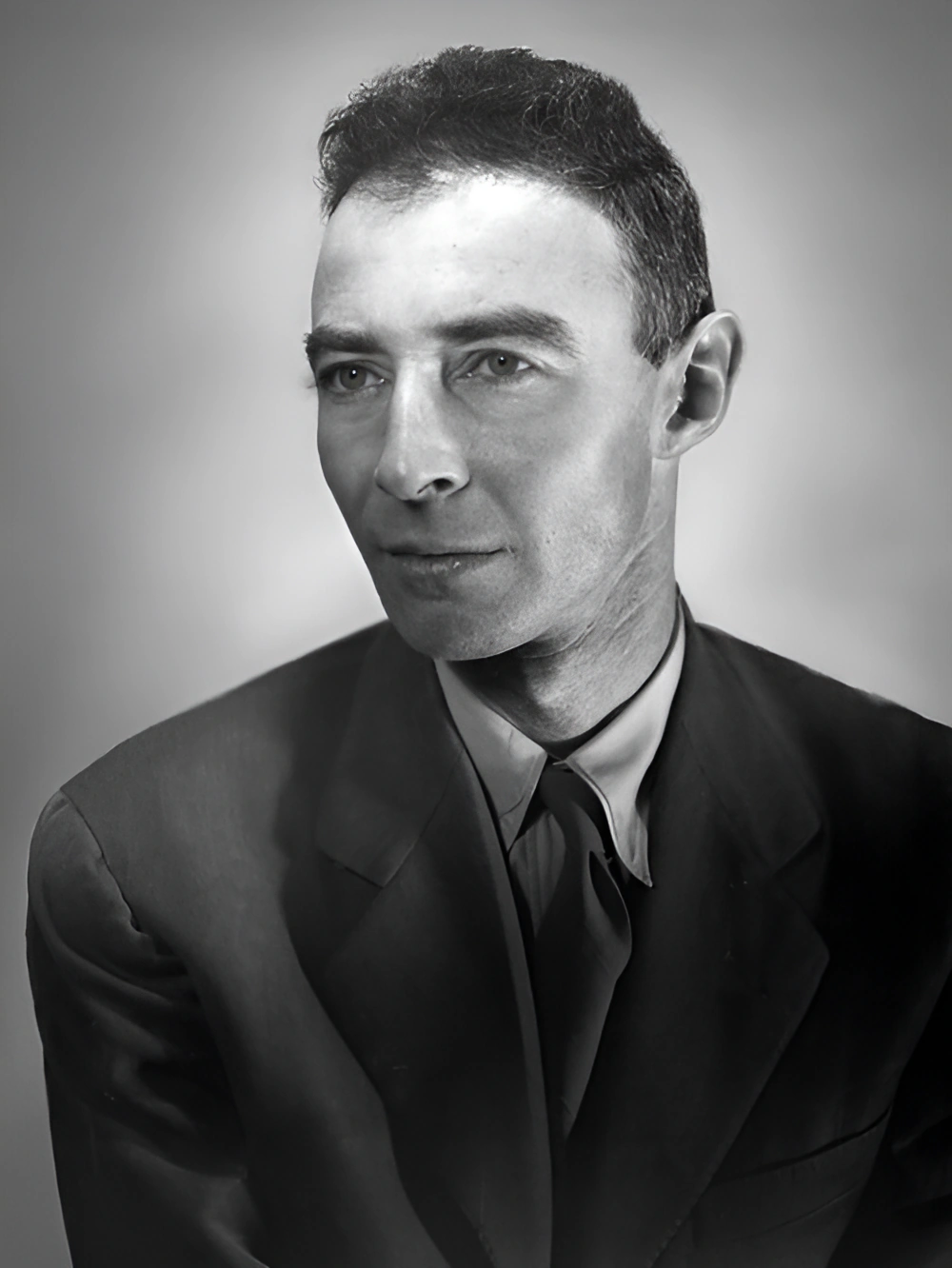
Attr: ahf.nuclearmuseum.org
| 12 Quotes | |
| Born as | Julius Robert Oppenheimer |
| Occup. | Physicist |
| From | USA |
| Born | April 22, 1904 New York City, New York, USA |
| Died | February 18, 1967 Princeton, New Jersey, USA |
| Cause | throat cancer |
| Aged | 62 years |
| Cite | |
Citation Formats
APA Style (7th ed.)
J. robert oppenheimer biography, facts and quotes. (2026, February 11). FixQuotes. https://fixquotes.com/authors/j-robert-oppenheimer/
Chicago Style
"J. Robert Oppenheimer biography, facts and quotes." FixQuotes. February 11, 2026. https://fixquotes.com/authors/j-robert-oppenheimer/.
MLA Style (9th ed.)
"J. Robert Oppenheimer biography, facts and quotes." FixQuotes, 11 Feb. 2026, https://fixquotes.com/authors/j-robert-oppenheimer/. Accessed 5 Mar. 2026.
Early Life and Background
Julius Robert Oppenheimer was born on April 22, 1904, in New York City, the son of Julius S. Oppenheimer, a prosperous German-Jewish textile importer, and Ella Friedman Oppenheimer, a painter. Raised on Manhattan's Upper West Side amid books, art, and cultivated conversation, he grew up with the confidence of comfort and the restlessness of a mind that ran ahead of his age. Frail as a child and prone to intense enthusiasms, he collected minerals, wrote letters dense with observation, and displayed a precocious seriousness that could read as hauteur to those who met him too quickly.The First World War and its aftermath shaped his generation's sense that modernity could be both triumphant and catastrophic. In a household committed to secular ethics and the ideals of assimilation, Oppenheimer absorbed a moral vocabulary that prized responsibility without providing the shelter of orthodox certainty. That tension - between a yearning for the absolute and a temperament trained for doubt - would later surface in his leadership style: visionary, exacting, and occasionally self-lacerating when the world refused to conform to the purity of an equation.
Education and Formative Influences
Oppenheimer attended the Ethical Culture School in New York, where rigorous humanism and public service were treated as inseparable from intellectual excellence. After a bout of illness delayed his plans, he entered Harvard in 1922, raced through chemistry and physics, and graduated in 1925. He then absorbed the new quantum mechanics in Europe: Cambridge's Cavendish Laboratory under J.J. Thomson (where bench work never suited him) and, decisively, Gottingen with Max Born, where he completed a doctorate in 1927 as the field's language was being invented by Born, Heisenberg, Dirac, and Pauli. Returning to the United States, he held appointments at the University of California, Berkeley and Caltech, helping to build an American school of theoretical physics that matched Europe in ambition and rigor.Career, Major Works, and Turning Points
In the 1930s Oppenheimer produced influential work across quantum electrodynamics, cosmic-ray showers, and the theory of neutron stars; with collaborators he clarified processes now central to astrophysics and particle physics, including the Oppenheimer-Phillips process and the gravitational collapse limit associated with the Oppenheimer-Volkoff equation. His life outside the seminar room grew complicated: he moved in left-wing circles, supported anti-fascist causes, and formed a lasting relationship with the biologist Katherine "Kitty" Puening, whom he married in 1940. The decisive turning point came in 1942-1943 when the US government recruited him to lead the Manhattan Project's Los Alamos Laboratory, where he fused disparate talents into a single machine of discovery under wartime secrecy. After Trinity in July 1945 and the bombs on Hiroshima and Nagasaki, he became a national authority on atomic policy - then, amid Cold War suspicion, lost his security clearance in the 1954 Atomic Energy Commission hearing, a public unmaking of the man once called the project's indispensable organizer. In 1963, the government partially repaired the breach by awarding him the Enrico Fermi Award; he died on February 18, 1967, in Princeton, New Jersey.Philosophy, Style, and Themes
Oppenheimer's inner life was marked by a near-constant oscillation between intellectual daring and moral self-interrogation. He liked aphorisms because they compressed judgment into a form as sharp as a proof, and his humor often carried a fatalistic edge: “The optimist thinks this is the best of all possible worlds. The pessimist fears it is true”. The line reads like a mask for anxiety - a way to concede darkness without surrendering to it - and it mirrors the posture he adopted as the public face of atomic power: lucid about danger, unwilling to pretend that knowledge can be unlearned.His leadership at Los Alamos was less bureaucratic than theatrical and pedagogical, built on intensity, breadth, and an ability to translate abstract physics into urgent tasks. Yet the same imagination that made him a synthesizer of fields also made him exquisitely sensitive to the ethical aftershock of success. He would later frame the bomb not as mere engineering but as a moral revelation: “In some sort of crude sense, which no vulgarity, no humor, no overstatement can quite extinguish, the physicists have known sin; and this is a knowledge which they cannot lose”. This was not
Our collection contains 12 quotes written by Robert Oppenheimer, under the main topics: Ethics & Morality - Wisdom - Science - Knowledge - Optimism.
Other people related to Robert Oppenheimer: Christopher Nolan (Director), Philip Morrison (Scientist), James Bryant Conant (Scientist), Klaus Fuchs (Physicist), Hans Bethe (Scientist)
J. Robert Oppenheimer Famous Works
- 1954 Science and the Common Understanding (Book)
- 1939 On Continued Gravitational Contraction (Essay)
- 1927 On the Quantum Theory of Molecules (Essay)