
Jack Welch Biography Quotes 25 Report mistakes
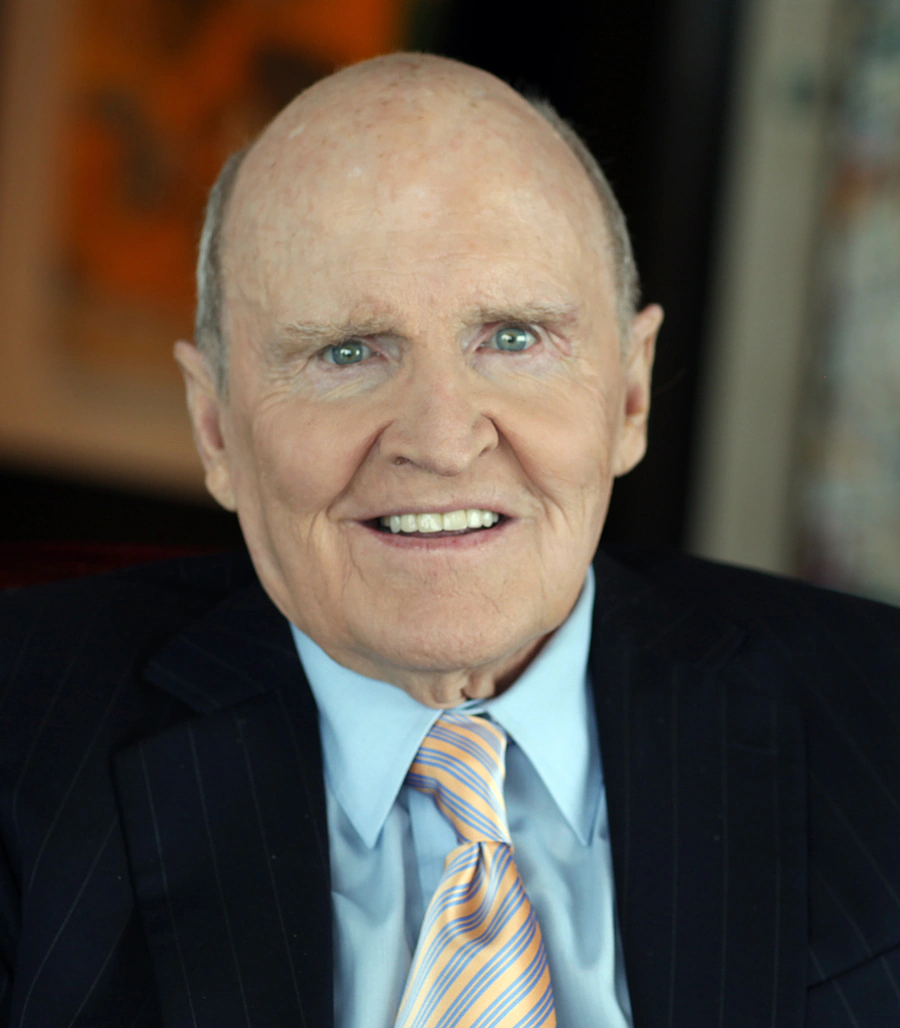
Attr: Hamilton83, CC BY-SA 3.0
| 25 Quotes | |
| Born as | John Francis Welch Jr. |
| Occup. | Businessman |
| From | USA |
| Spouse | Suzy Wetlaufer |
| Born | November 19, 1935 Peabody, Massachusetts, USA |
| Age | 90 years |
| Cite | |
Citation Formats
APA Style (7th ed.)
Jack welch biography, facts and quotes. (2026, February 11). FixQuotes. https://fixquotes.com/authors/jack-welch/
Chicago Style
"Jack Welch biography, facts and quotes." FixQuotes. February 11, 2026. https://fixquotes.com/authors/jack-welch/.
MLA Style (9th ed.)
"Jack Welch biography, facts and quotes." FixQuotes, 11 Feb. 2026, https://fixquotes.com/authors/jack-welch/. Accessed 26 Mar. 2026.
Early Life and Background
John Francis Welch Jr. was born on November 19, 1935, in Peabody, Massachusetts, the son of Grace and John Francis Welch Sr., an Irish-American railroad conductor. He grew up in a tight, working-class Catholic household where money was watched, loyalty mattered, and competitive talk was common. That background left him with a lasting sensitivity to status and performance - and a dislike of excuses - that later surfaced in his blunt corporate language and his belief that organizations should face reality early.As a boy, Welch struggled with a childhood stutter and found relief in sports, especially hockey and baseball, where pressure demanded quick decisions and where effort was visible. The stutter became a private formative wound and a public discipline: he learned to prepare, to drive through discomfort, and to value directness. In later years, even when he became the emblem of corporate confidence, the cadence of his leadership retained something of that early self-training - a man determined to win arguments with clarity and momentum.
Education and Formative Influences
Welch studied chemical engineering at the University of Massachusetts Amherst (BS, 1957) and earned a PhD in chemical engineering from the University of Illinois at Urbana-Champaign (1960). His technical education taught him to quantify problems, test assumptions, and treat process as destiny - habits he carried into management, where he asked for data, speed, and simple scorecards. Coming of age in the postwar American boom, he also absorbed the era's confidence in scale and science, even as the coming decades would punish complacent conglomerates and reward those willing to remake themselves.Career, Major Works, and Turning Points
Welch joined General Electric in 1960 as a junior engineer in Pittsfield, Massachusetts, working in plastics; he nearly quit early over bureaucracy and pay, but stayed after a manager intervened - an origin story that helped form his later obsession with removing layers. He rose through GE's materials and medical businesses, becoming the youngest vice president in GE history in 1972, then a vice chairman, and in 1981 succeeded Reginald H. Jones as CEO. Over two decades (1981-2001) he reshaped GE through divestitures, acquisitions, and a relentless push for productivity, making NBC a notable consumer-facing asset and expanding GE Capital into a major profit engine. His tenure coincided with deregulation, intensified global competition, and the shareholder-value revolution; he responded with boundaryless organization rhetoric, the Work-Out program, and the controversial vitality curve, while also tying the GE identity to management training at Crotonville. After retiring in 2001, he co-authored the bestseller "Jack: Straight from the Gut" (2001) and later wrote "Winning" (2005), codifying his operating system for a broader business audience.Philosophy, Style, and Themes
Welch's inner life as a leader was a blend of impatience with inertia and a near-athletic hunger for measurable improvement. He treated time as the scarcest resource in corporate life, insisting that comfort was a warning sign and that leaders had to seize initiative: “Control your own destiny or someone else will”. That sentence captures his psychology - a man who experienced bureaucracy as threat, who believed competition was not merely external but existential, and who translated anxiety into action. In his world, strategy was less a document than a daily posture of urgency.His style fused hard-edged portfolio discipline with an almost pastoral fixation on staffing and training. The most telling self-description is managerial, not heroic: “My main job was developing talent. I was a gardener providing water and other nourishment to our top 750 people. Of course, I had to pull out some weeds, too”. It reveals both warmth and ruthlessness: nurturing the strong, pruning the weak, and believing culture is built through repeated selection. His globalism, likewise, was not sentimental but acquisitive in the realm of ideas: “Globalization has changed us into a company that searches the world, not just to sell or to source, but to find intellectual capital - the world's best talents and greatest ideas”. Welch's themes - speed, candor, differentiation, and learning - were designed to make a massive institution behave like a competitive organism.
Legacy and Influence
Welch left an enduring template for late-20th-century American corporate leadership: the CEO as architect of culture, allocator of capital, and relentless talent judge. Admirers credit him with modernizing GE, popularizing frank performance management, and spreading Crotonville-style leadership development across corporate America; critics argue his emphasis on quarterly discipline and the expansion of GE Capital contributed to fragilities that became clearer after the financial crisis, and that his rank-and-yank methods hardened workplaces. Yet even the debates reflect his reach: Welch turned management into a public vocabulary of candor, differentiation, and change, and he remains a defining figure of the era when globalization, shareholder value, and managerial celebrity converged into a new model of corporate power.Our collection contains 25 quotes written by Jack, under the main topics: Motivational - Truth - Leadership - Honesty & Integrity - Servant Leadership.
Other people related to Jack: Mario Monti (Public Servant)
Jack Welch Famous Works
- 2015 The Real-Life MBA: Your No-BS Guide to Winning the Game, Building a Team, and Growing Your Career (Book)
- 2006 Winning: The Answers (Confronting 74 of the Toughest Questions in Business Today) (Book)
- 2005 Winning (Book)
- 2001 Jack: Straight from the Gut (Book)
Source / external links