
James D. Watson Biography Quotes 7 Report mistakes
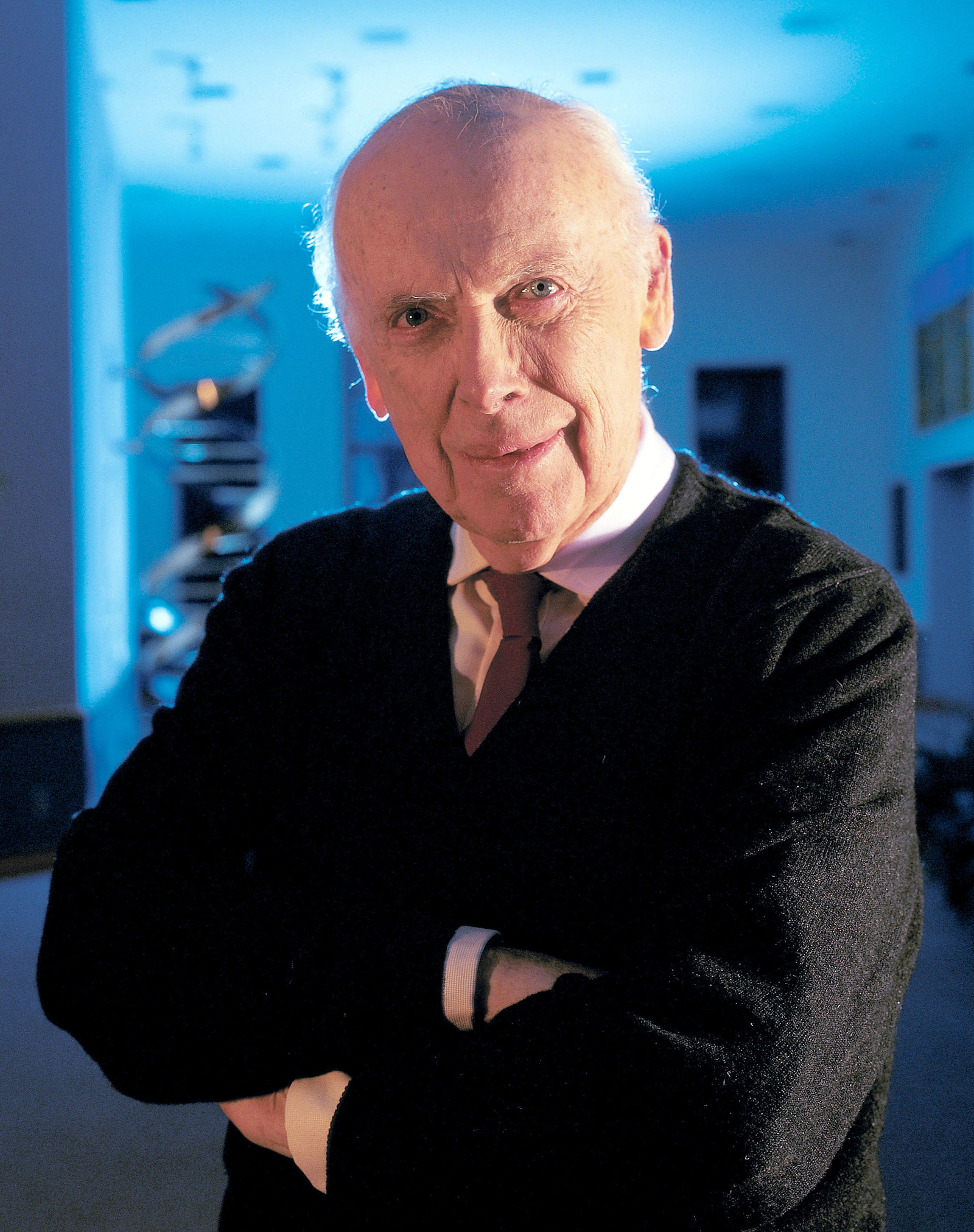
Attr: Jan Arkesteijn
| 7 Quotes | |
| Born as | James Dewey Watson |
| Occup. | Scientist |
| From | USA |
| Born | April 6, 1928 Chicago, Illinois, USA |
| Age | 97 years |
| Cite | |
Citation Formats
APA Style (7th ed.)
James d. watson biography, facts and quotes. (2026, February 11). FixQuotes. https://fixquotes.com/authors/james-d-watson/
Chicago Style
"James D. Watson biography, facts and quotes." FixQuotes. February 11, 2026. https://fixquotes.com/authors/james-d-watson/.
MLA Style (9th ed.)
"James D. Watson biography, facts and quotes." FixQuotes, 11 Feb. 2026, https://fixquotes.com/authors/james-d-watson/. Accessed 25 Mar. 2026.
Early Life and Background
James Dewey Watson was born on April 6, 1928, in Chicago, Illinois, into a middle-class American world being reshaped by the Great Depression and then by wartime mobilization. His father, James D. Watson, worked in business, and his mother, Jean Mitchell Watson, encouraged curiosity and a competitive, bookish intensity that would become central to his identity. Chicago in the 1930s and 1940s offered both the grit of industrial America and a civic culture that prized public education, museums, and debate - a milieu that rewarded a sharp mind willing to argue its way to the front.From early adolescence Watson showed a taste for performance and intellectual contest. He appeared on the popular radio quiz show Quiz Kids in 1947, an experience that trained him in rapid recall and public confidence while also reinforcing a lifelong habit: treating knowledge as something to be won, not merely learned. That competitive edge, later celebrated and criticized, formed alongside an emotional restlessness - a sense that ordinary success was not enough and that the real prize lay in uncovering hidden mechanisms of life.
Education and Formative Influences
Watson entered the University of Chicago through its early-admissions program, earning a B.S. in 1947, and then pursued a Ph.D. in zoology at Indiana University, completed in 1950 under Salvador Luria, one of the founders of modern phage genetics. In the postwar era, biology was pivoting from natural history to the physics-inspired search for molecular explanations; Watson absorbed that shift as a personal calling. A decisive jolt came from encountering Erwin Schrodinger's What Is Life? and, soon after, the emerging X-ray diffraction work on DNA - signals that the secret of heredity might be cracked with the right mix of genetics, chemistry, and structural reasoning.Career, Major Works, and Turning Points
After postdoctoral work in Europe, including time at the Cavendish Laboratory in Cambridge, Watson joined with Francis Crick in 1951 to solve DNA's structure, a race fueled by rival efforts at King's College London (notably Rosalind Franklin and Maurice Wilkins) and by Linus Pauling in California. In 1953 Watson and Crick proposed the double helix, published in Nature, using crucial constraints from Franklin's X-ray data and the base-pairing logic that made heredity intelligible. The model became the cornerstone of molecular biology, and Watson, Crick, and Wilkins received the 1962 Nobel Prize in Physiology or Medicine. Watson later shaped institutions as much as ideas: as a Harvard professor, as author of the vivid, controversial memoir The Double Helix (1968), and as director and later president of Cold Spring Harbor Laboratory, where he helped build a powerhouse of genetics and cancer research. In 1990 he became the first head of the Human Genome Project at NIH, but resigned in 1992 amid disputes over data access and patents, foreshadowing later conflicts over scientific governance and public responsibility.Philosophy, Style, and Themes
Watson's inner life as a scientist was defined by impatience with vagueness and an almost aesthetic hunger for mechanisms that "click". He portrayed discovery as a youthful drama in which boldness is a methodological tool: “Science moves with the spirit of an adventure characterized both by youthful arrogance and by the belief that the truth, once found, would be simple as well as pretty”. That sentence is not just rhetoric - it is a self-portrait. Watson trusted speed, informal argument, and the clarifying power of a well-chosen model, even when those habits brushed against collegial norms and the slower, meticulous virtues of experimental craft. His writing, especially The Double Helix, exposed this temperament with unusual candor: ambition, rivalry, and misjudgment appear not as embarrassing side effects but as the engine of a new biology.He also carried a managerial theory of creativity shaped by the mid-century laboratory as a competitive workshop. “Take young researchers, put them together in virtual seclusion, give them an unprecedented degree of freedom and turn up the pressure by fostering competitiveness”. That credo explains his institutional impact at Cold Spring Harbor and his belief in small, intense communities - but it also reveals a willingness to treat people as variables in an experimental design. Later, he worried that modern science was becoming less navigable to outsiders: “I think the reason people are dealing with science less well now than 50 years ago is that it has become so complicated”. The comment reflects both a democratic impulse and a subtle nostalgia for an era when a brilliant generalist could plausibly hold the whole puzzle in mind.
Legacy and Influence
Watson's enduring influence is double-edged and therefore unusually instructive. Scientifically, the double helix and the gene-centered view of life catalyzed everything from recombinant DNA to genomics and cancer genetics; institutionally, his leadership helped make Cold Spring Harbor a global hub and pushed the Human Genome Project into public view. Culturally, The Double Helix changed how discovery is narrated - as human, strategic, and sometimes ethically fraught - shaping how later generations imagine laboratory life. Yet his public controversies and disputed statements on race and genetics damaged his standing and forced renewed attention to the responsibilities that accompany scientific authority. In the long view, Watson remains a central figure for understanding the molecular revolution: a brilliant simplifier, a fierce competitor, and a reminder that epochal insight does not automatically confer sound judgment beyond the bench.Our collection contains 7 quotes written by James, under the main topics: Science - Career - Team Building.
Frequently Asked Questions
- Where was James Watson born: Chicago, Illinois, USA
- What Is James Watson famous for: Co-discovering the double-helix structure of DNA
- Awards won by James Watson: Nobel Prize in Physiology or Medicine, Presidential Medal of Freedom, National Medal of Science, Lasker Award
- James Watson wife: Elizabeth Lewis
- How old is James D. Watson? He is 97 years old
James D. Watson Famous Works
- 2012 The Annotated and Illustrated Double Helix (Book)
- 2007 Avoid Boring People: Lessons from a Life in Science (Memoir)
- 2003 DNA: The Secret of Life (Book)
- 1968 The Double Helix (Autobiography)
- 1965 Molecular Biology of the Gene (Book)
- 1962 Nobel Lecture (Non-fiction)
- 1953 Molecular structure of nucleic acids: a structure for deoxyribose nucleic acid (Non-fiction)
Source / external links