
James Madison Biography Quotes 65 Report mistakes
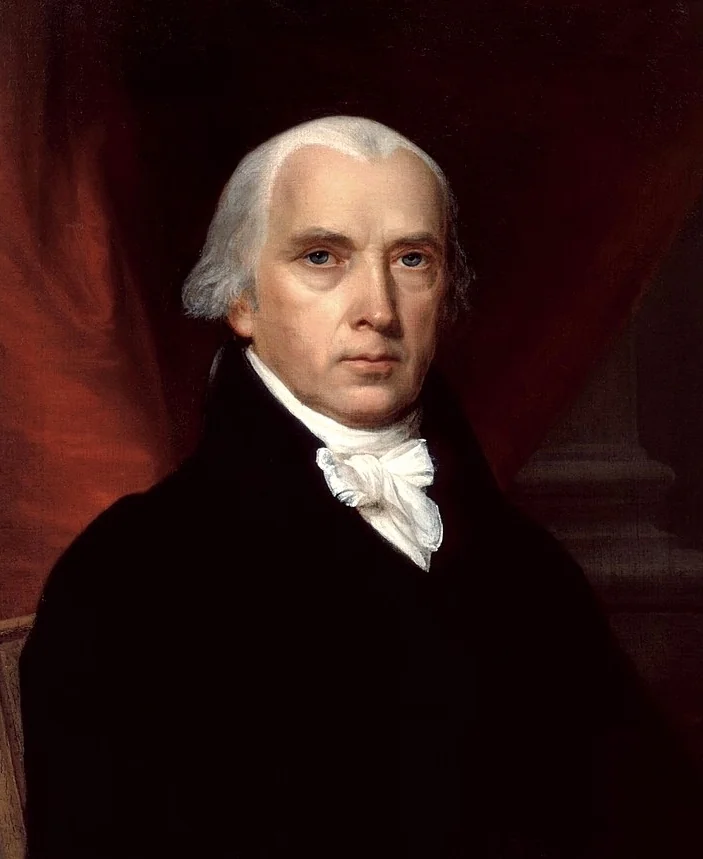
Attr: John Vanderlyn
| 65 Quotes | |
| Born as | James Madison Jr. |
| Occup. | President |
| From | USA |
| Born | March 16, 1751 Port Conway, Colony of Virginia |
| Died | June 28, 1836 Montpelier, Virginia |
| Cause | Heart failure |
| Aged | 85 years |
| Cite | |
Citation Formats
APA Style (7th ed.)
James madison biography, facts and quotes. (2026, February 11). FixQuotes. https://fixquotes.com/authors/james-madison/
Chicago Style
"James Madison biography, facts and quotes." FixQuotes. February 11, 2026. https://fixquotes.com/authors/james-madison/.
MLA Style (9th ed.)
"James Madison biography, facts and quotes." FixQuotes, 11 Feb. 2026, https://fixquotes.com/authors/james-madison/. Accessed 6 Mar. 2026.
Early Life and Background
James Madison Jr. was born on March 16, 1751, at Belle Grove on his familys plantation in Orange County, Virginia, and grew up at nearby Montpelier, a landscape of tobacco culture, enslaved labor, Anglican gentry habits, and widening imperial strain. The Madisons were prosperous planters with political connections, and the young heir absorbed early the assumptions and anxieties of a ruling class asked to justify authority in a world where that authority was increasingly contested.Physically slight and often beset by ill health, Madison developed a studious inwardness that contemporaries read as reserve but that also trained him for a life of sustained attention - to texts, to arguments, to the temper of assemblies. The decade of his adolescence coincided with the Stamp Act crisis, nonimportation, and the slide toward revolution; in Virginia, local power was intimate and personal, but the empire that framed it was distant, legalistic, and capable of coercion. Madison learned early that liberty could be lost not only by force, but by the slow tightening of rules and precedents.
Education and Formative Influences
Madison studied under the Scottish tutor Donald Robertson before entering the College of New Jersey (now Princeton), where he graduated in 1771 after an intense course that deepened his interest in moral philosophy, history, and the mechanics of republican government. His most durable intellectual formation came from reading the ancients alongside modern theorists, especially Locke and Montesquieu, and from a dissenters sensibility sharpened by witnessing religious persecution in Virginia. That experience helped shape his later insistence that civil freedom required protections for conscience as much as for property, and it drew him toward politics as the practical craft of securing rights through institutions.Career, Major Works, and Turning Points
In the Revolution Madison served in the Virginia legislature and the Continental Congress, where he confronted the weakness of the Articles of Confederation: fiscal paralysis, interstate rivalry, and a central government dependent on state compliance. He became a principal architect of the Constitutional Convention of 1787, arriving with the Virginia Plan and a habit of taking systematic notes that still define how the meeting is known. With Alexander Hamilton and John Jay he wrote much of The Federalist, including No. 10 and No. 51, arguing that an extended republic could manage faction by multiplying interests and refining public views through representation. In Virginia he helped secure ratification and then, working with Thomas Jefferson, founded the Republican opposition to Federalist consolidation. As secretary of state, then as fourth president (1809-1817), he faced the squeeze of European war on American commerce and the War of 1812, a conflict that exposed administrative limits but also stiffened national identity. In retirement at Montpelier he returned to constitutional interpretation, warning against sectionalism while wrestling with the moral and political contradictions of slavery in a republic he had helped design.Philosophy, Style, and Themes
Madisons inner life was marked by a tension between distrust and hope: distrust of power as a human constant, hope that structure could discipline it without extinguishing energy. He watched majorities turn punitive, executives reach for emergency authority, and legislatures drown principles in improvisation; from that experience came his steady suspicion of concentrated discretion. “The truth is that all men having power ought to be mistrusted”. Yet his mistrust was never merely cynical - it was operational, a reason to build durable checks rather than to rely on virtue.His prose is compact, lawyerly, and unusually psychological for a founder, attentive to motive and incentive as much as to ideals. He believed republicanism required designing for ambition and self-interest rather than pretending they could be educated away, hence his famous institutional maxim: “Ambition must be made to counteract ambition”. At the same time, he feared that complexity itself could become a kind of soft despotism, severing citizens from the meaning of what governs them; “It will be of little avail to the people that the laws are made by men of their own choice if the laws be so voluminous that they cannot be read, or so incoherent that they cannot be understood”. Across his career, Madison returned to a single theme: liberty survives when power is divided, transparent, and answerable to a people capable of understanding it.
Legacy and Influence
Madison died on June 28, 1836, at Montpelier, the last surviving major framer-president, and his legacy is less a single policy than a way of thinking about free government. The architecture he defended - separation of powers, federalism, an independent judiciary, and a wide republic managing faction - remains the core grammar of American constitutional debate, invoked by rival movements precisely because it embeds conflict within rules. His notes and essays became a civic scripture for later reformers and originalists alike, while his authorship of the Bill of Rights fixed him as a founder who treated liberty not as a slogan but as a set of enforceable boundaries. In an age still tempted by emergency powers, partisan purity, and legal overload, Madison endures as the anatomist of how republics fail - and how, with discipline and design, they might endure.Our collection contains 65 quotes written by James, under the main topics: Ethics & Morality - Wisdom - Truth - Justice - Leadership.
Other people related to James: George Mason (Statesman), Patrick Henry (Politician), John Randolph (Leader), DeWitt Clinton (Politician), Dolley Madison (First Lady), John C. Calhoun (Statesman), John Blair (Politician), Lynne Cheney (Author), Benjamin Hawkins (Diplomat), Richard Henry Lee (Politician)
James Madison Famous Works
- 1865 Letters and Other Writings of James Madison (Book)
- 1787 The Federalist Papers (Book)
- 1785 A Memorial and Remonstrance (Pamphlet)
Source / external links