
James Madison Biography Quotes 65 Report mistakes
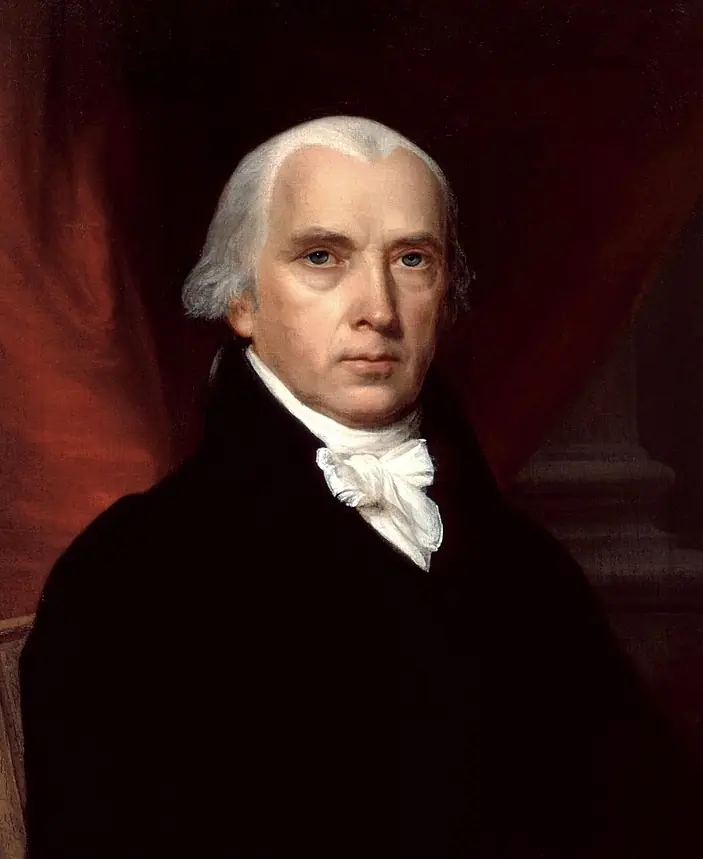
Attr: John Vanderlyn
| 65 Quotes | |
| Born as | James Madison Jr. |
| Occup. | President |
| From | USA |
| Born | March 16, 1751 Port Conway, Colony of Virginia |
| Died | June 28, 1836 Montpelier, Virginia |
| Cause | Heart failure |
| Aged | 85 years |
James Madison Jr. was born on March 16, 1751, in Port Conway, Virginia, and raised at Montpelier in Orange County. The eldest of several children of James Madison Sr. and Nelly Conway Madison, he grew up in the world of Virginia planters yet developed an early reputation for studiousness and quiet resolve rather than for plantation pursuits. Frail health and bouts of illness shaped his habits, turning him toward books and sustained reflection. He attended the College of New Jersey (now Princeton University), where President John Witherspoon exposed him to Scottish Enlightenment thought, moral philosophy, and rigorous training in political theory and classical languages. Madison absorbed lessons about mixed government, virtue, and the dangers of concentrated power that would later define his constitutional vision.
Revolutionary Apprenticeship
Returning to Virginia amid the American Revolution, Madison entered public life in the struggle to translate revolutionary principles into durable institutions. He served in the Virginia legislature and on the Council of State under Governors Patrick Henry and Thomas Jefferson, gaining practical experience in executive affairs and wartime administration. Deeply committed to religious liberty, he drafted the Memorial and Remonstrance Against Religious Assessments in 1785, rallying opposition to state-supported religion and aligning himself with Jeffersons broader campaign that culminated in the Virginia Statute for Religious Freedom. In the Continental Congress (1780-1783), Madison worked on issues of finance and western lands, concluding that the Articles of Confederation left the union too weak to meet national challenges.
Toward a New Constitution
Madison helped organize the Annapolis Convention of 1786, then channeled its momentum into a call for a general convention to revise the Articles. At the Philadelphia Convention of 1787, with George Washington presiding, Madison arrived early and prepared. He framed much of the discussion through what became known as the Virginia Plan, formally introduced by Edmund Randolph. He advocated for a national government with separated powers, checks and balances, and representation proportionate to population. He recorded the debates in notes that remain the most detailed window into the framers work. Though he did not prevail on every point, his synthesis of republican theory and practical politics gave the Constitution its structure and resilience.
The Federalist Papers and Ratification
To secure ratification, Madison joined Alexander Hamilton and John Jay in publishing The Federalist under the shared pen name Publius. Madison authored essays that became central to American political thought, including Federalist No. 10 on factions and Federalist No. 51 on the separation of powers. In the Virginia ratifying convention, he debated formidable opponents such as Patrick Henry and George Mason, arguing that the proposed system would guard liberty better than loose confederation. Madison pledged to support amendments to quiet fears about individual rights, and in the First Congress he fulfilled that commitment by drafting and guiding the Bill of Rights to adoption in 1791.
Congressional Leadership and Party Formation
As a leader in the House of Representatives, Madison worked closely with President George Washington at first but soon broke with Alexander Hamilton over a national bank and expansive fiscal programs. With Thomas Jefferson, he helped articulate an alternative vision wary of concentrated financial power and committed to limited federal government. Their collaboration contributed to the formation of the Democratic-Republican Party, a force that reshaped national politics in opposition to policies associated with Hamilton and, at times, John Adams.
Secretary of State
Madison served as Secretary of State under President Jefferson from 1801 to 1809. He managed landmark diplomatic undertakings, most notably the Louisiana Purchase negotiated by Robert R. Livingston and James Monroe, which doubled the nations territory. He oversaw implementation of Jeffersons exploratory ambitions, including the Lewis and Clark expedition. The period tested American neutrality as Britain and Napoleonic France waged war, seizing American ships and sailors. The administrative controversy that sparked Marbury v. Madison, decided by Chief Justice John Marshall, arose early in his tenure and helped define judicial review even as the Jefferson administration pursued its own constitutional understanding.
Presidency
Elected the fourth President of the United States in 1808 and reelected in 1812, Madison confronted diplomatic crises that spilled into open conflict. Congressional leaders such as Henry Clay and John C. Calhoun urged a firm response to British violations of neutral rights, impressment of seamen, and interference with commerce. After efforts like Macons Bill No. 2 failed to secure peace, Madison recommended war in 1812. The War of 1812 exposed American weaknesses in mobilization and coastal defense, culminating in the British burning of public buildings in Washington in 1814. Dolley Madison became a symbol of resolve, organizing the rescue of Gilbert Stuarts portrait of George Washington as the evacuation unfolded.
Despite early setbacks, American forces achieved notable successes. Naval victories by ships such as USS Constitution buoyed morale, and Andrew Jacksons triumph at New Orleans, though arriving after the peace accord, reinforced a sense of national honor. The Treaty of Ghent, negotiated by a commission that included John Quincy Adams and Henry Clay, ended the war without territorial loss, restoring the status quo ante bellum. The conflict nonetheless forged a new national consciousness and underscored the need for stronger fiscal and military institutions.
Postwar Policy and Governance
In Madisons second term, he adapted to postwar realities. He supported the chartering of the Second Bank of the United States in 1816 to stabilize the countrys finances and backed a protective Tariff of 1816 to foster domestic manufacturing. Yet he maintained constitutional scruples, vetoing the Bonus Bill on internal improvements on grounds that Congress lacked enumerated authority absent an amendment. His presidency thus balanced nation-building measures with an effort to remain faithful to the constitutional limits he had long defended.
Later Years
Retiring to Montpelier in 1817, Madison remained a counselor of the republic. He corresponded with Thomas Jefferson and later with James Monroe on constitutional interpretation, foreign policy, and the future of the union. After Jeffersons death, Madison helped guide the University of Virginia as rector, upholding the founders vision of secular learning and civic education. He organized and revised his Notes from the Constitutional Convention, mindful that they would inform generations of citizens and scholars. Even in advanced age, he reflected publicly on federalism, the separation of powers, and the role of parties in republican government.
Personal Life and Character
Madison married Dolley Payne Todd in 1794, forming a celebrated partnership that shaped Washington society and political culture. Dolley Madison was known for her hospitality and for bringing together rival factions in an atmosphere of civility. The couple had no children, though Dolleys son from her first marriage, John Payne Todd, lived with them. Madison was reserved in demeanor, small in stature, and often in frail health, but possessed a formidable intellect and powers of analysis. His friendships with figures like Jefferson and Monroe, and his rivalry and debate with Hamilton and Marshall, defined an era of vigorous constitutional argument.
Legacy
Remembered as the Father of the Constitution and principal architect of the Bill of Rights, Madison also stands as a founder of the American party system and a wartime president who shepherded the nation through its first major conflict after independence. His writings clarified how an extended republic could manage factions, how separated institutions could share powers, and how liberty might be secured in a large, diverse nation. By the time of his death on June 28, 1836, Madison had seen ideas once contested in convention halls take root in national life. Through collaboration with colleagues such as Washington, Jefferson, Hamilton, Jay, Monroe, and others, he helped give the United States a constitutional framework and political tradition that continue to shape public life.
Our collection contains 65 quotes who is written by James, under the main topics: Ethics & Morality - Wisdom - Truth - Justice - Leadership.
Other people realated to James: George Washington (President), George Will (Journalist), Henry B. Adams (Historian), John Randolph (Leader), Alexander Hamilton (Politician), Patrick Henry (Politician), Henry Adams (Historian), Joseph Story (Judge), Roger Sherman (Politician), Aaron Burr (Politician)
James Madison Famous Works
- 1865 Letters and Other Writings of James Madison (Book)
- 1789 Journal of the Constitutional Convention (Book)
- 1787 The Federalist Papers (Book)
- 1785 A Memorial and Remonstrance (Pamphlet)
Source / external links