
Javier Solana Biography Quotes 5 Report mistakes
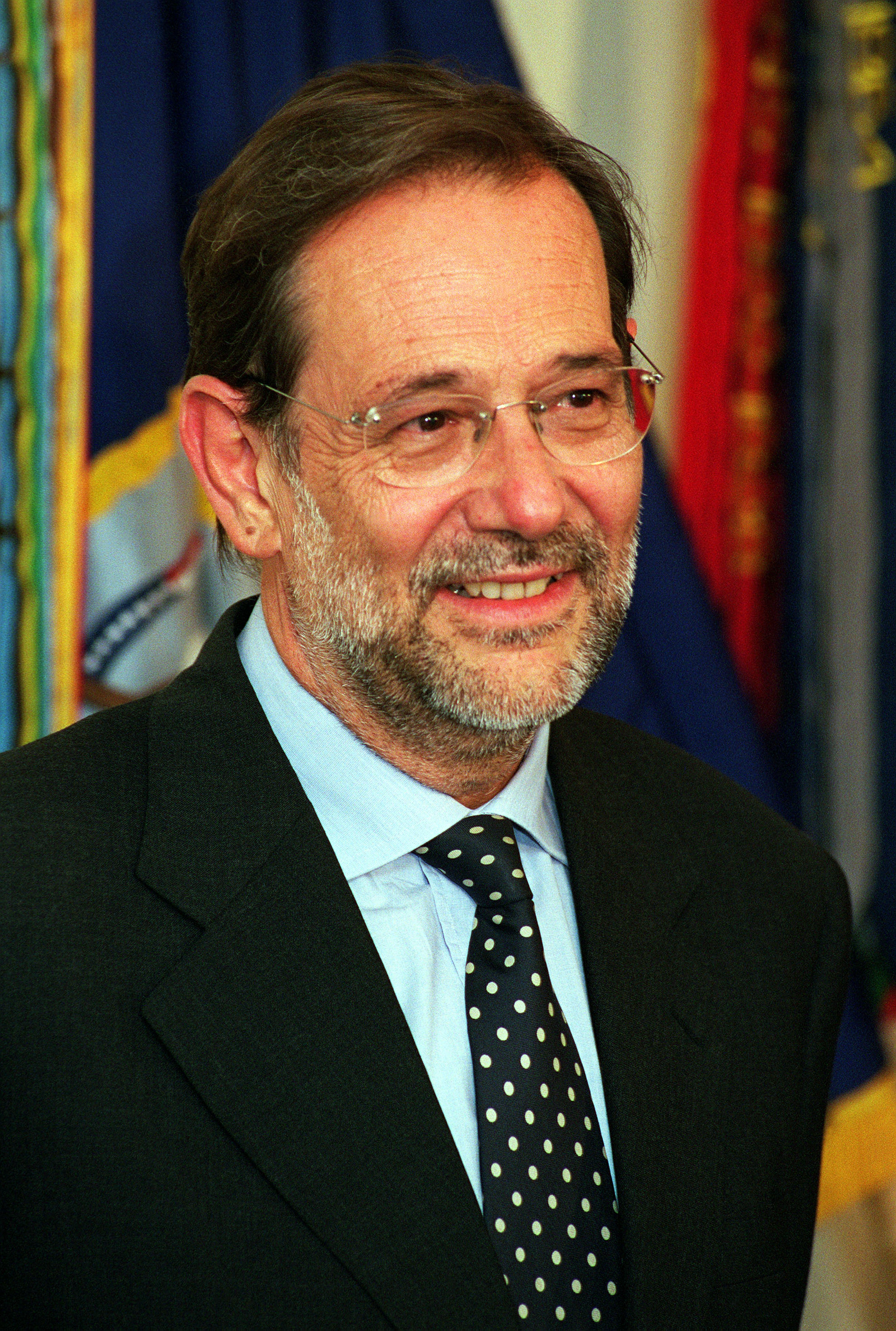
Attr: DoD photo by R. D. Ward
| 5 Quotes | |
| Born as | Francisco Javier Solana de Madariaga |
| Occup. | Politician |
| From | Spain |
| Born | July 14, 1942 Madrid, Spain |
| Age | 83 years |
| Cite | |
Citation Formats
APA Style (7th ed.)
Javier solana biography, facts and quotes. (2026, February 11). FixQuotes. https://fixquotes.com/authors/javier-solana/
Chicago Style
"Javier Solana biography, facts and quotes." FixQuotes. February 11, 2026. https://fixquotes.com/authors/javier-solana/.
MLA Style (9th ed.)
"Javier Solana biography, facts and quotes." FixQuotes, 11 Feb. 2026, https://fixquotes.com/authors/javier-solana/. Accessed 27 Mar. 2026.
Early Life and Education
Javier Solana de Madariaga was born on 14 July 1942 in Madrid, Spain, into a family steeped in scholarship and public service. His maternal lineage linked him to the noted Spanish diplomat and writer Salvador de Madariaga, whose example of liberal, European-minded engagement left an imprint on the younger Solana. He studied physics at the Complutense University of Madrid, where he earned a doctorate and began a career in academia. As a Fulbright scholar in the United States, including time at the University of Virginia, he strengthened his scientific training and gained an early appreciation for transatlantic exchange. Returning to Spain, he taught solid-state physics at the Complutense University and collaborated with research institutions, developing a reputation for rigor, clarity, and consensus-building that would later characterize his political style.Academic Roots and Political Awakening
During the final years of the Franco dictatorship and Spain's democratic transition, Solana joined the Spanish Socialist Workers' Party (PSOE). He brought to politics a scientist's temperament: emphasis on evidence, method, and patience. Elected to the Congress of Deputies after the restoration of democracy, he served across multiple legislatures. His brother, Luis Solana, also active in public life, reinforced a family commitment to democratic modernization. Within the PSOE he became a trusted figure, valued for measured judgment rather than ideological stridency. Even in the contentious debates of the 1980s over Spain's role in NATO, his positions were shaped by national priorities and the country's evolving foreign policy, a perspective that would later gain special resonance.Ministerial Leadership in Democratic Spain
After the PSOE victory under Prime Minister Felipe Gonzalez in 1982, Solana entered government, beginning a long series of cabinet responsibilities. As Minister of Culture, he worked to expand access to cultural life and modernize institutions during a period when Spain was consolidating freedoms and reconnecting with European currents after decades of isolation. Serving also as the government's spokesman, he became a public face of a transforming Spain.In 1988 he became Minister of Education and Science, where he promoted research capacity, university reform, and policies to anchor Spain more firmly in the European knowledge economy. In 1992 he was appointed Minister of Foreign Affairs. As Spain's chief diplomat, he represented the country amid the post-Cold War realignment and European integration. During Spain's 1995 presidency of the Council of the European Union, he helped shepherd the Euro-Mediterranean Partnership launched in Barcelona, a framework that sought to deepen ties across the Mediterranean through dialogue, trade, and security cooperation. His tenure at the foreign ministry coincided with complex Balkans diplomacy and early debates on the future of European security.
NATO Secretary General
In December 1995, Solana became Secretary General of the North Atlantic Treaty Organization, succeeding Willy Claes at a pivotal moment. Only months after the Dayton Accords, NATO took on major responsibilities in Bosnia and Herzegovina. Solana oversaw the transition from IFOR to SFOR, coordinating closely with UN Secretary-General Kofi Annan and international envoys such as Carl Bildt and, later, Paddy Ashdown. He worked with U.S. President Bill Clinton, Secretary of State Madeleine Albright, and NATO's Supreme Allied Commander Europe, General Wesley Clark, to align political objectives with military operations.In 1999, during the Kosovo crisis, he guided NATO through Operation Allied Force. The diplomacy that accompanied the air campaign involved intense coordination with European leaders and mediators. Finnish statesman Martti Ahtisaari and Russian envoy Viktor Chernomyrdin engaged Slobodan Milosevic in the negotiations that led to the withdrawal of Serbian forces and the deployment of KFOR. For Solana, who in earlier years had criticized NATO from a Spanish domestic vantage point, stewardship of the Alliance through Bosnia and Kosovo showcased a pragmatic and evolving vision: collective security anchored in multilateral legitimacy and post-conflict stabilization.
High Representative of the European Union
With the Amsterdam Treaty, the European Union created the role of High Representative for the Common Foreign and Security Policy. In 1999, Solana became the first to hold that office, while also serving as Secretary-General of the Council of the EU and of the Western European Union. Working alongside European Commission Presidents Romano Prodi and Jose Manuel Barroso and External Relations Commissioners Chris Patten and Benita Ferrero-Waldner, he helped knit together disparate strands of EU external action. He championed the European Security Strategy of 2003, A Secure Europe in a Better World, a concise document that framed EU interests around effective multilateralism, prevention, and comprehensive security.Solana was central to building the EU's crisis-management capacity, then known as the European Security and Defence Policy. Under his watch, the EU launched its first civilian and military operations: Concordia in North Macedonia, Artemis in the Democratic Republic of Congo, police missions in the Western Balkans, and EUFOR Althea in Bosnia and Herzegovina. He worked closely with national foreign ministers, including Jack Straw, Dominique de Villepin, Joschka Fischer, and later Frank-Walter Steinmeier, to align national positions with EU-wide objectives.
He also became the EU's principal envoy in the international negotiations over Iran's nuclear program. As the EU representative to the E3/EU+3 (also called P5+1), he coordinated European efforts with the United States, Russia, China, France, the United Kingdom, and Germany, engaging successive Iranian negotiators, including Hassan Rouhani and Ali Larijani. In the Middle East peace process, he maintained sustained contacts with Israeli and Palestinian leaders, including Yasser Arafat and Mahmoud Abbas, coordinating with the United States (under Secretaries of State Colin Powell and Condoleezza Rice), Russia, and the United Nations in the framework of the Quartet. In 2009, following the entry into force of the Lisbon Treaty, he was succeeded by Catherine Ashton as the EU's High Representative in a reconfigured post that also led the newly established European External Action Service.
Style, Networks, and Influence
Solana's method fused scientific discipline with diplomatic patience. Rather than public grandstanding, he favored quiet shuttle diplomacy, iterative problem-solving, and the aggregation of consensus among actors with divergent interests. His proximity to figures such as Felipe Gonzalez during Spain's democratic consolidation, to Madeleine Albright and Wesley Clark in NATO's crisis years, and to Chris Patten, Benita Ferrero-Waldner, and national foreign ministers in EU diplomacy, positioned him at the intersection of national, transatlantic, and European decision-making. Relationships with UN leaders like Kofi Annan and, later, Ban Ki-moon supported a multilateral ethos that guided his crisis responses in the Balkans, the Middle East, and beyond.Later Activities and Legacy
After 2009, Solana returned to academic and policy work, notably leading the ESADE Center for Global Economy and Geopolitics (ESADEgeo) in Barcelona, and contributing to debates on European strategic autonomy, the neighborhood policy, and transatlantic relations. He remained engaged in public discourse through lectures and analysis, drawing on decades of experience to argue for principled pragmatism: alliance-based security, robust diplomacy, and a comprehensive understanding of threats ranging from state conflict to governance fragility.Across more than three decades in public life, Javier Solana helped design the operating system of contemporary European foreign and security policy. In Spain, he was part of the generation that translated democratic aspirations into durable institutions. In NATO, he presided over the Alliance's first large-scale out-of-area operations and the delicate transition from coercive intervention to stabilization. In the European Union, he forged tools that allowed a community of states to act collectively in crises, from the Balkans to Africa and the Middle East, while giving strategic coherence to European external action. His legacy resides as much in the institutions he helped shape as in the habits of cooperation he nurtured among leaders and diplomats who worked alongside him.
Our collection contains 5 quotes written by Javier, under the main topics: Hope - War - Peace.
Frequently Asked Questions
- Anatoly Yakovenko: Co-founder of the Solana blockchain; unrelated to Javier Solana.
- Concepción Giménez Díaz Oyuelos: Javier Solana's spouse, mother of his children.
- Javier Solana Kosovo: Authorized NATO's 1999 air campaign during the Kosovo conflict.
- Javier Solana Glasgow: No widely noted connection beyond visits or lectures.
- Javier Solana NATO: Secretary General of NATO (1995-1999).
- Diego Solana: Javier Solana's son.
- Javier Solana previous offices: NATO Secretary General (1995-1999); EU High Representative for CFSP and Secretary-General of the Council/WEU (1999-2009); Spain's Foreign Minister (1992-1995); Minister of Education and Science (1988-1992); Minister of Culture and Government Spokesman (1982-1988).
- How old is Javier Solana? He is 83 years old
Source / external links