
Jean de La Bruyère Biography Quotes 59 Report mistakes
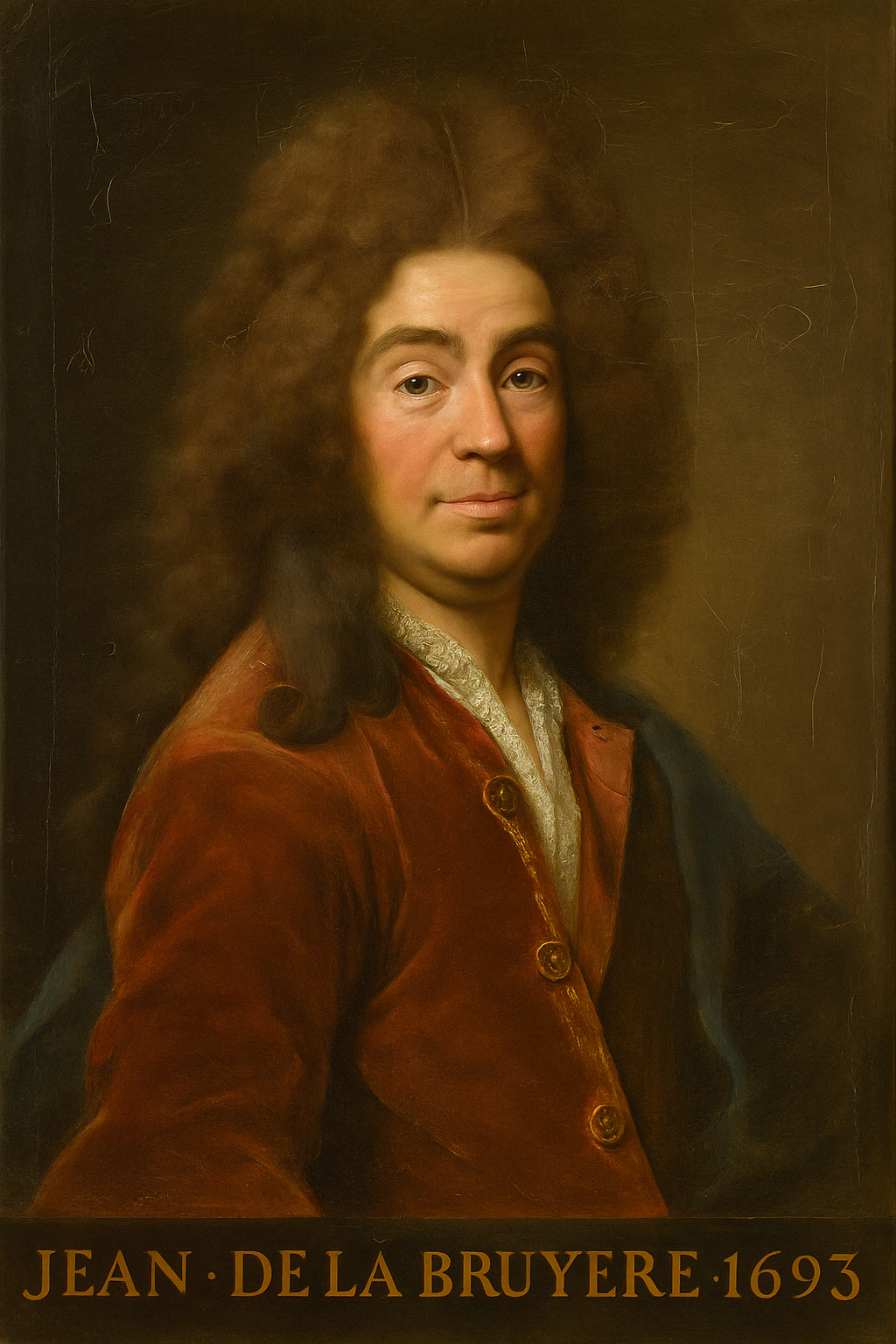
Attr: Élisabeth Louise Vigée Le Brun
| 59 Quotes | |
| Known as | La Bruyere |
| Occup. | Philosopher |
| From | France |
| Born | August 16, 1645 Paris, Kingdom of France |
| Died | May 11, 1696 Versailles, Kingdom of France |
| Aged | 50 years |
| Cite | |
Citation Formats
APA Style (7th ed.)
Jean de la bruyère biography, facts and quotes. (2026, February 11). FixQuotes. https://fixquotes.com/authors/jean-de-la-bruyere/
Chicago Style
"Jean de La Bruyère biography, facts and quotes." FixQuotes. February 11, 2026. https://fixquotes.com/authors/jean-de-la-bruyere/.
MLA Style (9th ed.)
"Jean de La Bruyère biography, facts and quotes." FixQuotes, 11 Feb. 2026, https://fixquotes.com/authors/jean-de-la-bruyere/. Accessed 21 Mar. 2026.
Early Life and Background
Jean de La Bruyere was born on 16 August 1645, in Paris, during the afterglow of the Thirty Years' War and the simmering tensions that would soon flare in the Fronde's memory and then subside under Louis XIV's tightening grip. His family belonged to the solid, literate world of the robe - comfortable enough to aim at office, not exalted enough to escape anxiety about rank. That middle station mattered: it gave him proximity to power without the narcotic of believing in it, and it trained his eye on the small humiliations and small triumphs by which people try to purchase importance.He grew up as France moved toward the centralized, theatrical monarchy that culminated at Versailles. In such a culture, style was not ornament but a social weapon, and morality was constantly negotiated in public. La Bruyere's later portraits of vanity, compliance, and cruelty are hard to imagine without this early schooling in the politics of appearance - a boy learning that manners can be both a refuge and a trap, and that the fastest way to know someone is to watch what they do when they think they are being watched.
Education and Formative Influences
La Bruyere studied law (at Orleans) and entered the magistrate-leaning world of officeholding, but his real education was literary and moral: the classical tradition of Theophrastus, the French moralists (Montaigne, La Rochefoucauld, Pascal), and the salon culture that turned conversation into a craft and a contest. He was also formed by the period's hard Christian debates - between sincere devotion and socially useful piety - and by the new confidence in observation and method that marked the early modern mind, even when directed at character rather than nature.Career, Major Works, and Turning Points
After purchasing a minor office as a treasurer of finances in Caen, La Bruyere's decisive turn came in 1684 when he became tutor to the Duke de Bourbon, grandson of the Prince de Conde, and later served as librarian in the Conde household. This anchored him near court society while leaving him slightly outside its inner circles, a perfect vantage for the anatomist of manners. In 1688 he published Les Caracteres de Theophraste traduits du grec, avec les Caracteres ou les moeurs de ce siecle, a translation expanded into an original masterpiece of maxims, sketches, and portraits that he kept enlarging across successive editions. The book made him famous and controversial; he was elected to the Academie francaise in 1693 after resistance, a sign that his moral scalpel had cut close to recognizable faces. He died in Paris on 11 May 1696, leaving behind not a system but a mirror.Philosophy, Style, and Themes
La Bruyere was a philosopher by temperament rather than by treatise: he distrusted grand metaphysical architecture and preferred the moral experiment of the observed fact. His unit of thought was the scene - the dinner table, the corridor, the antechamber - where ambition reveals itself in posture and speech. The Characters is built from compression and surprise: aphorisms that snap shut like traps, portraits that begin as comedy and end as indictment. Under the wit lies a serious claim that ethics is not abstract but behavioral, that the soul can be read in habits, and that society is the arena where self-love learns disguises.Psychologically, he writes as a man both fascinated and fatigued by the social performance he describes. He notes the speed at which welcome turns into irritation - “The first day one is a guest, the second a burden, and the third a pest”. - not merely as etiquette but as a study in how quickly affection becomes accounting. He exposes public virtue as a derivative fashion, suggesting how belief can be yoked to power: “A pious man is one who would be an atheist if the king were”. And he frames mortality itself as a kind of democratic mercy that spares us the nightmare of exception: “If some persons died, and others did not die, death would be a terrible affliction”. These lines show his inner posture - wary of crowds, allergic to hypocrisy, yet unwilling to surrender to despair, because even the bleakest truths can be clarified into a tolerable order by intelligence.
Legacy and Influence
La Bruyere endures as one of the clearest lenses on the Grand Siecle: the court not as myth, but as a factory of motives. His Characters helped define the French moralist tradition as a literature of psychological precision, bridging the classical ethics of character with modern social observation; later writers from the Enlightenment essayists to nineteenth-century realists drew on his method of revealing a world through types, speech, and contradictions. He remains quoted because he never merely condemns - he diagnoses, and in doing so preserves the uneasy intimacy between reader and subject: we recognize "them" and then, uncomfortably, ourselves.Our collection contains 59 quotes written by Jean, under the main topics: Witty One-Liners - Ethics & Morality - Truth - Wisdom - Art.
Frequently Asked Questions
- La Bruyere Watch: A watch brand/model name seen on some vintage pieces; unrelated to the writer.
- Jean de La Fontaine: Different author: Jean de La Fontaine (1621–1695), famed for his Fables.
- Jean de La Bruyère oeuvres: Les Caractères ou les Moeurs de ce siècle (1688); Traduction des Caractères de Théophraste; Discours de réception à l’Académie française (1693).
- Jean de La Bruyère books: Les Caractères (The Characters), incl. his translations of Theophrastus.
- Jean de La Bruyère pronunciation: zhahn də lah brü-YAIR (IPA: ʒɑ̃ də la bʁɥjɛr)
- How old was Jean de La Bruyère? He became 50 years old
Jean de La Bruyère Famous Works
- 1688 Les Caractères (Collection)
Source / external links