
Jean-Michel Jarre Biography Quotes 5 Report mistakes
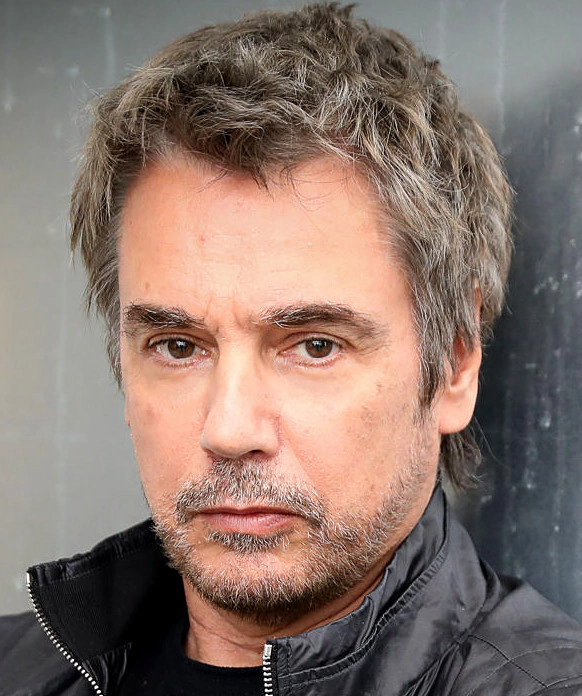
| 5 Quotes | |
| Born as | Jean-Michel André Jarre |
| Occup. | Composer |
| From | France |
| Spouse | Natacha Lindinger (m. 1998–2009) |
| Born | August 24, 1948 Lyon, France |
| Age | 77 years |
| Cite | |
Citation Formats
APA Style (7th ed.)
Jean-michel jarre biography, facts and quotes. (2026, February 11). FixQuotes. https://fixquotes.com/authors/jean-michel-jarre/
Chicago Style
"Jean-Michel Jarre biography, facts and quotes." FixQuotes. February 11, 2026. https://fixquotes.com/authors/jean-michel-jarre/.
MLA Style (9th ed.)
"Jean-Michel Jarre biography, facts and quotes." FixQuotes, 11 Feb. 2026, https://fixquotes.com/authors/jean-michel-jarre/. Accessed 12 Feb. 2026.
Early Life and Background
Jean-Michel Andre Jarre was born on August 24, 1948, in Lyon, France, into a household where art was both vocation and burden. His father, Maurice Jarre, would become one of cinema's defining composers; his mother, France Pejot, moved in literary and Resistance-linked circles. The marriage fractured early, and Jarre spent formative years largely apart from his father, a distance that sharpened his drive to build an identity that was not an echo of a famous surname.Postwar France was remaking itself through modernity - new cities, new media, new anxieties - and Jarre grew up with that hum in the background. He absorbed pop and rock as they arrived, but also the sounds of the street: engines, radios, public address systems. Long before he became known for synthesizers, he was listening like a documentarian, treating everyday noise as raw material and a clue to how a mass society actually felt.
Education and Formative Influences
In Paris, Jarre studied at the Conservatoire de Paris under Pierre Schaeffer, the pioneer of musique concrete, where tape, microphones, and edited sound were treated as instruments. He also played in bands and wrote songs, learning structure and immediacy alongside the studio's laboratory ethos. Schaeffer's influence was less about a single technique than a permission slip: sound could be sculpted, assembled, and staged, and technology could be intimate rather than cold.Career, Major Works, and Turning Points
Jarre's breakthrough arrived with "Oxygene" (1976), composed largely in a modest home studio and released into a world newly receptive to electronic timbres; it made him a global figure and established a melodic, atmospheric strain of synthesizer music that crossed radio, clubs, and living rooms. He followed with "Equinoxe" (1978) and the more conceptual "Magnetic Fields" (1981), balancing hooks with long-form movement. From the late 1970s onward he also expanded the concert itself into civic spectacle: massive outdoor events in Paris, Houston, and elsewhere, using lasers, fireworks, architecture, and synchronized imagery to turn electronic music into public ritual, while later albums and collaborations kept shifting between ambient grandeur, rhythmic drive, and pop-facing vocal work.Philosophy, Style, and Themes
Jarre's inner life, as it emerges across decades of work, is defined by a paradox: he is a romantic of machines. His melodies often feel like human breathing inside circuitry - long arcs, tender harmonies, and a patient sense of space - but they sit atop sequences and textures that signal modern infrastructure. He treats the studio as both instrument and confessional, revising until a track communicates not just sound but a state of attention. That is why his music so often evokes night travel, city light, weather, and the sensation of being alone in a crowd: it is the psychology of late-20th-century modernity translated into timbre.His public statements point to an ethical as well as aesthetic project. "I consider music as a universal language that can break down barriers, and through which people can communicate and understand each other". That universalism is not abstract in his case; it is engineered, built into the nonverbal clarity of his themes and the way his large-scale shows invite mixed audiences to share the same horizon of sound and light. Yet he is also candid about restlessness and risk: "You have to reinvent yourself constantly, and sometimes the audience may not follow you. But that's the risk of being an artist". The statement explains the oscillation in his catalog between accessible anthems and more experimental turns, and it reveals a temperament that fears stasis more than failure. At the center is a pragmatic humanism about technology: "The main challenge for electronic music is to keep a human touch behind the machines". His best work solves that challenge by making the machine sing, but also by staging the machine as theater - a mirror for the era rather than an escape from it.
Legacy and Influence
Jarre helped normalize electronic music as mainstream listening and as a live, communal event, bridging the experimental lineage of Schaeffer with the melodic reach of pop and the awe of public art. Artists across ambient, synth-pop, trance, and cinematic scoring have drawn on his vocabulary of arpeggios, evolving pads, and spacious mix architecture, while his city-scale performances anticipated the modern festival's emphasis on synchronized spectacle. Beyond sound, his career stands as a case study in how a composer can turn new tools into shared emotion, insisting that modern technology need not erase the human voice - it can amplify it.Our collection contains 5 quotes written by Jean-Michel, under the main topics: Art - Music - Reinvention.
Other people related to Jean-Michel: Anne Parillaud (Actress), Charlotte Rampling (Actress)
Source / external links