
Jean Paul Biography Quotes 48 Report mistakes
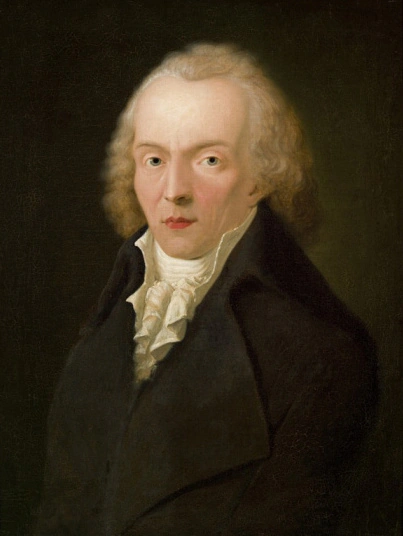
Attr: Heinrich Pfenninger
| 48 Quotes | |
| Born as | Johann Paul Friedrich Richter |
| Occup. | Author |
| From | Germany |
| Born | March 21, 1763 Wunsiedel, Bavaria, Holy Roman Empire |
| Died | November 14, 1825 Bayreuth, Bavaria, German Confederation |
| Aged | 62 years |
| Cite | |
Citation Formats
APA Style (7th ed.)
Jean paul biography, facts and quotes. (2026, February 11). FixQuotes. https://fixquotes.com/authors/jean-paul/
Chicago Style
"Jean Paul biography, facts and quotes." FixQuotes. February 11, 2026. https://fixquotes.com/authors/jean-paul/.
MLA Style (9th ed.)
"Jean Paul biography, facts and quotes." FixQuotes, 11 Feb. 2026, https://fixquotes.com/authors/jean-paul/. Accessed 26 Mar. 2026.
Early Life and Background
Johann Paul Friedrich Richter, who would sign himself "Jean Paul", was born on March 21, 1763, in Wunsiedel in the Fichtelgebirge, a small Franconian town then on the margins of the German literary world. His father was a Lutheran pastor and schoolmaster, and the household economy was fragile enough that the boy learned early how quickly dignity can be outpaced by necessity. When the family moved to nearby Joditz and later Hof, the landscape of parsonages, village schools, and provincial officials became his first archive of voices - comic, pious, vain, wounded - that later reappeared transformed in his fiction.The loss of his father in 1779 forced a sharpened awareness of time and contingency: a gifted student suddenly had to calculate meals, lodging, and prospects. That mix of spiritual inheritance and material insecurity shaped the characteristic Jean Paul tone - at once tender and sardonic, ecstatic and bookkeeping-precise. He developed an inward life that was not escapist so much as compensatory: the imagination as a second economy, where the poor could spend lavishly and the overlooked could become morally central.
Education and Formative Influences
In 1781 he entered the University of Leipzig to study theology, but the city offered him a different catechism - the Enlightenment essay, satire, and the emerging culture of the book market - and he quickly drifted away from a clerical career. He read voraciously (including Swift, Sterne, Rousseau, and contemporary German moralists), kept notebooks that mixed aphorism with self-scrutiny, and began to suspect that the true calling of his mind was neither sermon nor system but the creation of a prose capable of holding contradictions: sentiment and mockery, metaphysics and street observation, private grief and public comedy.Career, Major Works, and Turning Points
After leaving Leipzig he lived precariously in Hof, writing satirical pieces that culminated in his early, biting "Gronlandische Prozesse" (1783) and "Auswahl aus des Teufels Papieren" (1789), works that trained his eye on hypocrisy and intellectual fashion while he himself remained poor and little known. His breakthrough came with "Die unsichtbare Loge" (1793), followed by the sensational success of "Hesperus" (1795), which made him a national literary figure; later novels such as "Siebenkas" (1796-97), "Titan" (1800-03), and "Flegeljahre" (1804-05) expanded his range from domestic comedy to panoramic moral and political reflection. Settling in Weimar and later Bayreuth, he navigated a literary Germany dominated by Goethe and Schiller by refusing their classical restraint: his turning point was not conversion to a school but the discovery that his very excess - digression, collage, sudden lyricism - could be a coherent art.Philosophy, Style, and Themes
Jean Paul's inner life was governed by a double lens: he saw human beings as comic animals of self-deception and as souls capable of real tenderness. That psychology underwrites his fascination with indirect confession - diaries, letters, portraits, and narrator masks - because he believed character emerges most sharply in the way we judge others: “A man never discloses his own character so clearly as when he describes anothers”. His novels populate entire moral ecosystems, where minor figures are granted the same metaphysical weight as heroes; the comedy is rarely cruel, because it rises from the recognition that everyone is improvising a self under pressure.Time, mortality, and consolation are the other poles of his work, expressed not as abstract philosophy but as felt weather. The poignancy of birthdays, anniversaries, and quiet evenings becomes a way to think about history without surrendering the individual: “Our birthdays are feathers in the broad wing of time”. Yet he distrusts mere eloquence or idealism detached from conduct, a suspicion sharpened by his own climb from poverty into fame and by the revolutionary and Napoleonic decades that tested German intellectual life: “You prove your worth with your actions, not with your mouth”. Stylistically he is a master of the sudden telescope shift - from a joke about provincial manners to a sentence that opens into cosmic melancholy - and his signature is the digression that becomes revelation, as if the mind tells the truth only when it stops trying to be linear.
Legacy and Influence
Jean Paul died in Bayreuth on November 14, 1825, leaving behind a body of work that resisted easy classification and therefore kept renewing itself for later readers. He helped invent a distinctly modern German prose: intimate yet encyclopedic, psychologically alert, structurally experimental, and willing to mix the sublime with the everyday without apology. His influence runs through Romantic and post-Romantic narrative (from E.T.A. Hoffmann to later experiments in the novel), and his aphoristic brilliance ensured a second life in quotation and essay. For biographers and readers, he remains a case study in how a writer can turn provincial constraint, financial precarity, and spiritual longing into a style expansive enough to hold both laughter and metaphysics in the same paragraph.Our collection contains 48 quotes written by Jean, under the main topics: Witty One-Liners - Motivational - Ethics & Morality - Wisdom - Music.
Other people related to Jean: Robert Schumann (Composer)
Jean Paul Famous Works
- 1809 Dr. Katzenberger's Badereise (Novella)
- 1804 Flegeljahre (Novel)
- 1800 Titan (Novel)
- 1796 Siebenkäs (Novel)
- 1796 Quintus Fixlein (Novel)
- 1795 Hesperus (Novel)
- 1793 The Invisible Lodge (Novel)
Source / external links