
Jefferson Davis Biography Quotes 5 Report mistakes
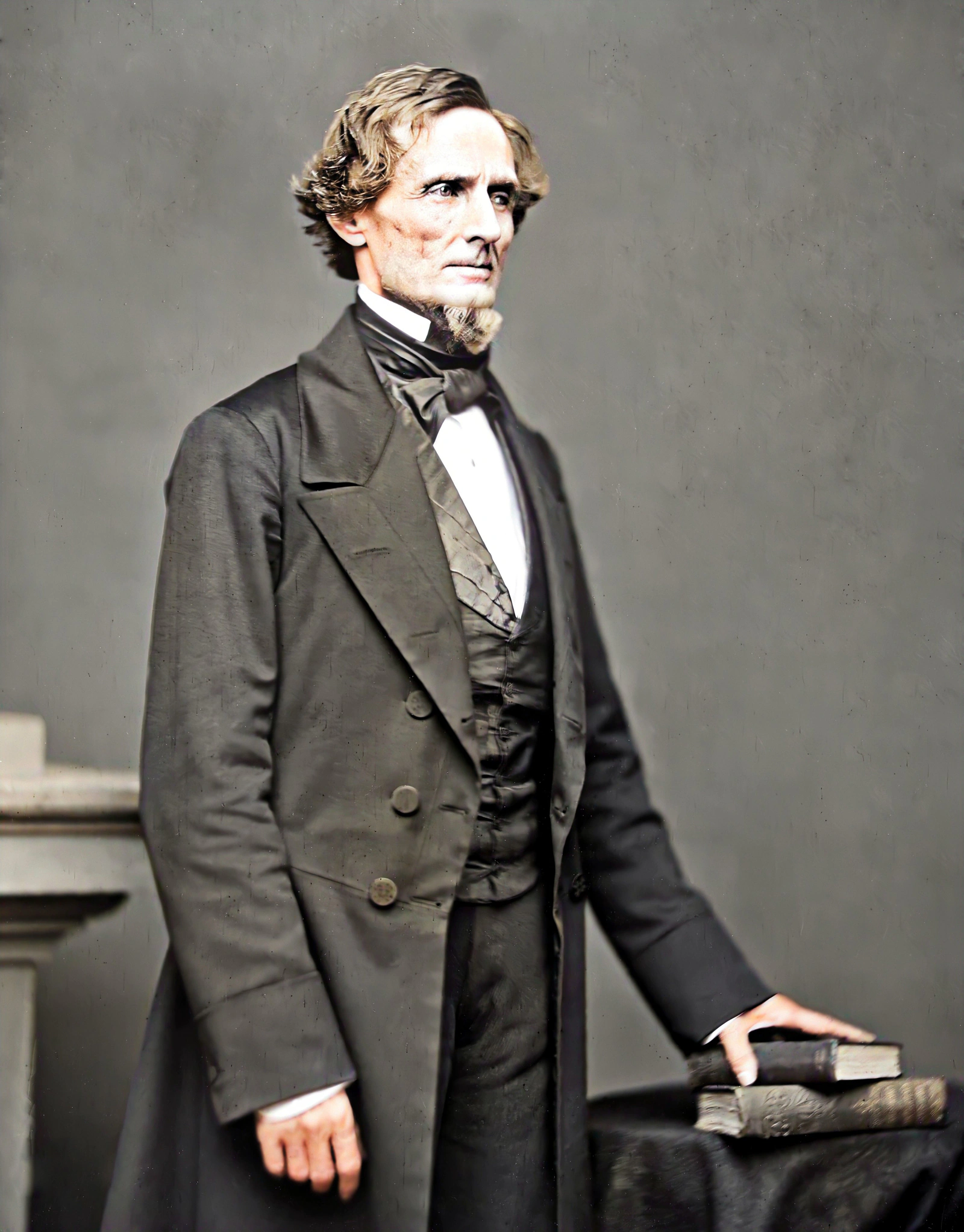
Attr: Mathew Benjamin Brady, Public domain
| 5 Quotes | |
| Born as | Jefferson Finis Davis |
| Occup. | President |
| From | USA |
| Spouse | Varina Howell Davis |
| Born | June 3, 1808 Fairview, Kentucky, USA |
| Died | December 6, 1889 New Orleans, Louisiana, USA |
| Cause | Heart failure |
| Aged | 81 years |
| Cite | |
Citation Formats
APA Style (7th ed.)
Jefferson davis biography, facts and quotes. (2026, February 11). FixQuotes. https://fixquotes.com/authors/jefferson-davis/
Chicago Style
"Jefferson Davis biography, facts and quotes." FixQuotes. February 11, 2026. https://fixquotes.com/authors/jefferson-davis/.
MLA Style (9th ed.)
"Jefferson Davis biography, facts and quotes." FixQuotes, 11 Feb. 2026, https://fixquotes.com/authors/jefferson-davis/. Accessed 26 Mar. 2026.
Early Life and Background
Jefferson Finis Davis was born on June 3, 1808, in Christian County, Kentucky, the youngest of ten children in a Scots-Irish American family that soon moved to the Mississippi frontier near Woodville and later Wilkinson County. His father, Samuel Emory Davis, and mother, Jane Cook Davis, raised him in the plantation society of the lower Mississippi Valley, where cotton expansion, enslaved labor, and a fierce code of honor formed the air a boy breathed before he had words for politics.That borderland upbringing mattered: Davis grew into a man for whom local autonomy was not an abstraction but a lived condition of scattered settlements, weak infrastructure, and constant negotiation with distance and authority. The frontier also produced insecurity - about status, about order, about the fragility of community - and Davis carried that vigilant temperament into adulthood, quick to read disagreement as coercion and compromise as surrender.
Education and Formative Influences
Davis was educated at local schools and at St. Thomas College in Kentucky before entering the United States Military Academy at West Point, graduating in 1828. The academy gave him professional discipline and a soldier-administrator's regard for hierarchy, logistics, and duty, yet it also sharpened a lifelong sensitivity to questions of jurisdiction: who commands, by what right, and where obedience ends. Service on the frontier and in the Black Hawk War, followed by resignation in 1835 to marry Sarah Knox Taylor (who died months later), deepened his stoic self-image and his tendency to translate private grief into public resolve.Career, Major Works, and Turning Points
Returning to Mississippi, Davis became a planter at Brierfield and entered Democratic politics, serving in the U.S. House (1845-1846), fighting in the Mexican-American War as colonel of the Mississippi Rifles, and then serving in the U.S. Senate. As Secretary of War under Franklin Pierce (1853-1857), he pushed army modernization and favored a transcontinental railroad survey, building a reputation for administrative rigor. The crisis of 1860-1861 made him the South's most recognizable constitutional nationalist: he resigned from the Senate after Mississippi seceded and was chosen president of the Confederate States (1861-1865). His wartime presidency fused micromanagement with grim endurance - frequent clashes with governors, reliance on trusted advisers, and the burden of military reverses from Vicksburg to Atlanta. Captured in 1865, imprisoned at Fort Monroe, and later released, he spent his postwar years defending secession's legitimacy and writing The Rise and Fall of the Confederate Government (1881), an extended brief for the cause that had destroyed his life.Philosophy, Style, and Themes
Davis' inner life was governed by a moralized idea of sovereignty: he believed communities possessed rights prior to national power, and he framed the Confederacy as a defensive reaction to encroachment. His most revealing refrain was the plea for autonomy disguised as innocence - “All we ask is to be let alone”. Psychologically, it reads as both principle and shield: a man who wanted to be seen as resisting aggression rather than choosing rupture, even as secession required radical action. That posture helped him endure catastrophe by locating blame outside himself and converting defeat into martyrdom.His public prose and private bearing were formal, legalistic, and prosecutorial, shaped by Senate debate and wartime dispatches rather than the popular stump. Yet beneath the lawyer's cadence was a patrician ethic of dignity and control, condensed into advice he treated as self-command: “Never be haughty to the humble or humble to the haughty”. The sentence exposes the tension at his core - a desire to appear just while insisting on fixed ranks. Even in defeat he insisted the Confederacy's collapse would be misread as practical failure rather than ideological contradiction - “If the Confederacy fails, there should be written on its tombstone: Died of a Theory”. It is the voice of a man who preferred abstract constitutional argument to the social reality - especially slavery - that made his theory violent, and who sought refuge in coherence when history refused it.
Legacy and Influence
Davis died on December 6, 1889, in New Orleans, after years of public appearances that turned him into a living relic of the Lost Cause. His legacy is inseparable from the Confederacy's defense of slavery and from the postwar campaign to recast secession as a principled quarrel over states' rights; his writing supplied later apologists with citations, tone, and a model of dignified grievance. At the same time, his presidency remains a case study in the limits of ideological rigidity under modern war: a leader of notable administrative ability whose need for control, faith in constitutional argument, and unwillingness to square rhetoric with human bondage helped steer a doomed nation through its brief, brutal existence and into a long afterlife of contested memory.Our collection contains 5 quotes written by Jefferson, under the main topics: Truth - Freedom - War - Humility.
Other people related to Jefferson: Mary Chesnut (Author), Gideon Welles (Soldier), Henry A. Wise (Statesman), John H. Reagan (Politician), Robert Toombs (Politician), Judah Philip Benjamin (Politician), John B. Hood (Soldier), Joseph E. Brown (Politician), Zachary Taylor (President)
Jefferson Davis Famous Works
- 1890 A Short History of the Confederate States of America (Book)
- 1881 The Rise and Fall of the Confederate Government (Book)
Source / external links